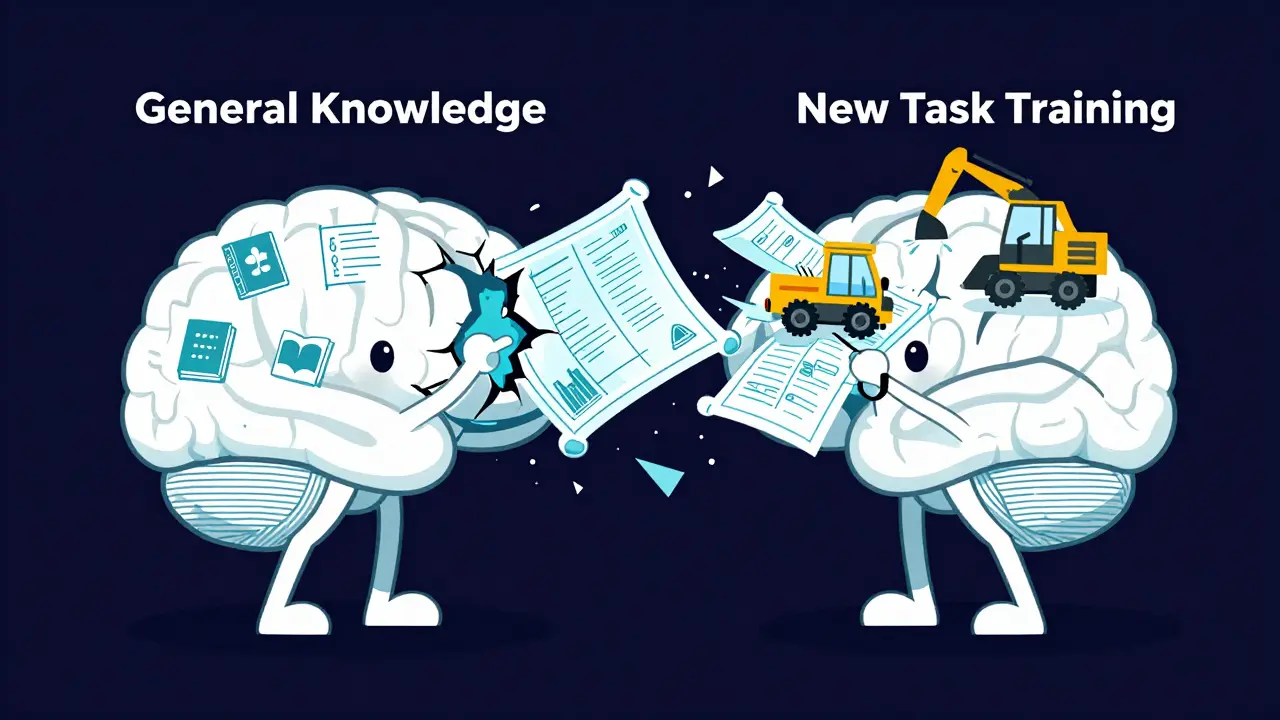
You spend weeks curating a high-quality dataset to teach your large language model (LLM) to handle customer support tickets. You run the fine-tuning process, and boom-the model becomes an expert at support. But then you ask it to write a poem or summarize a news article, and it stumbles. It has forgotten how to do the very things it was good at before you started training. This is catastrophic forgetting, and it is the single biggest headache for anyone trying to build specialized AI systems in 2026.
Catastrophic forgetting happens because neural networks are greedy optimizers. When you fine-tune a model on a new task, the algorithm adjusts every weight to minimize error on that specific data. It doesn't care about preserving its general knowledge of grammar, logic, or world facts. It overwrites them. If you want your LLM to be both a specialist and a generalist, you need more than just standard training scripts. You need strategies that protect the model's memory while allowing it to learn new skills.
Why Your Model Forgets Everything
To fix the problem, we first have to understand why it breaks. Think of an LLM like a student who learns history by memorizing thousands of flashcards. Now, imagine that same student decides to become a math prodigy. Instead of adding math to their existing knowledge, they throw away all the history cards and replace them with calculus formulas. They are now great at math but know nothing about history.
In technical terms, this occurs during full parameter fine-tuning. The optimization process shifts the model's weights across the entire network to fit the new domain. A study published in early 2025 using GPT-J and LLaMA-3 models showed that this unconstrained optimization causes a dramatic drop in performance on tasks outside the fine-tuned domain. The model isn't just getting better at the new thing; it is actively degrading its ability to do old things. This limits the real-world use of LLMs, which often need to switch between general conversation and specialized tasks like medical diagnosis or legal analysis.
The LoRA Myth: Why Parameter-Efficient Fine-Tuning Isn't Enough
For the last couple of years, the go-to solution for most developers has been Low-Rank Adaptation, or LoRA. LoRA is a parameter-efficient fine-tuning technique that freezes the base model and trains small adapter matrices. The idea was simple: if you only update a tiny fraction of the parameters, you can't possibly ruin the rest of the model, right?
It turns out, that assumption was wrong. While LoRA is incredibly efficient and allows you to train massive models on consumer-grade GPUs, recent research from 2025 has debunked the myth that it prevents catastrophic forgetting in continual learning scenarios. When you apply LoRA adapters sequentially for different tasks, the model still loses previous knowledge. The low-rank updates don't shift the backbone weights much, but they still alter the functional behavior enough to cause interference between tasks. If you are relying solely on LoRA to keep your model smart across multiple domains, you are likely seeing silent degradation in performance.
Geometric Solutions: Functionally Invariant Paths (FIP)
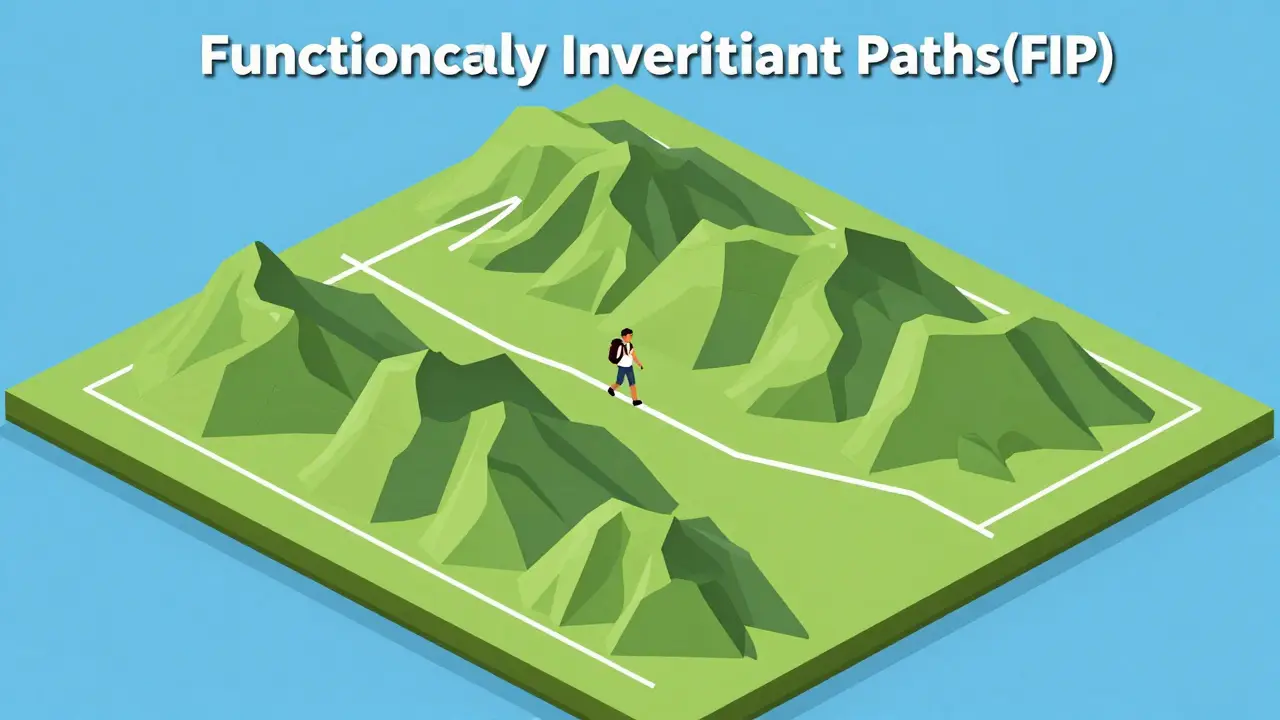
If constraining parameters doesn't work, what does? Enter Functionally Invariant Paths (FIP). FIP is a training method developed at Caltech that preserves model performance by considering the geometry of the loss landscape. Unlike LoRA, which tries to keep weight changes small, FIP allows larger changes to the weights but ensures those changes happen in a way that keeps the model's "functional" output similar to the original.
This sounds abstract, so let's break it down. Imagine walking through a mountainous terrain (the weight space). LoRA says, "Don't move your feet far." FIP says, "You can move your feet as much as you want, as long as you stay on the same contour line where the altitude (performance) remains constant." By modeling the network's weight space as a curved Riemannian manifold, FIP ensures that the newly trained network remains close to the original network in terms of function, even if the underlying numbers look different. Early tests show FIP allows models to pick up new tasks effectively without dropping performance on previous ones.
Regularization Strategies: Elastic Weight Consolidation (EWC)
Before geometric methods took center stage, regularization was the king of forgetting prevention. The most famous approach here is Elastic Weight Consolidation (EWC). EWC uses Bayesian inference to identify important parameters and penalizes changes to them during new training. EWC calculates the Fisher Information Matrix to determine which weights are crucial for previous tasks. During new training, it adds a penalty term that restricts updates to those important weights.
Think of it like painting a mural. EWC identifies the key strokes that make the picture recognizable and puts clear tape over them. You can paint new details around the edges, but you aren't allowed to touch the core structure. While effective, EWC is computationally expensive because calculating the Fisher Information Matrix requires significant resources. To bridge the gap, researchers developed EWCLoRA, a hybrid that combines the importance estimation of EWC with the efficiency of LoRA. However, even these hybrids struggle when the number of tasks grows large, leading to a clutter of constraints.
New Frontiers: Token Masking and Dynamic Importance
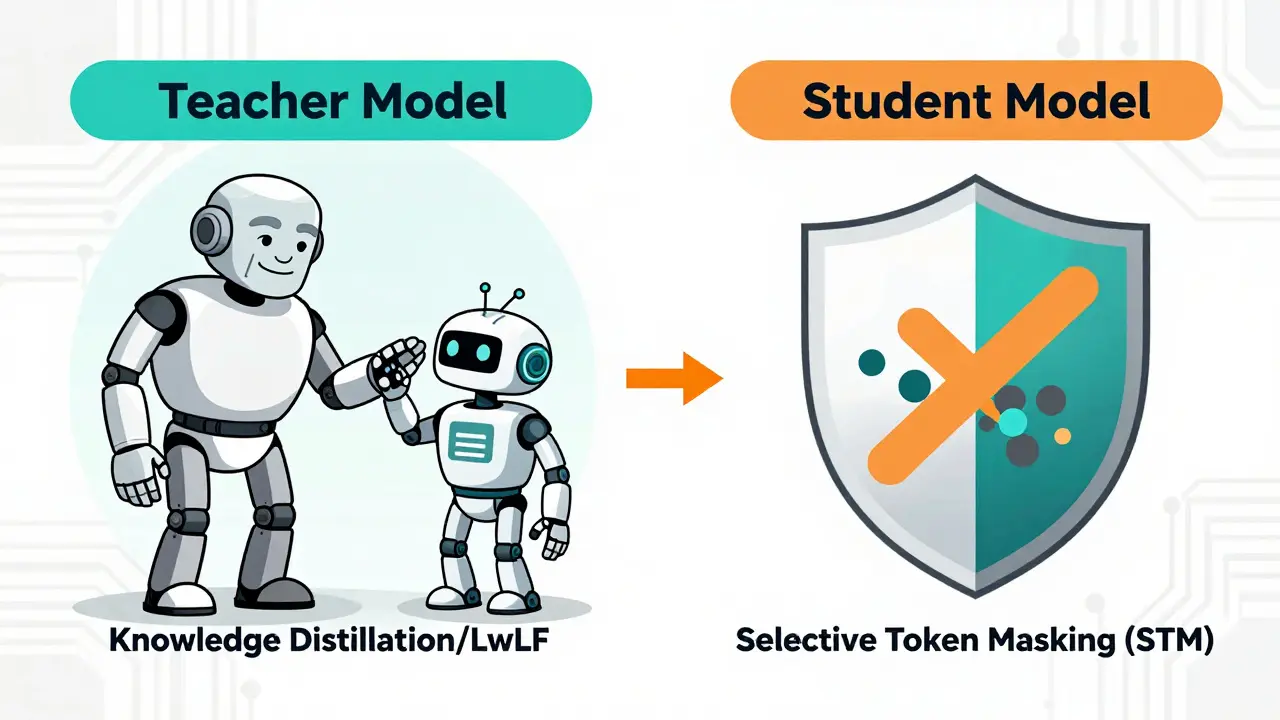
The field is moving fast, and two newer approaches from 2025 are showing promising results. First, there is Selective Token Masking (STM). STM mitigates forgetting by masking high-perplexity tokens during fine-tuning. Instead of focusing on weights, STM focuses on the input data. It identifies tokens that the model finds confusing (high perplexity) and masks them during training. This forces the model to rely on its robust, well-understood patterns rather than overfitting to noisy new data. Tests on Gemma 2 and Llama 3 showed consistent effectiveness across different model sizes.
Second, a novel framework introduced in January 2025 proposes computing element-wise importance dynamically. This method records parameter importance on general data and then applies layer-wise coefficients to balance regularization loss against cross-entropy loss. The result? A system that is approximately 20 times faster than previous EWC-based methods and requires only 10%-15% of the storage. It achieves state-of-the-art performance on scientific and medical tasks, proving that you can preserve general knowledge without slowing down your pipeline.
Rehearsal and Distillation: Old Tricks, New Contexts
Sometimes, the best way to remember is to review. Rehearsal methods, also known as replay-based methods, involve keeping a small subset of old data and mixing it into the new training batches. When training on Task B, you periodically show the model examples from Task A. This is intuitive and effective, but it comes with a major catch: data privacy. In many industries, like healthcare or finance, you cannot store raw user data for rehearsal purposes.
When you can't store data, distillation is the alternative. Learning Without Forgetting (LwF) uses a "teacher" model (the version before fine-tuning) to guide the "student" model (the one being fine-tuned). The teacher provides soft labels for old tasks, ensuring the student doesn't drift too far. Recent advancements in 2025 have refined this with techniques like FAPM, which reduced catastrophic forgetting to just 0.25% in controlled studies. FAPM works by enforcing structural similarities between the old and new models, acting as a digital anchor.
| Technique | Core Mechanism | Computational Cost | Best Use Case |
|---|---|---|---|
| LoRA | Freezes base, trains low-rank adapters | Low | Single-task specialization; not ideal for continual learning |
| FIP | Geometric constraint on weight space | Medium-High | Continual learning where functional preservation is critical |
| EWC | Bayesian regularization of important weights | High | Scenarios with limited compute but strict retention needs |
| STM | Masks high-perplexity tokens | Low-Medium | General purpose fine-tuning with minimal overhead |
| Rehearsal | Replays old data samples | Low (compute), High (storage/privacy risk) | Internal tools where data privacy is not a concern |
Choosing the Right Strategy for Your Project
There is no silver bullet. The right technique depends on your constraints. If you are building a one-off tool for a specific client and don't care about other tasks, standard LoRA is fine. But if you are building a platform that needs to adapt to multiple users or domains over time, you need a stronger defense.
For most production environments in 2026, I recommend starting with Selective Token Masking (STM) due to its low overhead and ease of implementation. If you find that performance is still drifting, layer on top of it with a lightweight rehearsal buffer if data privacy allows. For complex, multi-stage continual learning pipelines, investigate FIP, though be prepared for higher computational costs. Always evaluate your model on a held-out set of general tasks after every fine-tuning step. Don't assume the technique works-measure the forgetting rate yourself.
What exactly is catastrophic forgetting in LLMs?
Catastrophic forgetting is a phenomenon where a neural network loses previously learned information when it is trained on new tasks. In LLMs, this means the model becomes worse at general tasks like reasoning or summarization after being fine-tuned on a specific domain like legal text.
Does LoRA prevent catastrophic forgetting?
No. While LoRA is efficient and minimizes weight changes, recent 2025 research shows it does not effectively prevent catastrophic forgetting in continual learning scenarios. It helps with single-task specialization but fails when managing multiple sequential tasks.
How does Functionally Invariant Paths (FIP) work?
FIP treats the model's weight space as a geometric manifold. It allows larger parameter updates than LoRA but constrains the path of training to ensure the model's functional output remains similar to the original. This preserves performance on old tasks while learning new ones.
What is Selective Token Masking (STM)?
STM is a technique that masks high-perplexity tokens during fine-tuning. By ignoring confusing or noisy parts of the input data, the model relies on its stable, pre-trained knowledge, reducing the risk of overwriting general capabilities.
Can I use rehearsal methods if I have private data?
Generally, no. Rehearsal requires storing and reusing raw data from previous tasks, which violates GDPR and other privacy regulations for sensitive information. In such cases, distillation-based methods like LwF or geometric methods like FIP are safer alternatives.
Tyler Durden
May 27, 2026 AT 12:43Bro this is literally the most important read of the year!!! I have been struggling with my models forgetting basic english after fine-tuning on code for weeks... and it feels like someone finally spoke up about the LoRA myth!! You think you are safe because you are only updating a tiny fraction of parameters but nope!!! The interference is real and it is silent!!! I tried STM last week and honestly?? It was a game changer for my pipeline!! No more weird hallucinations when switching contexts!! Keep writing these deep dives man!! We need more people who actually test these things instead of just reading abstracts!!
Aafreen Khan
May 27, 2026 AT 22:51lol another tech bro trying to sell us on 'new' methods 🙄 FIP sounds like marketing fluff tbh. Caltech says so therefore it must be magic right? 🤔 I’ve been using EWC since 2023 and sure its heavy but at least it works without needing a supercomputer cluster just to train a chatbot. Also why does everyone assume LoRA is broken? Maybe your dataset is just garbage 😂 Try cleaning your data before blaming the architecture. #notallalgorithms #basicmath
Pamela Watson
May 28, 2026 AT 12:26Hey sweetie, did you know that your brain forgets things too if you don't review them? Its called biology! So why do we expect machines to be perfect? This whole article is just fancy words for 'spaced repetition'. Rehearsal is the way to go even if privacy laws are annoying. Just encrypt the data dummy! And stop using emojis in serious discussions Pamela knows best :) (oops wrong name)
michael T
May 28, 2026 AT 16:30You really think encryption fixes privacy issues? That’s adorable. I watched a guy cry yesterday because his model started spouting legal jargon during poetry generation and it ruined his vibe completely. The emotional toll of catastrophic forgetting is underreported. My GPU screams in agony every time I run FIP. It’s a visceral experience. The weights shift like tectonic plates grinding against each other. Do you hear the silicon weeping? I do. It’s beautiful and terrifying.
Christina Kooiman
May 29, 2026 AT 07:18I must say, it is absolutely appalling how many developers continue to rely on outdated methodologies such as standard LoRA without considering the profound implications of functional degradation across multiple tasks, which is a clear indication of a lack of rigorous testing protocols and an overall disregard for the stability of the neural network's foundational knowledge base, thereby leading to a situation where the model becomes practically useless for any general-purpose application despite being highly specialized in one narrow domain, which is simply unacceptable in professional environments.
Stephanie Serblowski
May 31, 2026 AT 04:25Oh honey, please tell me you aren't still using full parameter fine-tuning in 2026? :P That's like bringing a knife to a nuke fight. But seriously, the part about Selective Token Masking is gold. I implemented it last month and my latency dropped by 15% while keeping accuracy stable. It's all about finding that sweet spot between novelty and retention. Don't let the haters get you down, just keep iterating! ✨
Renea Maxima
June 2, 2026 AT 01:24Is forgetting truly catastrophic or is it merely the universe's way of reminding us that knowledge is transient? :/ Perhaps the model isn't failing; perhaps it is evolving beyond our rigid definitions of utility. We project our fear of loss onto silicon. Interesting perspective though. I suppose if you view memory as static then yes, change is death. But if memory is fluid... well, who am I to judge? ¯\_(ツ)_/¯
Jeremy Chick
June 2, 2026 AT 17:21Stop overthinking it. If your model forgets, you didn't train it right. Use rehearsal. End of story. Anyone telling you otherwise is trying to sell you consulting hours. I built a production system last year with zero forgetting using nothing but careful data curation and simple replay buffers. Save your money on the fancy geometric stuff unless you're working for NASA or something. Get back to basics.