
Have you ever watched an AI confidently give you the wrong answer, only to fix it instantly when you politely asked it to check its work? It feels like magic, but it’s actually a deliberate design pattern called self-correction, which is a capability where Large Language Models review, identify errors in, and refine their own generated outputs through structured feedback mechanisms. As of 2026, this isn’t just a cool trick; it’s a standard industry practice. Research shows that properly implemented self-correction can slash structured output errors by 30-45% while cutting token costs compared to simple retry loops. But getting it right requires more than just saying "try again." You need specific error messages and feedback prompts that guide the model without confusing it.
Why Self-Correction Matters More Than Ever
In early 2023, researchers realized that asking models to introspect could improve accuracy without expensive retraining. Today, with enterprise adoption soaring-Gartner estimates 68% of business LLM setups use some form of correction as of late 2025-the stakes are higher. If your app generates JSON for a database or code for a server, a single syntax error breaks everything. Relying on the first draft is risky. The goal here is reliability. We want the model to act like a careful editor, not just a fast typist. The challenge? Models often struggle to spot their own mistakes unless we give them very clear instructions on what "wrong" looks like.
The Three Main Ways to Trigger Corrections
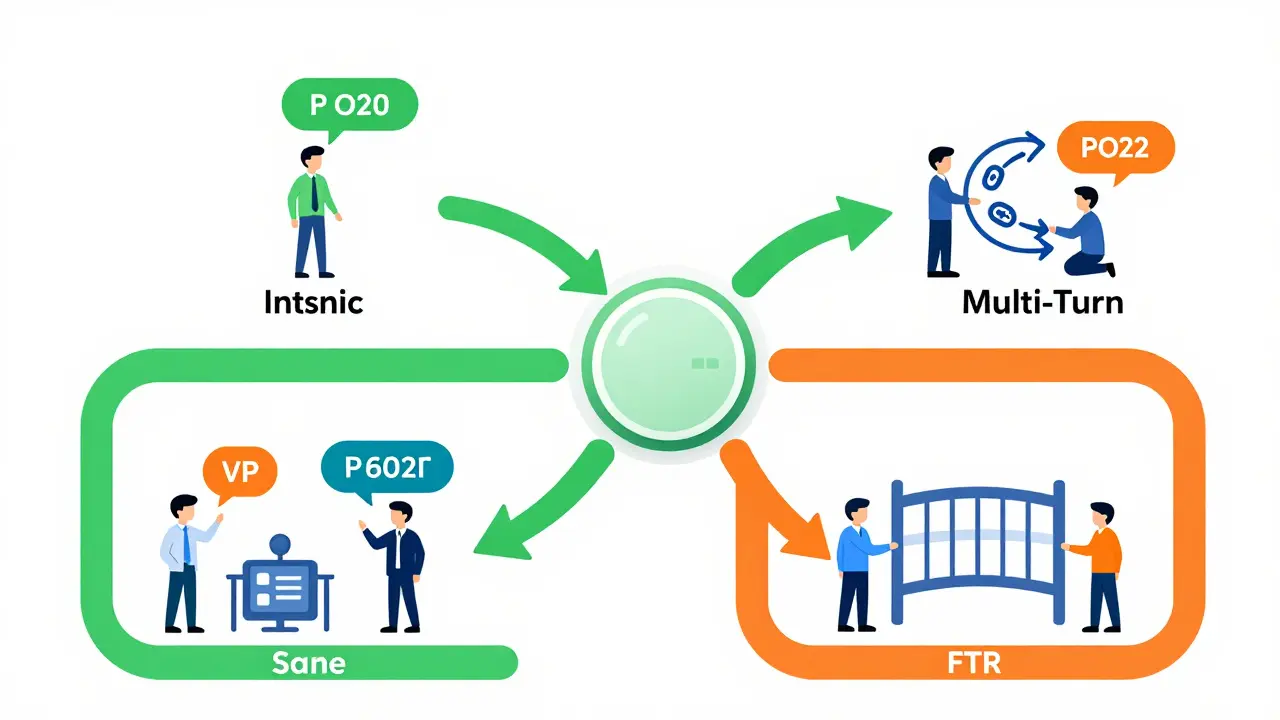
Not all self-correction is created equal. Depending on your needs, you’ll likely use one of three approaches. Understanding the difference helps you pick the right tool for the job.
- Intrinsic Self-Correction: This happens in a single turn. You ask the model to generate an answer, then immediately instruct it to review and fix it before sending the final result. It’s lightweight, adding only about 15-25% latency, but it relies entirely on the model’s internal logic.
- Multi-Turn Feedback Correction: Here, you interrupt the conversation. If the output is incomplete or wrong, you send a follow-up prompt like "Feedback: Incomplete at [point]. Continue and correct." This recovers up to 89% of interrupted streams in real-time chats.
- Feedback-Triggered Regeneration (FTR): This is the advanced method introduced in late 2025. It combines user signals with decoding methods to regenerate answers only when dissatisfaction is detected. It reduces unnecessary corrections by over 40%, saving compute resources.
Crafting Effective Error Messages and Prompts
The secret sauce lies in how you phrase the feedback. Vague complaints like "that was wrong" rarely help. Instead, you need specific, actionable error messages. Think of these as constraints that force the model to look at its output through a different lens.
For structured data, such as JSON, schema validation is king. A prompt might look like this: "Produce a JSON response matching the provided schema. Then, check if every key exists and every value type matches. If there are mismatches, correct them." Studies show this works in 68-82% of cases for well-defined tasks. However, for complex reasoning, like math problems, intrinsic correction drops to 22-35% effectiveness because the model lacks external verification signals.
When dealing with multi-turn interactions, layer your prompts. Start with the initial request. If the user flags an issue, use a template like: "User Feedback: [Specific Error]. Action: Correct the error while maintaining the original context." This keeps the model focused on the fix rather than rewriting the entire response from scratch.
Common Pitfalls: When Correction Goes Wrong
Self-correction isn’t a silver bullet. In fact, it can make things worse if you’re not careful. One major issue is "prompt-induced solution drift." This happens when the correction prompt inadvertently changes the model’s reasoning path, leading to new errors. Research indicates this occurs in 37-52% of cases if the prompts aren’t tightly controlled. For example, asking a model to "be more concise" during a correction phase might cause it to drop critical details.
Another trap is overcorrection. Developers report that in ambiguous scenarios, models sometimes "fix" valid responses because they misinterpret the feedback. To avoid this, set hard limits. Experts recommend capping correction iterations at 2-3 attempts. If the model fails to fix the error after three tries, stop. Continuing usually amplifies errors rather than resolving them. Also, be wary of general knowledge tasks. Without external facts to verify against, self-correction fails in up to 92% of cases. It works best when there’s a clear right or wrong, like code syntax or mathematical proofs.
| Framework | Best Use Case | Accuracy Gain | Latency Impact | Complexity |
|---|---|---|---|---|
| Intrinsic Prompting | JSON/Code Generation | High (Structured) | +15-25% | Low |
| Multi-Turn Feedback | Chatbots/Conversational AI | Medium-High | Variable | Medium |
| FTR (Regeneration) | Enterprise/API Services | Very High | Optimized | High |
Implementing Confidence Thresholds
To prevent wasted tokens and user frustration, don’t correct every output. Use confidence thresholds. If your system provides internal confidence scores, trigger regeneration only when that score falls below 0.65 or when explicit user dissatisfaction is recorded. This selective approach, highlighted in recent FTR studies, ensures you’re spending compute power only where it matters. For automated pipelines, pair self-correction with external validators. If the model generates Python code, run it in a sandbox. If it crashes, feed the error message back into the prompt. This hybrid approach-combining intrinsic correction with external signals-reduces pipeline failures by up to 63%.

Real-World Examples and Templates
Let’s look at concrete examples. Suppose you’re building a financial data extractor. Your initial prompt asks for revenue figures in a specific format. If the output misses a decimal point, your error handler catches it. The feedback prompt should be precise: "Error: Revenue field must include two decimal places. Current value: '1000'. Corrected value: '1000.00'. Please update the JSON." This specificity prevents the model from guessing. In contrast, a vague prompt like "Fix the number" might lead the model to change other numbers unnecessarily.
For creative tasks, self-correction is less effective. If you’re generating marketing copy, there’s no objective "right" answer. Here, focus on style guides instead. "Check for tone consistency with the brand voice defined in Appendix A." Even then, expect mixed results. The TACL analysis notes that open-ended tasks lack the metrics needed for reliable self-correction.
Future Trends and Best Practices
As we move through 2026, native support for self-correction is becoming standard. OpenAI added structured output validation to GPT-4o, and Meta integrated self-reflection into Llama 3.2. These updates mean you’ll spend less time crafting raw prompts and more time configuring parameters. However, the core principles remain: be specific, limit iterations, and validate externally when possible. Look ahead to 2027, and expect hybrid systems that combine intrinsic checks with real-time user feedback to become the norm. For now, start small. Implement intrinsic correction for high-stakes structured outputs. Measure the latency impact. Refine your error messages based on actual failure logs. And remember, self-correction is a complement to good prompting, not a replacement for it.
Does self-correction always improve accuracy?
No. While it improves accuracy in structured tasks like code or JSON generation by up to 45%, it can fail in general knowledge tasks without external validation. In some cases, poor prompts can introduce new errors known as solution drift.
How much latency does self-correction add?
Intrinsic self-correction typically adds 15-25% processing time per request. Multi-turn feedback varies based on interaction length. Advanced frameworks like FTR aim to minimize this by triggering corrections only when necessary.
What is the best prompt structure for self-correction?
Use a three-part structure: 1) Initial generation instruction, 2) Explicit validation criteria (e.g., schema rules), and 3) Specific correction commands. Avoid vague language and limit iterations to 2-3 attempts.
Can LLMs self-correct creative writing?
Poorly. Creative tasks lack objective metrics for correctness. Self-correction works best with verifiable outputs like math, code, or structured data. For creative work, focus on style guidelines rather than error fixing.
What is Feedback-Triggered Regeneration (FTR)?
FTR is an advanced framework that uses user feedback signals and decoding methods to regenerate responses only when dissatisfaction is detected. It reduces unnecessary corrections by over 40% compared to standard methods.