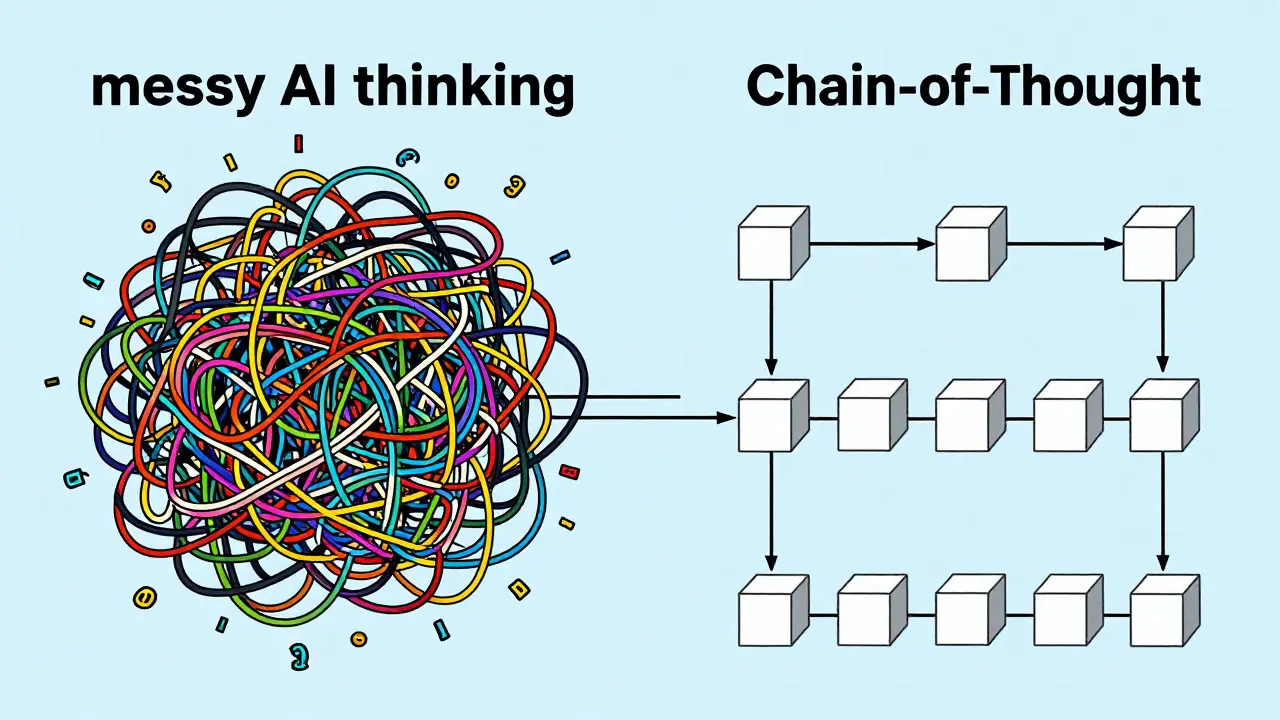
Have you ever watched an AI confidently explain why the sky is green? It sounds absurd, but it happens more often than we’d like to admit. Large Language Models (LLMs) are incredible at generating text, yet they frequently stumble on complex logic, math, or multi-step planning. The problem isn’t that they lack knowledge; it’s that their "thinking" process is a messy, unstructured stream of tokens. Enter Structured Reasoning Modules, a new architectural approach introduced in early 2026 that forces AI to plan, verify, and revise its answers before speaking. This isn't just a tweak; it's a fundamental shift from guessing to calculating.
The Problem with Traditional AI Thinking
To understand why structured reasoning matters, you first have to see how current models work. Most LLMs rely on Chain-of-Thought (CoT) prompting. You ask a question, and the model generates a long string of intermediate steps before giving an answer. On the surface, this looks smart. But under the hood, it’s chaotic. There’s no built-in mechanism to check if step three actually follows from step two. If the model makes a small error early on, that mistake compounds, leading to a completely wrong final result. Researchers call this "error propagation."
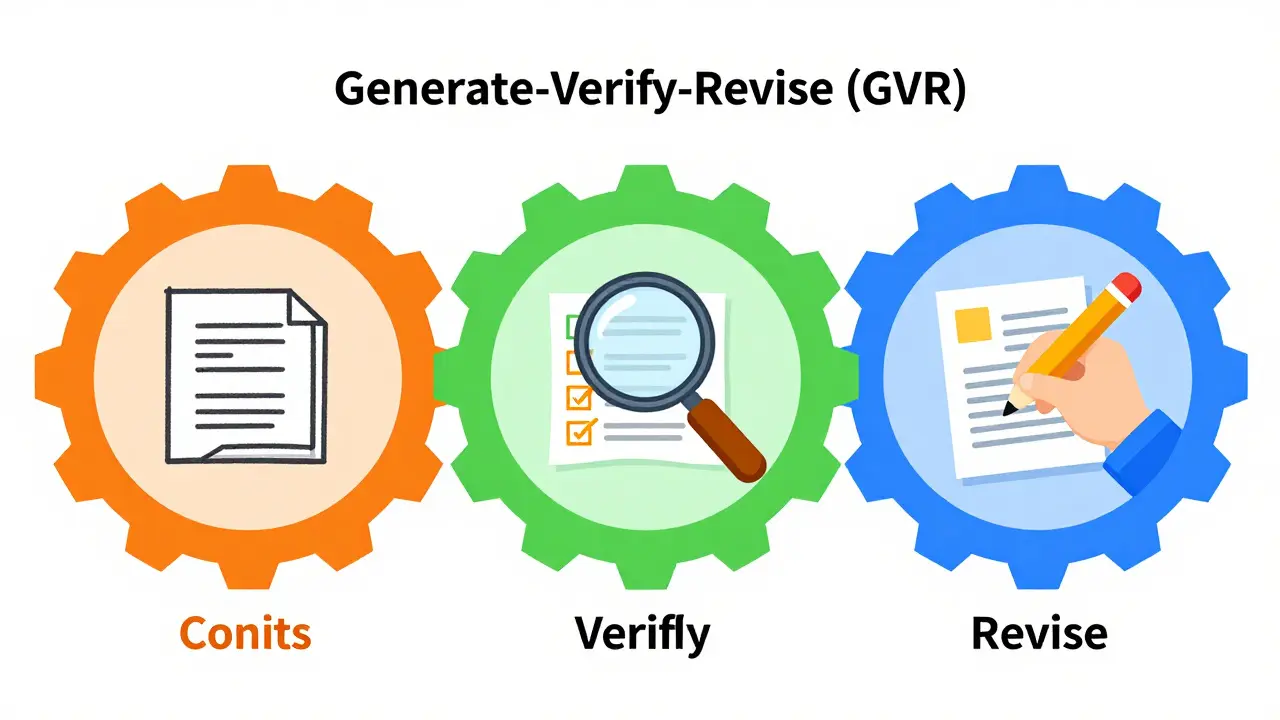
In January 2026, a landmark paper titled 'Structured Reasoning for Large Language Models' highlighted this flaw. The authors noted that while CoT helps, it treats reasoning as a monolithic block. You can’t easily isolate where things went wrong. Structured Reasoning Modules (SRM) change this by breaking the process into discrete, evaluable components. Instead of one long guess, the AI now operates in a clear loop: Generate, Verify, and Revise. This transparency allows developers to optimize each stage independently, drastically cutting down on hallucinations and logical gaps.
How Structured Reasoning Works: The GVR Loop
The core of this technology is the Generate-Verify-Revise (GVR) paradigm. Think of it like writing an essay. First, you draft it (Generate). Then, you read it over to catch errors (Verify). Finally, you fix those errors (Revise). SRM automates this cycle within the model itself.
- Generate: The model produces an initial solution using standard autoregressive text generation. This is similar to how current LLMs work, but it’s treated as a rough draft, not a final answer.
- Verify: A specialized verification module critiques the draft. It doesn’t just look at the final answer; it checks the logic of every step. According to the 2026 study, this phase achieves 94.3% accuracy in identifying correct versus incorrect reasoning paths.
- Revise: If the verifier spots an error, the revision module steps in. It doesn’t start over. Instead, it conditionally modifies only the flawed parts of the reasoning. This is controlled by Dynamic Termination Supervision (DTS), which decides when the reasoning is solid enough to stop iterating.
This structure transforms opaque black-box predictions into transparent workflows. You can actually see where the model struggled and how it fixed itself. For complex tasks like mathematical proofs or code debugging, this clarity is invaluable.
Planning and Tool Use: Beyond Text Generation
Reasoning isn’t just about internal logic; it’s also about interacting with the world. This is where Tool Use comes into play. In traditional setups, calling an external API or calculator was a separate, clunky process. With Structured Reasoning Modules, tool invocation becomes part of the reasoning trajectory.
Imagine asking an AI to plan a budget. It needs to calculate interest rates, fetch current exchange rates, and apply tax laws. In a standard model, it might hallucinate the numbers. In an SRM-enhanced model, the planning module recognizes the need for precise data. During the revision phase, it dynamically invokes a calculator or financial API. Preliminary experiments showed this integration improved performance on physics and engineering problems by 18.7%. The model doesn’t just guess; it knows when to reach for a tool to ensure accuracy.
This capability turns LLMs from passive text generators into active agents. They can plan a sequence of actions, execute them using tools, and then verify the results. This is critical for enterprise applications where a wrong number can cost millions.
Performance Gains: The Numbers Don’t Lie
You might wonder if this extra complexity is worth the effort. The benchmarks say yes, especially for hard problems. Let’s look at the data from the January 2026 arXiv publication.
| Metric | Standard Chain-of-Thought | Structured Reasoning (SCR) | Improvement |
|---|---|---|---|
| Olympiad Math Accuracy | 58.7% | 71.4% | +12.7% |
| AIME24 Dataset Precision | ~60% | ~68.3% | +8.3% |
| Hallucinated Reasoning Steps | High | Low | -32.1% |
| Redundant Token Generation | Baseline | Lower | -22% |
Notice the jump in Olympiad-level math accuracy. That’s a massive leap for a field where margins are thin. However, there’s a trade-off. On simple tasks like grade-school arithmetic, SCR offers less than a 1.5% improvement because standard CoT already nails those at 98.2%. The real value of structured reasoning is in high-difficulty, ambiguous, or multi-step scenarios where standard models fail.
Implementation Challenges and Costs
It’s not all smooth sailing. Implementing Structured Reasoning Modules requires significant resources. The framework demands additional computational power for the verification and revision loops. Benchmark tests on NVIDIA A100 GPUs showed an inference time increase of 18-22%. For real-time chat applications, this latency might be unacceptable. But for backend analysis, legal review, or scientific research, the trade-off is usually worth it.
Data preparation is another hurdle. Training these models requires "Correction Trajectories"-datasets where initial wrong answers are paired with detailed critiques and revisions. Creating this data is labor-intensive. Early adopters reported spending over 120 person-hours to create just 500 high-quality training examples. Furthermore, calibrating the Dynamic Termination Supervision thresholds takes iteration. About 82% of early teams needed 3-5 attempts to get the stopping criteria right.
Despite these challenges, adoption is accelerating. Gartner predicts that by Q4 2026, 45% of enterprise LLM implementations requiring complex reasoning will use structured modules. Major players like Anthropic and Meta are already integrating these principles into their next-gen models, such as Claude 3.5 and Llama-4.

Who Should Adopt Structured Reasoning?
Not every business needs this. If you’re building a casual chatbot for customer greetings, stick with standard CoT. But consider SRM if you fall into these categories:
- Financial Modeling: Where calculation errors lead to direct monetary loss.
- Legal Analysis: Where citing incorrect precedents can cause liability issues.
- Scientific Research: Where logical deduction must be flawless and reproducible.
- Software Engineering: Where code generation requires rigorous self-correction before deployment.
For these domains, the ability to verify and revise internally reduces the need for human oversight, saving time and reducing risk.
The Future of AI Reasoning
We are witnessing a shift from probabilistic guessing to deterministic reasoning. As models evolve, the line between thinking and acting will blur. Structured Reasoning Modules provide the scaffolding for this transition. By making reasoning explicit, evaluable, and trainable, we give AI the ability to catch its own mistakes. This doesn’t just make models smarter; it makes them trustworthy. In a world increasingly reliant on AI for critical decisions, trust isn’t a luxury-it’s a requirement.
What is the main difference between Chain-of-Thought and Structured Reasoning?
Chain-of-Thought (CoT) generates a linear sequence of thoughts without checking for errors mid-process. Structured Reasoning (SCR) breaks the process into Generate, Verify, and Revise stages, allowing the model to critique and correct its own logic before finalizing an answer.
Does Structured Reasoning slow down AI responses?
Yes, slightly. Because the model performs verification and potential revision steps, inference time increases by approximately 18-22%. However, it reduces redundant token generation by 22%, making it more efficient per correct answer on complex tasks.
Is Structured Reasoning useful for creative writing?
Currently, no. SCR excels in domains with clear correctness criteria, like math, logic, and code. Creative writing lacks objective truth values, making verification difficult. Experts suggest SCR is best suited for analytical and technical tasks rather than open-ended creativity.
How does tool use integrate with Structured Reasoning?
Tool use is integrated into the revision phase. When the verification module identifies a gap in knowledge or precision (e.g., needing a current stock price), the planning module can invoke an external API or calculator to fetch accurate data, which is then used to revise the reasoning path.
Which companies are adopting Structured Reasoning Modules?
As of early 2026, major AI developers like Anthropic (Claude 3.5) and Meta (Llama-4 roadmap) are incorporating SCR principles. Additionally, 37 Fortune 100 companies are piloting these systems, primarily in finance, legal, and scientific research sectors.