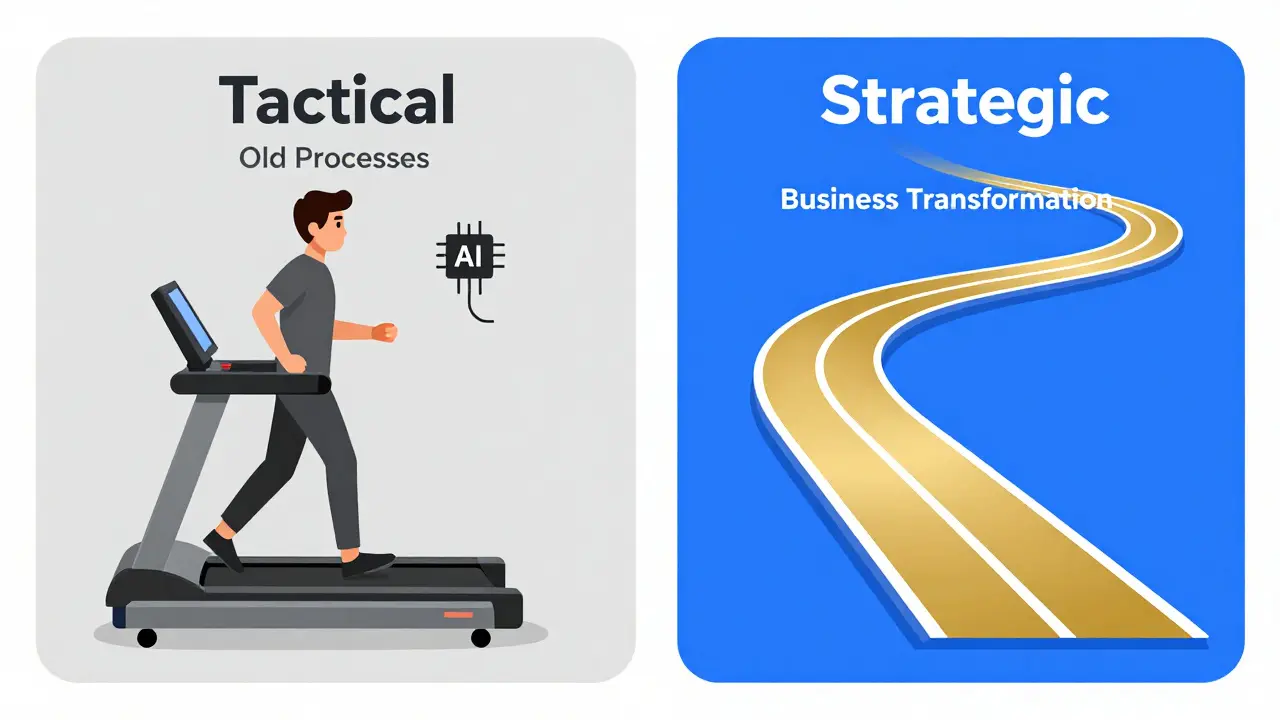
To actually win in this environment, you need to stop thinking about generative AI strategy as a tech project and start treating it as a leadership evolution. This isn't about replacing people; it's about augmenting them and redesigning how work actually happens. When you save 10 hours a week via automation, that time doesn't just vanish-it becomes a strategic asset. The question is: will you spend it on more meetings, or on the human-centric leadership that AI can't replicate?
The Three Pillars of AI-Driven Leadership
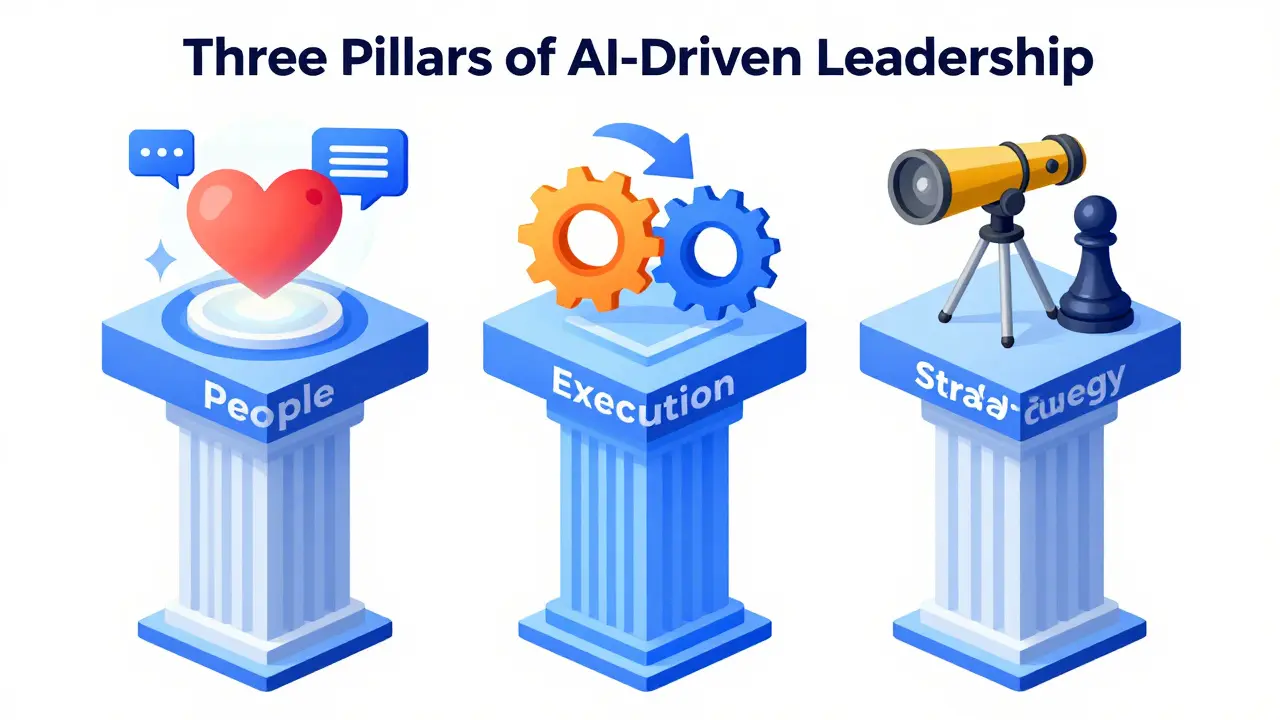
Implementing AI at scale requires more than a subscription to a LLM. According to frameworks used by IBM is a global technology and consulting giant focusing on hybrid cloud and AI solutions, successful leadership in this era rests on three distinct pillars: people, execution, and strategy.
- People: This is about doubling down on what makes us human. While AI handles the data, leaders must handle the empathy, courage, and authenticity. It means moving from being a "manager of tasks" to a "coach of talent."
- Execution: This is the operational side. It's not just about using a tool, but about operational efficiency. How does the workflow change? If you keep the same 20-step process but just use AI for step 5, you're wasting the tech's potential.
- Strategy: This is the big picture. This pillar focuses on business transformation. Are you using AI to do the same things faster, or are you using it to offer services that were previously impossible?
The risk here is "the void." Many managers report saving 15 to 20 hours a week on admin, but they struggle to redeploy that time. Without a clear plan, that saved time often gets sucked back into low-value activities, effectively neutralizing the AI's impact on the bottom line.
Why Governance Beats Bans
Some executives are tempted to ban generative AI tools to protect data or prevent "lazy" work. That is a losing strategy. Research from MIT Sloan Management Review is a leading publication providing research and insights on management and innovation shows that companies with clear governance policies outperform those with outright bans by 3.2x in employee productivity. Bans don't stop usage; they just push it into the "shadow AI" realm where you have zero visibility and zero security.
Effective governance isn't about restriction; it's about guardrails. You need a framework that tells your team what is encouraged, what is risky, and what is strictly forbidden. This includes establishing a cross-functional leadership team within the first 30 days of any AI initiative to set these boundaries. If your staff is anxious about replacement, a transparent policy is the only way to lower the stress levels and keep them engaged.
The High-Performer Blueprint: Moving Beyond Pilots
Too many organizations are stuck in "pilot purgatory"-running a few small tests that never scale. High performers, those seeing actual financial impact, do things differently. According to McKinsey & Company is a global management consulting firm known for its deep industry research and strategic frameworks, these companies don't just tweak a few tasks; they redesign their core workflows. Specifically, 68% of high-performing organizations have redesigned at least 30% of their core workflows to integrate AI.
| Feature | Tactical Approach (Low Impact) | Strategic Approach (High Impact) |
|---|---|---|
| Goal | Incremental efficiency | Business transformation |
| Workflow | AI plugged into old processes | Processes redesigned around AI |
| Validation | Occasional spot-checks | Strict human-in-the-loop validation |
| Leadership | Delegated to IT | Direct ownership by senior executives |
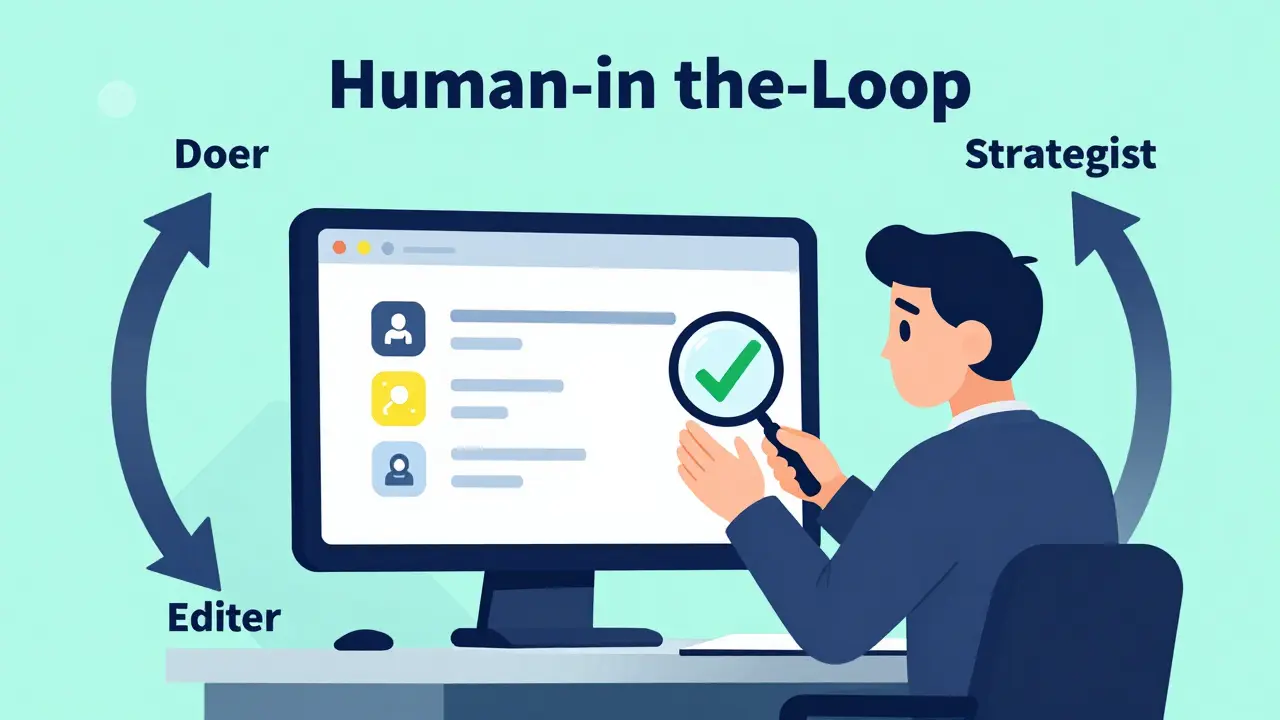
A key differentiator for these high-impact firms is human validation. While 87% of high performers have defined processes for validating model outputs, only 29% of lower-performing firms do. They realize that AI is a "probabilistic" tool, not a "deterministic" one-it gives you the most likely answer, not necessarily the correct one.
Managing the Human Cost and Culture Shift
The technical side of AI is a math problem; the cultural side is a psychology problem. When employees see a tool that can write a report in six seconds, they don't see "efficiency"-they see a threat to their job security. This leads to a spike in anxiety and a drop in critical thinking. If you tell your team "AI will augment you" but you don't change the KPIs they are measured by, they will assume the augmentation is just a precursor to a layoff.
Take the example of USAA is a diversified financial services group providing insurance and banking to the US military community. They focused their AI efforts exclusively on internal use cases to help staff handle customer service better, rather than replacing the customer interface with a bot. This strategic choice reduced case resolution time by 27% while keeping the human element front and center.
To lead through this shift, you must prioritize the development of your teams. As Marvin Boakye of Cummins noted, culture is a strategic differentiator. Your role as a leader is to guide employees on how to transition from "doers" to "editors" and "strategists." This requires structured training-typically 8 to 12 weeks for frontline managers-to help them integrate these tools without losing their critical thinking skills.
A Practical Implementation Timeline
You can't transform an organization overnight, but you can't afford to wait. A realistic rollout looks less like a "big bang" and more like a phased approach. Successful implementations typically take 6 to 9 months for initial strategic alignment.
- Days 1-30: Assemble a cross-functional team. Define your "North Star"-is the goal revenue growth, cost reduction, or customer experience? Establish the initial governance guardrails.
- Days 31-60: Identify high-impact use cases. Look for tasks that offer at least a 20% efficiency improvement and can be implemented within 120 days.
- Days 61-180: Launch pilot programs with strict human-in-the-loop validation. Train your frontline managers on how to lead AI-augmented teams.
- Months 6-12: Evaluate metrics and begin the workflow redesign. Shift from "tool usage" to "process transformation."
Remember that the learning curve is different for different levels. Executives may only need 4 to 6 weeks to understand the capabilities, but they face the hardest part of the journey: driving the cultural transformation across the entire organization.
Will generative AI actually replace my middle management?
Not necessarily, but it will replace the *functions* of middle management that are purely administrative. Tasks like scheduling, basic reporting, and data synthesis are being automated. Managers who only provide "coordination" are at risk. However, those who pivot toward coaching, strategic thinking, and emotional intelligence will find themselves more valuable than ever because they can focus on people while the AI handles the paperwork.
How do I prevent my team from losing their critical thinking skills?
The danger is "automation bias," where humans trust the machine's output without questioning it. To fight this, implement a mandatory "human-in-the-loop" validation process. Require employees to document *why* they accepted or rejected an AI suggestion. Shift your performance metrics from the final output to the quality of the critique and the strategic refinement of that output.
What is the first step to creating an AI governance policy?
Start by categorizing your data and tasks into risk levels: Low, Medium, and High. Low risk might be drafting an internal email; high risk might be analyzing sensitive customer financial data. Define clear rules for each level. Instead of a blanket ban, provide a list of "approved tools" and a set of "mandatory checks" for any AI-generated content that leaves the organization.
How much time should I expect to save with these tools?
Real-world data from managers using tools like Copilot suggests a gain of roughly 8 to 20 hours per week on administrative tasks. However, these gains are only realized if the leader consciously redirects that time toward higher-value activities like team development and strategic planning, rather than just absorbing more meetings into their calendar.
Which industries are adopting generative AI the fastest?
As of 2025, the technology sector leads with 78% adoption, followed by financial services at 67% and healthcare at 59%. Manufacturing and retail are slightly behind (42% and 38% respectively), largely due to the complexities of integrating AI with physical supply chains and legacy hardware.
Next Steps for Implementation
If you are just starting, don't buy a bunch of licenses and hope for the best. Start by mapping your current workflows. Identify the "bottleneck" tasks that are high-volume but low-complexity. Run a 60-day experiment with a small, diverse group of collaborators-not just the tech-savvy ones, but the skeptics too. This creates a culture of shared ownership rather than top-down imposition.
For those already in the pilot phase, it's time to look at your KPIs. If your only metric is "time saved," you're measuring the wrong thing. Start measuring "value created." Are you launching products faster? Is team engagement higher? Are you spending more time on a 2026 strategic vision than you are on a 2025 weekly report? That is the true marker of AI success.
Jeff Napier
April 27, 2026 AT 19:18just another way for the suits to track our every move while pretending it is about efficiency lol. total control masquerading as progress
Mark Tipton
April 28, 2026 AT 01:54It is quite fascinating how the narrative suggests that governance is the antidote to risk, yet fails to mention that the very frameworks provided by these consulting giants are designed to create a dependency on their high-priced advisory services. One must wonder if the 3.2x productivity increase is merely a statistical anomaly curated to entice the C-suite into a false sense of security. Furthermore, the notion of "shadow AI" is simply a convenient boogeyman used to justify more invasive surveillance of employee digital footprints. It is essentially a digital panopticon where the guardrails are actually invisible fences. We are witnessing the systematic erasure of cognitive autonomy in the name of operational efficiency. The alignment of these "North Star" goals almost always leads back to shareholder value, never to the actual well-being of the workforce. I find it profoundly naive to believe that a 60-day experiment with skeptics is anything other than a psychological tactic to manufacture consent. The transition from "doer" to "editor" is just a corporate euphemism for doing more work with less pay because the tool does the heavy lifting. In reality, the machine is training us to be more predictable, not more strategic. Truly, the illusion of augmentation is the most successful product these companies are selling right now.
Adithya M
April 28, 2026 AT 10:46The logic in the table is spot on but the phrasing in the intro is a mess! You can't just say "According to frameworks used by IBM is a global technology..." That is a grammatical disaster! Fix your syntax if you want to be taken seriously by executives!
Jessica McGirt
April 29, 2026 AT 05:16The idea of shifting from a manager of tasks to a coach of talent is so inspiring. It really puts the focus back on the human element which is often lost in tech discussions.
Ronak Khandelwal
April 29, 2026 AT 20:34This is such a beautiful way to look at the evolution of work! 🌟 We have a chance to reclaim our time and pour that energy into mentoring others and growing together as a community. Let's embrace the shift with open hearts and minds! ✨🚀
Sibusiso Ernest Masilela
May 1, 2026 AT 19:00Only a complete amateur would think a "phased approach" is a revelation. This is basic management 101, and yet people act like they've discovered fire. The sheer mediocrity of most corporate "strategic alignment" is honestly exhausting to witness.
Donald Sullivan
May 3, 2026 AT 13:07Cut the fluff. Most of these "strategic" frameworks are just buzzwords to make consultants feel important while they bill five figures a week. Just give the people the tools and get out of their way.
Tina van Schelt
May 4, 2026 AT 06:29The "pilot purgatory" description is just scrumptious. It perfectly captures that weird limbo where companies play with toys for two years and then wonder why nothing actually changed in the real world.
Daniel Kennedy
May 5, 2026 AT 12:15Look, I get the frustration, but if we don't set up these guardrails, the chaos will just swallow the productivity gains. We have to be aggressive about training the staff now so they aren't left behind when the industry shifts. It's about protecting the people through preparation.