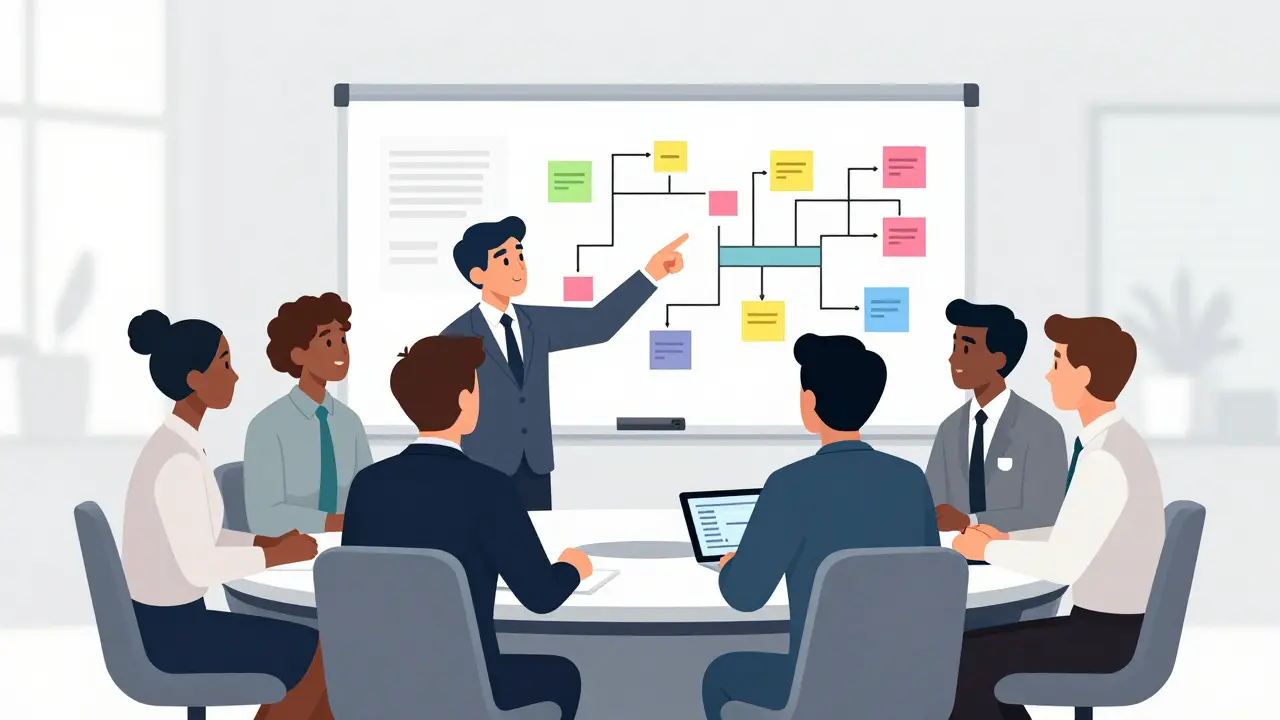
Imagine launching a powerful new Large Language Model (LLM) customer service bot that accidentally gives bad legal advice. Or worse, an internal hiring tool that quietly filters out qualified candidates based on biased training data. These aren't just hypothetical nightmares; they are real risks facing companies today. You can’t fix these problems with code alone. You need people. Specifically, you need a group of people from different parts of your company working together. This is where a Cross-Functional Committee for Ethical Large Language Model Use comes in.
These committees are not just another meeting on the calendar. They are structured governance bodies designed to oversee how your organization develops and uses AI. According to research by OneTrust, organizations that set up these formal committees accelerate their AI adoption by 37% while cutting rework by 28%. That’s because when Legal, Security, Product, and Ethics teams talk to each other *before* deployment, things go smoother. But building one that actually works-and doesn’t become a bottleneck-is tricky. Here is how to do it right.
Who Needs to Be at the Table?
The biggest mistake companies make is treating AI governance as an IT problem. It isn’t. An effective committee needs diverse voices. A survey of 127 enterprise implementations by Truyo found that the most successful committees have between 6 and 12 members. If you keep it smaller than that, you miss critical perspectives. If you go larger, decision-making grinds to a halt.
Here is who should be there:
- Legal (100% of effective committees): They handle liability, intellectual property, and regulatory compliance like the EU AI Act.
- Ethics and Compliance (92%): They ensure the AI aligns with your company’s values and broader societal standards.
- Privacy (88%): They protect user data and ensure you aren’t leaking sensitive information into public models.
- Information Security (85%): They guard against prompt injection attacks and data breaches.
- Research and Development (78%): They explain what the model can and cannot technically do.
- Product Management (75%): They define the user experience and business goals.
- Human Resources (63%): Crucial if you are using AI for hiring or employee monitoring.
- Business Unit Leadership (58%): They provide context on how the AI will impact specific operations.
Dr. Rumman Chowdhury, former Responsible AI Lead at Twitter, argues that these committees must move beyond checklist compliance. She says they need to become "innovation accelerators that bake ethics into the product development lifecycle from inception." In other words, don’t invite them in only after the product is built. Invite them in when you’re still sketching ideas on a whiteboard.
The "New Triad" Approach to Structure
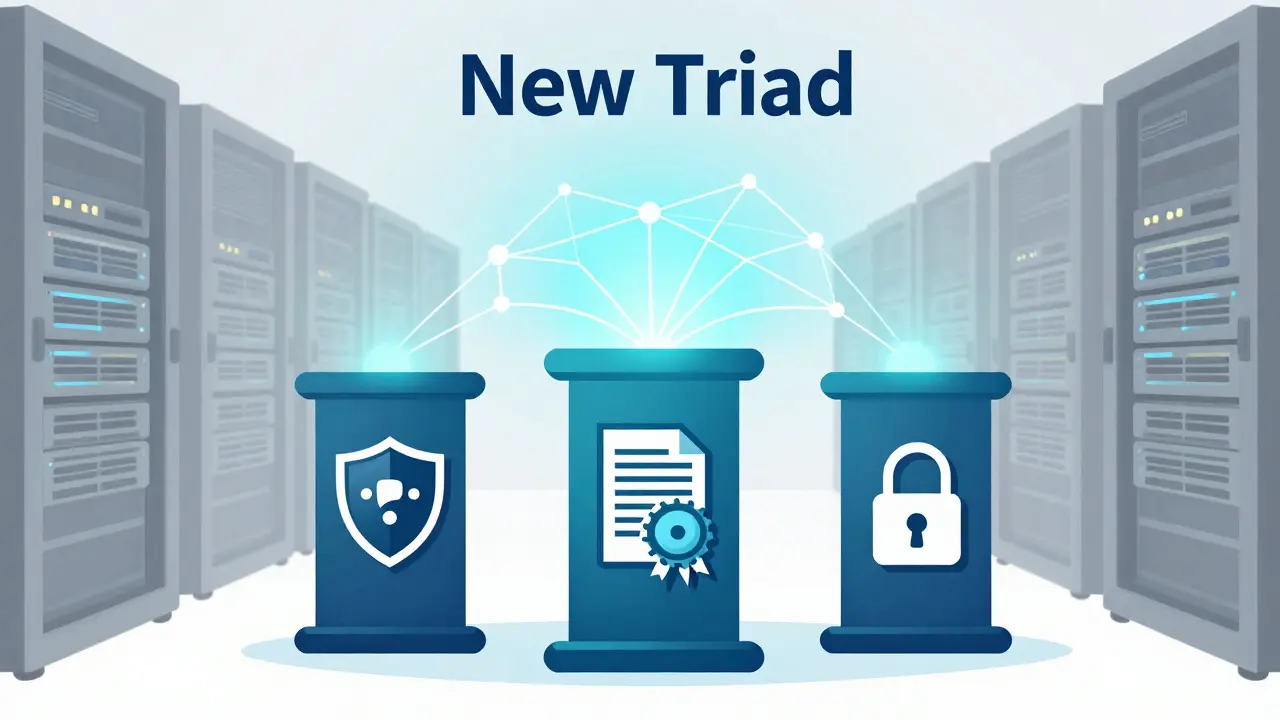
Not all committees are created equal. ISACA’s research highlights a structure they call the "New Triad," which integrates Privacy, Cybersecurity, and Legal teams as the core foundation. Organizations using this model see 42% fewer governance failures compared to those sticking to traditional IT-only structures.
Why does this triad work? Because AI risk is rarely just one thing. A bias issue might look like an HR problem, but it stems from data privacy gaps and creates legal liability. By having these three functions lead the charge, you catch issues early. For example, 83% of bias issues originate during data collection. If Privacy and Legal are watching the data pipeline, they spot red flags before the model even starts training.
You also need a clear hierarchy. OneTrust recommends a tiered structure:
- Central Committee: Meets bi-weekly to set strategic direction and review high-risk projects.
- Working Groups: Meet weekly to handle day-to-day reviews of specific use cases.
- Business Owners & Data Stewards: Provide contextual evidence to support decisions without needing full committee approval for every minor tweak.
This prevents the central committee from getting bogged down in details. As one technology manager noted, committees often become bottlenecks when they don’t define clear decision gates. Don’t let your leaders spend three months debating minor UI changes. Let the working groups handle that.
Defining Roles with a RACI Matrix
Avoid the "everyone is responsible, so no one is responsible" trap. The single most effective tool for clarifying accountability is a RACI matrix. Palo Alto Networks reports that implementing a correct RACI matrix reduces ambiguity by 63%.
RACI stands for Responsible, Accountable, Consulted, and Informed. Here is how it typically looks for an LLM project:
| Task | Responsible (Does the work) | Accountable (Signs off) | Consulted (Provides input) | Informed (Kept updated) |
|---|---|---|---|---|
| Data Collection Review | Data Engineering | Privacy Officer | Legal, Security | Product Manager |
| Bias Testing | ML Engineers | Ethics Lead | HR (if hiring tool) | Executive Sponsor |
| Final Deployment Approval | Project Manager | Chief Ethics Officer / CIO | Full Committee | Board of Directors |
Fisher Phillips notes that 76% of effective implementations use this method. Without it, 57% of failed implementations experienced critical issues falling through the cracks because departments assumed someone else was watching. Make sure you have a single executive sponsor-usually the CIO, CTO, or Chief Ethics Officer-who has the final say. 89% of successful committees assign this role clearly.
Operationalizing the Process: Assessments and Checkpoints
Having people in a room isn’t enough. You need processes. The cornerstone of this process is the AI Impact Assessment. About 76% of organizations have adapted existing privacy impact assessments to include LLM-specific considerations. What should yours include?
- Model Explainability Metrics: Can you explain why the model made a specific decision?
- Data Adequacy Verification: Is the training data sufficient and representative?
- Bias Detection Protocols: Have you tested for gender, racial, or age bias?
- Security Vulnerabilities: Are you protected against prompt injections?
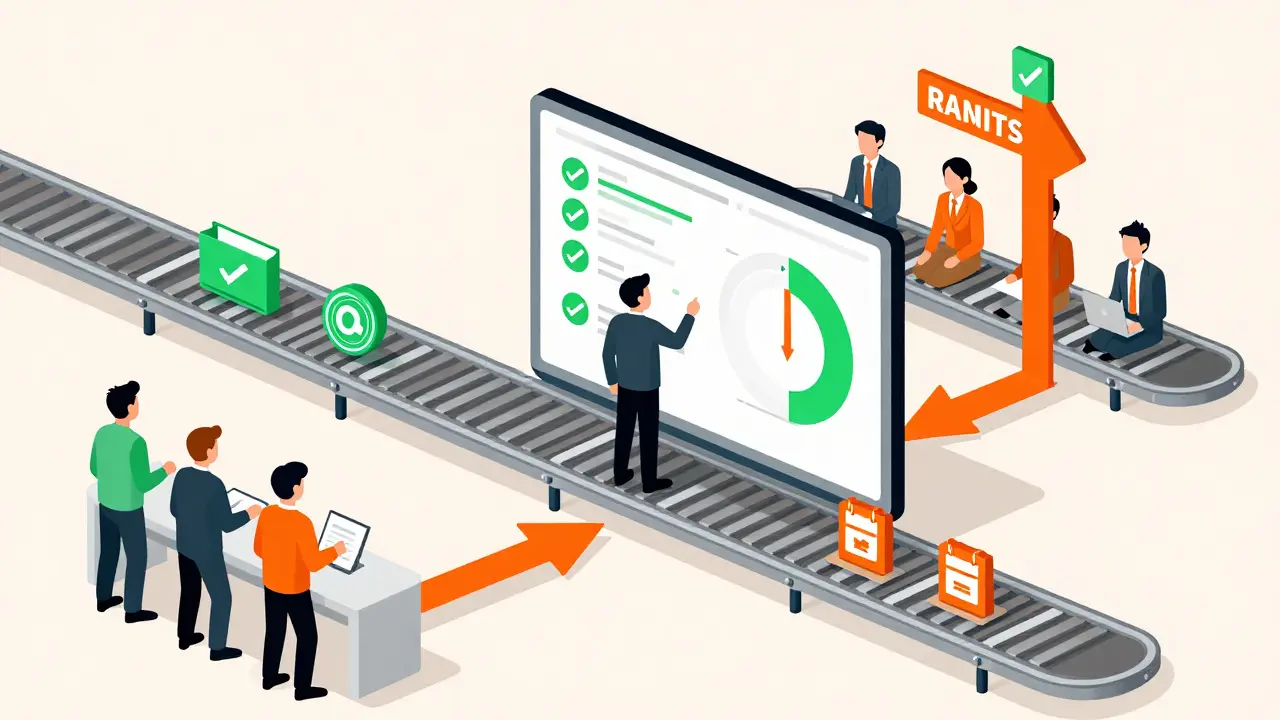
Don’t review everything equally. Use a risk-based categorization system. Palo Alto Networks finds that 76% of mature committees use automated initial risk assessments to route low-risk applications to working groups, while sending high-risk apps to the full committee. This keeps velocity high. Thompson Hine warns that committees focused exclusively on compliance achieve only 28% of the innovation velocity of those balancing compliance with strategic enablement. Your goal is to be an enabler, not a gatekeeper.
Set checkpoints at critical stages:
- Data Collection: Where 83% of bias issues originate.
- Model Training: Where 71% of security vulnerabilities are introduced.
- Pre-Deployment: Where 65% of ethical concerns are identified.
Overcoming Common Pitfalls
Building this committee is hard. Truyo’s survey cited "difficulty getting consistent participation from all required functions" as the top challenge, especially from engineering teams under delivery pressure. How do you solve this?
First, get executive buy-in. Executive sponsorship is present in 94% of successful implementations versus only 32% of failed ones. If the CEO or Board doesn’t care, engineers won’t either. Second, integrate with existing workflows. Don’t create parallel processes that require extra documentation nobody wants to write. Embed the checks into your CI/CD pipeline or project management tools.
Be wary of performative governance. Dr. Timnit Gebru criticizes many corporate AI committees as lacking independent verification mechanisms. Ensure your committee has the power to halt deployments. If they can only recommend changes but not stop a launch, they are toothless. Fisher Phillips data shows that organizations without formal governance committees face 4.7x higher litigation risk. Conversely, documenting every governance decision reduces regulatory penalty risk by 68%.
Looking Ahead: Regulatory Pressure and Maturity
The landscape is shifting fast. With the EU AI Act taking effect in February 2026 and US Executive Order 14110 requiring federal agencies to establish governance committees, this is no longer optional for many. Gartner projects the global AI governance market will reach $1.24 billion by 2026. Adoption is accelerating: 68% of Fortune 500 companies now have formal AI governance committees, up from 22% in January 2023.
Healthcare leads adoption at 82%, followed by financial services at 76%. Why? Because the stakes are highest there. But even tech companies are catching on. By 2027, analysts predict 95% of enterprises with significant AI investments will have these structures. Failure to implement is becoming a material risk factor for public companies, evidenced by shareholder resolutions filed in Q1 2025 specifically targeting AI governance gaps.
Start small if you must, but start now. Identify your stakeholders, draft a charter, and define your first checkpoint. The cost of getting it wrong far outweighs the effort of setting it up right.
How long does it take to set up an AI governance committee?
OneTrust recommends a timeline of 12-16 weeks. This includes 2 weeks for stakeholder identification, 4 weeks for charter development, 3 weeks for role definition, 4 weeks for process design, and 3-4 weeks for training and rollout. Rushing this process often leads to unclear roles and ineffective oversight.
What is the "New Triad" in AI governance?
The "New Triad" is a committee structure identified by ISACA that integrates Privacy, Cybersecurity, and Legal teams as the core leadership. This approach results in 42% fewer governance failures compared to traditional IT-led structures because it addresses the interconnected nature of AI risks early in the lifecycle.
Do we really need an AI Impact Assessment?
Yes. 76% of organizations use adapted AI Impact Assessments to verify model explainability, data adequacy, and bias detection. These assessments are crucial for compliance with regulations like the EU AI Act and for reducing litigation risk. Documenting these decisions can reduce regulatory penalty risk by 68%.
How do we prevent the committee from becoming a bottleneck?
Use a tiered review process. Implement automated initial risk assessments to route low-risk applications to smaller working groups for quick approval. Reserve the full central committee for high-risk, high-stakes decisions. Clearly defined decision gates and a RACI matrix also help keep things moving efficiently.
What happens if we don't have a formal AI governance committee?
Organizations without formal committees face significantly higher risks. Fisher Phillips analysis shows a 4.7x higher litigation risk for companies without these structures. Additionally, you may fail to meet emerging regulatory requirements like the EU AI Act, leading to fines and reputational damage.
Fredda Freyer
May 29, 2026 AT 17:43The philosophical underpinning of this framework is that ethics cannot be an afterthought, but rather a foundational element of the architectural design. When we consider the nature of bias in LLMs, we are essentially looking at a reflection of human societal flaws encoded into mathematical weights. The committee structure described here attempts to bridge the gap between technical capability and moral responsibility. It is interesting to note how the 'New Triad' approach mirrors ancient democratic ideals where power is distributed among distinct branches to prevent tyranny or error. However, one must wonder if such committees can truly remain independent when they are funded by the very entities whose actions they are meant to scrutinize. The risk of performative governance is high, as Dr. Gebru points out. We need mechanisms that ensure these bodies have teeth, not just advisory status. This requires a cultural shift within organizations where ethical compliance is valued equally with profit margins. It is a delicate balance to strike.
Gareth Hobbs
May 30, 2026 AT 21:27THIS IS ALL BULLSHIT!!! They want to control your thoughts!!! The EU AI Act is just a way for foreign powers to censor us!!! Why do we need a committee??? Just let the market decide!!! If it’s bad, people won’t use it!!! But no, they want bureaucrats deciding what is “ethical”!!! It’s a conspiracy!!! They are watching you!!! Your data is being stolen!!! Don’t trust them!!!
Zelda Breach
June 1, 2026 AT 03:14Your grammar is atrocious. You clearly do not understand the nuance of corporate governance structures. The idea that “the market” will self-regulate AI bias is naive and dangerously ignorant. Bias is often invisible to the end-user until significant harm has been done. Furthermore, suggesting that regulatory frameworks are merely “foreign censorship” ignores the complex legal liabilities involved in deploying autonomous systems. It is pathetic that you reduce a sophisticated discussion on risk mitigation to a paranoid rant. Educate yourself before posting nonsense.
Alan Crierie
June 2, 2026 AT 00:32I think we can all agree that having diverse perspectives is important 🌟 While I appreciate the passion in some comments here, it might help to focus on the practical aspects of setting up these committees. The article mentions that smaller teams (6-12 members) are more effective. This makes sense because too many voices can lead to decision paralysis. 😊 It is also crucial to include HR if you are using AI for hiring, as they understand the human impact better than engineers might. Let’s keep the conversation constructive and helpful for everyone trying to implement these changes safely. 🤝
Nicholas Zeitler
June 3, 2026 AT 23:24This is an excellent breakdown!! The RACI matrix section is particularly useful!! Many projects fail simply because roles are ambiguous!! Having a clear Accountable person is key!! Also, the point about executive buy-in is critical!! Without support from the top, these committees become toothless!! Great read!! 👏
Teja kumar Baliga
June 5, 2026 AT 13:32Great insights! In India, we are seeing similar trends with the Digital Personal Data Protection Act. Cross-functional teams are essential. It helps to have legal and tech working together early. Saves time later. Very useful post!
k arnold
June 5, 2026 AT 22:02Yeah, sure, another committee. Because nothing slows down innovation like adding more meetings. The article says it accelerates adoption, but anyone who has worked in a large corporation knows that committees are designed to kill momentum, not accelerate it. It’s just corporate theater to make people feel safe while the actual product gets delayed by six months. Typical.
Tiffany Ho
June 7, 2026 AT 09:07i totally get why people might think committees are slow but i think if you set it up right it can actually help. the part about automated risk assessments sounds really smart. so low risk stuff goes fast and high risk gets looked at closely. that seems like a good balance. i hope my company tries this soon because we definitely need better checks on our ai tools
michael Melanson
June 7, 2026 AT 09:20The tiered structure mentioned is pragmatic. Central committees should not be bogged down in minor UI tweaks. Delegating to working groups for day-to-day reviews is the only way to maintain velocity while ensuring oversight. The statistic about 42% fewer governance failures with the New Triad model is compelling evidence for integrating Privacy, Cybersecurity, and Legal from the start.
lucia burton
June 8, 2026 AT 01:43It is imperative that we leverage synergistic cross-functional paradigms to optimize the holistic ecosystem of AI governance frameworks, thereby mitigating epistemological risks associated with algorithmic bias and ensuring robust compliance with emerging regulatory landscapes such as the EU AI Act, which necessitates a proactive rather than reactive stance towards ethical deployment strategies, ultimately fostering a sustainable trajectory for technological advancement while preserving stakeholder trust and operational integrity across all verticals of the enterprise value chain.