
There is a widespread myth in the AI world that more context equals better results. You feed an Large Language Model (a machine learning system trained on vast amounts of text data to generate human-like responses) a massive document, expecting it to synthesize everything perfectly. But research from 2023 and 2024 tells a different story: adding more tokens often makes the model dumber, slower, and more prone to hallucinations.
This counterintuitive relationship between prompt length and output quality is one of the most critical yet misunderstood aspects of working with modern AI. We are going to break down why this happens, where the breaking points lie for major models like GPT-4 and Claude, and how you can structure your inputs to get the best possible reasoning without burning through your compute budget.
The Attention Mechanism Bottleneck
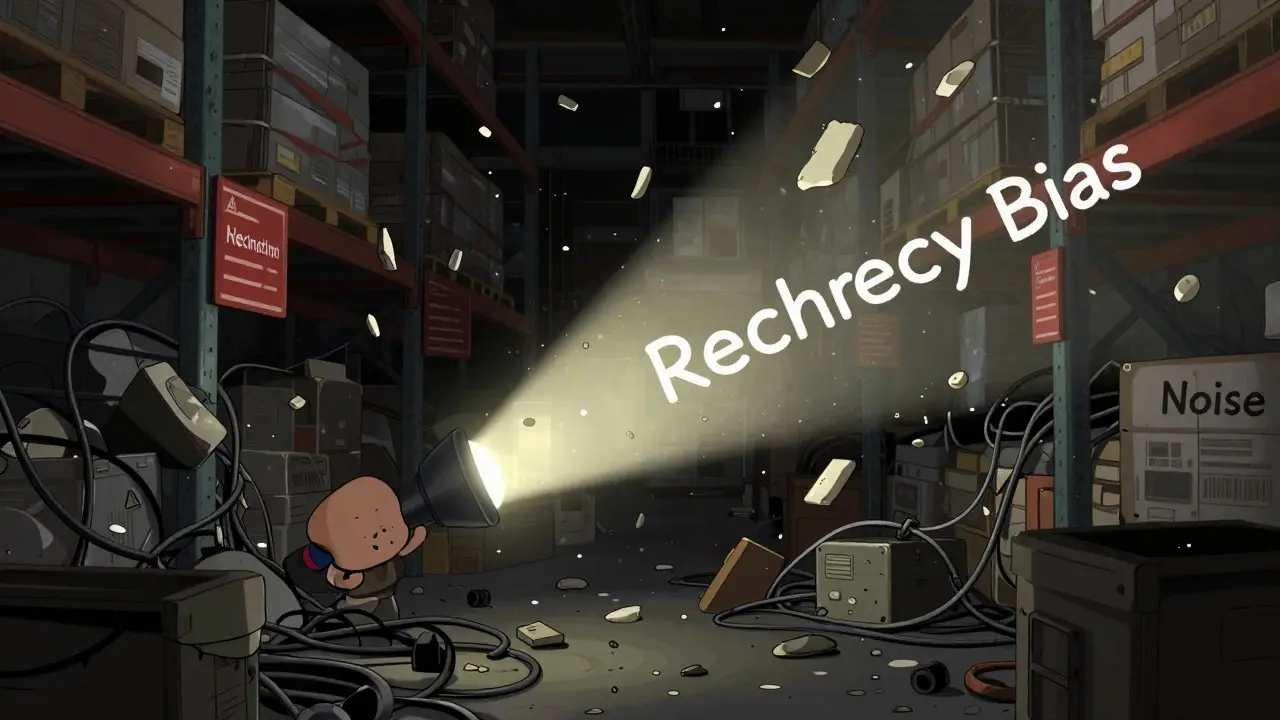
To understand why longer prompts fail, we have to look under the hood at how these models process information. They use something called an attention mechanism. Think of it like a spotlight scanning a crowded room. When the room is small (a short prompt), the spotlight easily finds every important detail. When the room is huge (a long prompt), the spotlight struggles to focus on everything equally.
The problem is mathematical. The computational complexity of attention scales quadratically with token count. This means if you double the number of tokens, the work doesn't just double-it multiplies significantly. A benchmarking study by PromptLayer in 2024 showed that doubling prompt tokens from 1,000 to 2,000 increased processing time by 2.3x for GPT-4-turbo (an advanced version of OpenAI's language model optimized for speed and accuracy). Extending that to 4,000 tokens resulted in a 5.1x latency increase.
But speed isn't the only casualty. Accuracy takes a hit too. Research documented by PromptPanda in 2023 revealed a linear decline in reasoning performance. Here is what the data looks like in practice:
- 500 tokens: ~95% accuracy
- 1,000 tokens: ~90% accuracy
- 1,500 tokens: ~85% accuracy
- 2,000 tokens: ~80% accuracy
- 2,500 tokens: ~75% accuracy
- 3,000 tokens: ~70% accuracy
Every additional 500 tokens reduced reasoning performance by approximately 5 percentage points. This degradation happens even though newer models claim to support contexts of 100,000+ tokens. Just because the model *can* hold the information doesn't mean it *processes* it well.
Recency Bias and Information Overload
One specific phenomenon that ruins long prompts is recency bias. Transformers disproportionately weight tokens that appear later in the sequence. If you put your critical instructions or key facts at the beginning of a 10,000-token prompt, the model might barely notice them.
PromptLayer’s testing demonstrated that critical information placed in the first 20% of a 10,000-token prompt received only 12-18% of the model's attention allocation. Meanwhile, the end of the prompt gets over-indexed. This leads to a frustrating experience where the model ignores your setup but obsesses over the last few sentences.
Then there is the noise factor. Dr. Percy Liang, Director of Stanford's Center for Research on Foundation Models, put it bluntly in his October 2024 NeurIPS keynote: "Beyond 2,000 tokens, we're not giving models more context-we're giving them more noise to filter through."
This noise increases hallucination rates. A joint study by Microsoft Research and Stanford University published in June 2024 found that hallucination rates jump by 34% when prompts exceed 2,500 tokens. Bias amplification also spikes, with a 28% higher incidence of problematic outputs in lengthy prompts.
Model-Specific Thresholds
Not all models degrade at the same rate. While the general trend holds true, there are nuances between proprietary and open-weight architectures. Let's look at how different players handle length.
| Model | Max Context Window | Optimal Reasoning Length | Accuracy Drop-off Point |
|---|---|---|---|
| GPT-4-turbo | 128,000 tokens | 800 - 1,200 tokens | ~2,000 tokens |
| Claude 3 (Anthropic Claude) | 200,000 tokens | ~1,800 tokens | ~2,000 tokens |
| Gemini 1.5 Pro | 1,000,000+ tokens | 1,000 - 2,000 tokens | ~2,500 tokens |
| Llama 3 70B | 8,192 tokens | 1,000 - 1,500 tokens | ~2,000 tokens (less severe drop) |
Google's Gemini 1.5 Pro maintains slightly higher accuracy (88%) at 2,000 tokens compared to GPT-4-turbo (82%), according to MLPerf testing in Q1 2025. However, both exhibit similar degradation curves beyond that point. Interestingly, research by Goldberg et al. (MLOps Community, August 2024) found that Llama 3 70B, an open-weight model, shows less severe degradation-only a 3% accuracy drop between 1,000 and 2,000 tokens-suggesting some open-source architectures may handle longer contexts more effectively than their proprietary counterparts.
Why Chain-of-Thought Isn't a Silver Bullet
You might think using advanced prompting techniques like Chain-of-Thought (CoT) would fix the length issue. CoT encourages the model to show its step-by-step reasoning, which usually boosts accuracy. But it has limits.
The same MLOps Community study demonstrated that while CoT improved reasoning accuracy by 19% at 1,000 tokens, it provided only a 6% improvement at 2,500 tokens. The technique helps, but it cannot overcome the fundamental bottleneck of quadratic attention complexity. Once the prompt gets too long, the signal-to-noise ratio drops so low that even structured reasoning fails to recover lost context.
Better Alternatives: RAG and Hybrid Strategies
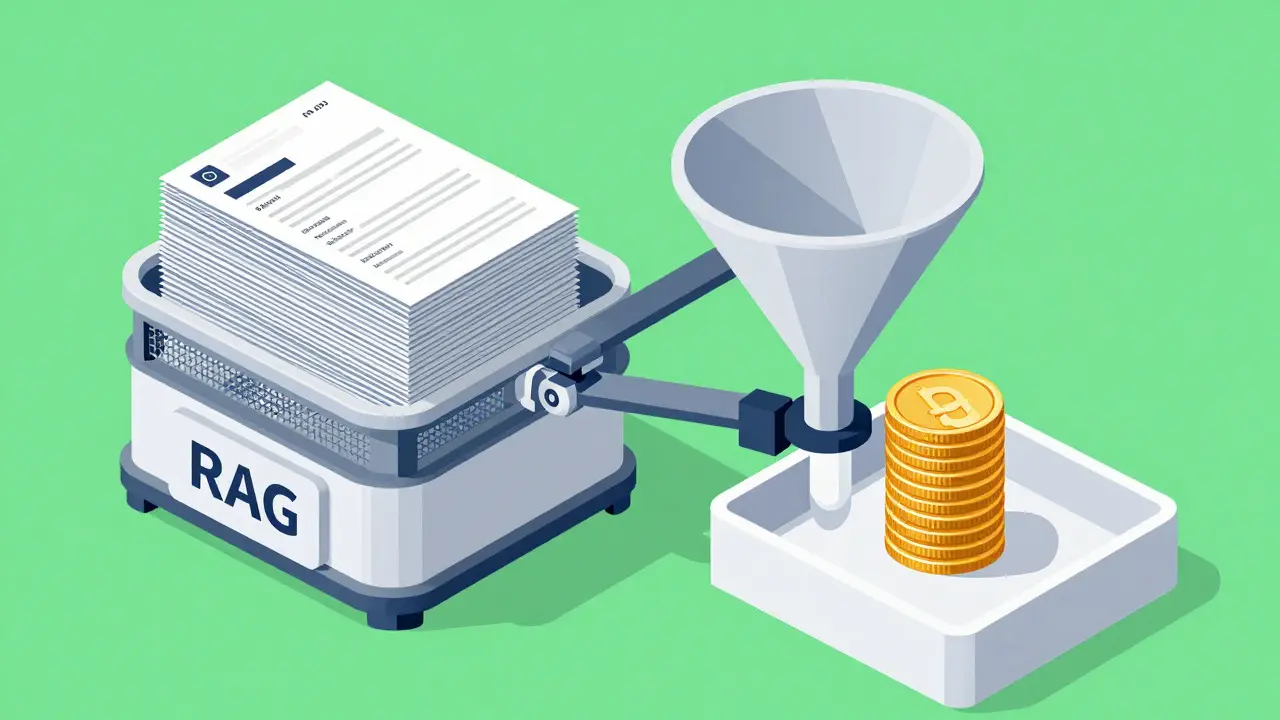
If brute-forcing context length doesn't work, what should you do? The industry consensus points toward Retrieval-Augmented Generation (RAG). Instead of stuffing everything into the prompt, you retrieve only the most relevant snippets of information and feed those to the model.
A PromptLayer case study showed that a well-structured 16K-token RAG implementation outperformed a monolithic 128K-token prompt by 31% in accuracy while reducing latency by 68%. This confirms that strategic context management consistently beats dumping raw data.
For specialized tasks like legal contract analysis or medical documentation review, where cross-referencing distant clauses is necessary, longer contexts (32,000+ tokens) can be marginally beneficial, as noted in Nature's April 2025 study on healthcare LLM applications. But for 92% of use cases, shorter, targeted prompts win.
Practical Guidelines for Prompt Optimization
So, how long should your prompts actually be? The MLOps Community's Prompt Engineering Guide (Version 3.1, February 2025) offers these concrete recommendations:
- Simple Classification Tasks: Start with 500-700 tokens.
- Complex Reasoning: Aim for 800-1,200 tokens.
- Hard Limit: Never exceed 2,000 tokens without empirical validation.
Developers report a 3-5 hour learning curve to master these length optimization techniques. Common challenges include identifying irrelevant content (solved through iterative pruning) and managing recency bias. To address recency bias, try repeating critical instructions at both the beginning and the end of your prompt. This anchors the model's attention at both ends of the sequence.
Tools are emerging to help automate this. The PromptLayer API launched a 'PromptOptimizer' feature in January 2025 that automates length testing. Data shows that 83% of users achieved optimal results within just 2-3 iterations using this tool. Additionally, community resources like PromptPanda's 'Prompt Length Calculator' help determine optimal lengths based on specific model parameters.
Cost and Efficiency Implications
It’s not just about quality; it’s about money. An Altexsoft case study from 2023 demonstrated that appropriate prompt length optimization reduced cloud computing costs by 37% while improving output accuracy by 22% in customer service chatbots. With the prompt optimization market projected to reach $1.2 billion by 2028, enterprises are taking this seriously. Forrester’s Q4 2024 survey found that 89% of Fortune 500 companies now list prompt length optimization as their top priority for AI deployment.
By trimming fat from your prompts, you reduce token usage fees, lower latency, and get cleaner answers. It is a win-win scenario that requires no new hardware, just smarter engineering.
What is the ideal prompt length for GPT-4?
The ideal prompt length for GPT-4 for complex reasoning tasks is typically between 800 and 1,200 tokens. Beyond 2,000 tokens, accuracy begins to degrade significantly due to attention mechanism limitations and increased noise.
Does a larger context window mean better performance?
No. A larger context window (e.g., 100k+ tokens) allows the model to accept more input, but it does not guarantee better reasoning. In fact, performance often plateaus and then declines as prompt length increases beyond optimal thresholds due to recency bias and computational overhead.
How does recency bias affect LLM outputs?
Recency bias causes the model to pay disproportionate attention to tokens appearing later in the sequence. Critical information placed at the start of a long prompt may receive only 12-18% of the model's attention, leading to ignored instructions or missed context.
Is Retrieval-Augmented Generation (RAG) better than long prompts?
Yes, for most use cases. RAG retrieves only relevant snippets, keeping the prompt concise. Studies show RAG implementations can outperform monolithic long prompts by up to 31% in accuracy while reducing latency by 68%.
When should I use prompts longer than 2,000 tokens?
You should only exceed 2,000 tokens for highly specialized tasks requiring extensive cross-referencing, such as analyzing complex legal contracts or medical records. For general reasoning, coding, or classification, shorter prompts yield better results.
Kyle Ware
August 15, 2026 AT 19:48honestly this is the most practical take on prompt engineering i have seen in a while. everyone keeps throwing context windows at problems like they are magic wands but the math just doesnt lie about that quadratic scaling. we need to stop treating llms as infinite memory banks and start treating them like focused workers who get distracted easily. if you want better results trim the fat and use rag properly instead of dumping your entire hard drive into the input field. it saves money and actually improves accuracy which is a win win for everyone involved
Joanna Mucha
August 17, 2026 AT 09:49ah yes another article telling us to restrict our cognitive horizons because the silicon gods demand brevity. how quaint. one might assume that intelligence involves synthesis of vast disparate threads yet here we are being told to feed the beast scraps. it is a reflection of our own intellectual laziness that we blame the tool rather than refining our ability to distill meaning. the model does not fail us our inability to curate fails the model. truly a tragic commentary on the state of modern discourse where nuance is sacrificed for efficiency
Kim Edwards
August 18, 2026 AT 13:14i am literally shaking right now because i spent three weeks building a system that feeds 50k tokens per request and it was giving me garbage answers. i thought my code was broken i thought the api was down i even blamed my internet connection. turns out the model was just drowning in noise like a drowning rat. i feel so stupid but also relieved that someone finally said it out loud. why did no one tell me sooner???
Bonnie Watt
August 18, 2026 AT 13:38you people are all missing the point entirely. sure short prompts work for basic tasks but what about when you need deep contextual understanding? you are oversimplifying complex interactions to fit a tidy little graph. the real issue is that these models are fundamentally flawed architectures trying to mimic human cognition without the biological substrate. blaming prompt length is like blaming the canvas size for a bad painting. the artist is the problem not the medium
Meagan Mueller
August 20, 2026 AT 06:40they want you to believe that shorter is better so they can sell you more compute cycles later or lock you into their proprietary rag systems. think about it. why would big tech admit their flagship feature is useless unless you buy their enterprise solution? its all a conspiracy to keep developers dependent on their ecosystem. trust nothing verify everything and keep your data local always. the attention mechanism is just a distraction from the real agenda
Dave Gibbeson
August 20, 2026 AT 09:28listen up team this is exactly why we need to enforce strict token limits in our development pipeline starting tomorrow. i saw a spike in costs last month that traced back to one developer ignoring best practices. lets fix this now. implement the rag strategy discussed above and cut those latency numbers in half. no excuses we need to be efficient and accurate or we will lose the contract. get to work