Have you ever asked an AI model a simple question only to get a confident, detailed answer that was completely wrong? You are not alone. This phenomenon, known as hallucination, remains the biggest hurdle in deploying large language models (LLMs) for serious work. By mid-2026, we have moved past the initial shock of these errors. The industry has settled into a new reality: we cannot trust the model blindly, so we must build systems to verify its output in real-time. This is where online verification strategies come in.
Evaluating factuality during generation is no longer just an academic exercise. It is a critical engineering requirement. Whether you are building a customer support bot, a legal research tool, or a healthcare assistant, the cost of a factual error can be devastating. In this guide, we will break down how these verification systems work, which tools actually perform well in 2026, and how you can implement them without breaking your budget or your latency targets.
The Core Problem: Why LLMs Lie (And How We Catch Them)
To understand the solution, we first need to look at the problem. Large language models like GPT-4o or Llama-3 are prediction engines, not truth engines. They predict the next most likely word based on patterns in their training data. When they lack specific information, they often fill the gap with plausible-sounding nonsense. Studies from the HaluEval benchmark show that even top-tier models produce factual errors in 15-25% of responses across diverse topics.
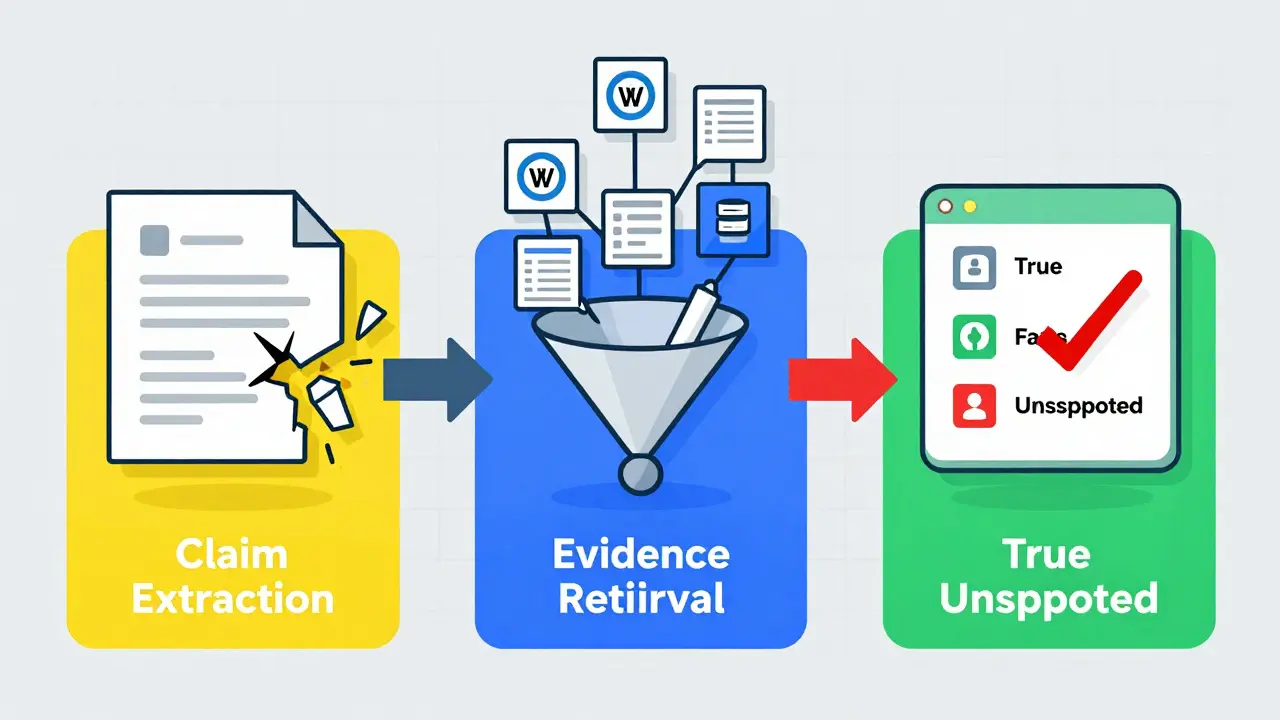
Online verification strategies address this by adding a layer of scrutiny between the model’s generation and the user’s screen. Instead of accepting the text as-is, the system breaks it down, checks it against authoritative sources, and flags or corrects inaccuracies. This process typically follows a three-stage pipeline:
- Claim Extraction: The system decomposes the generated text into atomic, context-independent statements. For example, "The capital of France is Paris" becomes a single claim.
- Evidence Retrieval: The system searches authoritative knowledge bases-like Wikipedia, verified news databases, or custom enterprise documents-for supporting evidence.
- Verification: A verifier module compares the claim against the retrieved evidence using natural language inference or rule-based logic to determine if the claim is true, false, or unsupported.
This architecture transforms the LLM from a black box into a transparent, auditable system. But not all verification tools are created equal. Let’s look at the heavy hitters in the market today.
Top Verification Frameworks Compared
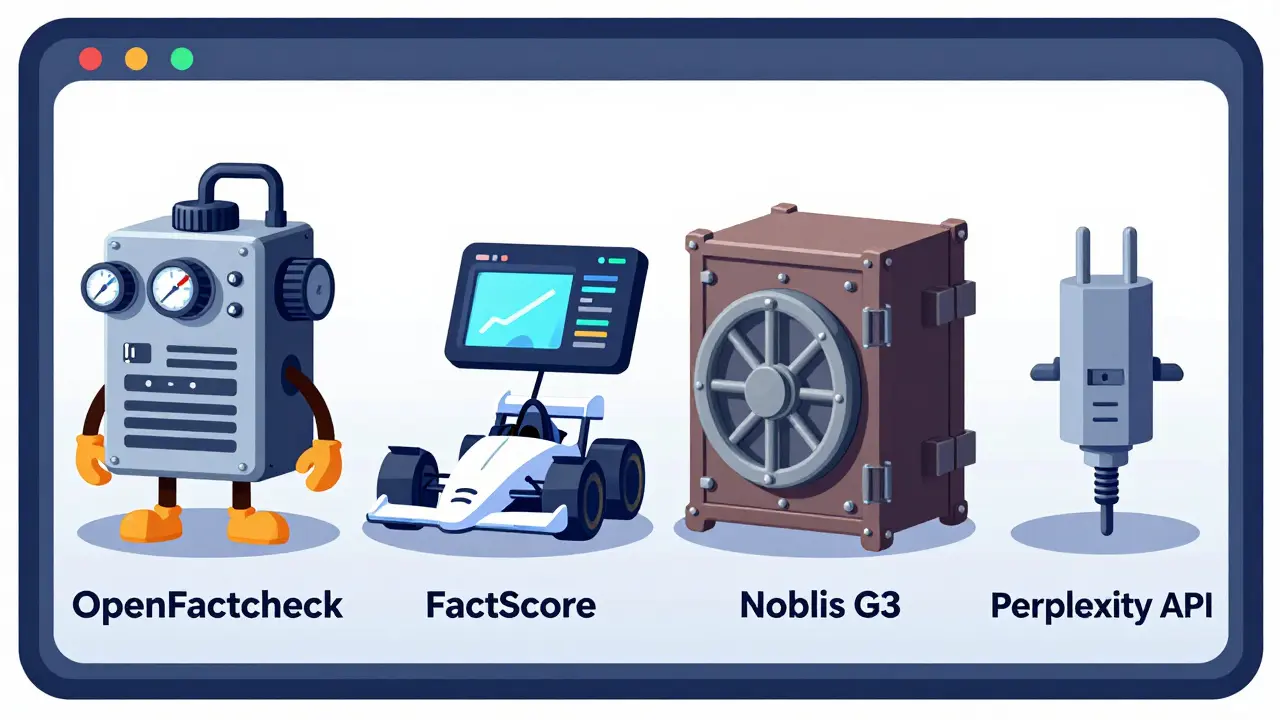
In 2026, the landscape of fact-checking tools has matured significantly. Three main approaches dominate: comprehensive research frameworks, lightweight efficiency-focused tools, and specialized enterprise solutions. Here is how they stack up.
| Framework | Primary Strength | Accuracy (Avg.) | Latency per Claim | Cost per Verification | Best For |
|---|---|---|---|---|---|
| OpenFactCheck | Modularity & Customization | 81.7% | ~10 seconds (varies) | $0.01 - $0.04 | R&D, Complex Enterprise Apps |
| FactScore | Speed & Efficiency | 76.8% | 2.3 seconds | Negligible | High-Volume Production Environments |
| Noblis G3 | Domain-Specific Precision | 85.2% | Variable | High Setup Cost | Government, Defense, Legal |
| Perplexity.ai API | Ease of Integration | 72.1% | 1.8 seconds | Proprietary | Quick Prototyping |
OpenFactCheck, released in its 2.0 version in early 2025, is currently the gold standard for researchers and developers who need granular control. Developed by Stanford University, it integrates multiple modules like CustChecker and CheckerEval. Its strength lies in flexibility; you can swap out retrievers or verifiers depending on your needs. However, this power comes with complexity. Setting it up can take 15-20 hours for experienced engineers, and full evaluation of a document can take up to 47 minutes on standard hardware.
FactScore, introduced by Carnegie Mellon University, takes the opposite approach. It prioritizes speed. With a latency of just 2.3 seconds per claim and negligible costs, it is ideal for high-volume applications where every millisecond counts. While its accuracy (76.8%) is slightly lower than OpenFactCheck, it is often sufficient for general-purpose tasks. Developers love it for its simplicity, though some note it lacks deep customization options for niche domains like medicine.
For highly regulated industries, Noblis G3 stands out. Released in 2023, it uses a vector database approach tailored for enterprise settings. It achieves impressive accuracy (85.2%) on technical documentation but requires significant upfront investment. One Department of Defense contractor reported spending six months and three full-time engineers to configure it properly. If you are in government or defense, this might be worth it. For everyone else, the barrier to entry is likely too high.
Implementing Verification: A Practical Guide
Choosing a tool is only half the battle. Implementing it effectively requires navigating several common pitfalls. Based on developer feedback from GitHub issues and community forums, here are the key steps to successful deployment.
- Start with Hybrid Retrieval: Don’t rely solely on dense retrieval (vector search). Combine it with BM25 (keyword-based search). Systems using this hybrid approach reduce false negatives by 27.3%. This ensures you catch both semantic matches and exact keyword hits.
- Set Confidence Thresholds: Not all claims need the same level of scrutiny. Implement confidence thresholds to filter out obvious facts. This reduces the verification load and cuts false positives by up to 34.1%.
- Optimize for Latency: Real-time verification is the trend. In 2026, 68% of new implementations use "self-verification," where the LLM pauses generation to check high-risk claims before continuing. This reduces final output errors by an additional 22.4% compared to post-hoc checking.
- Manage Costs Carefully: API costs add up fast. Factcheck-GPT, for instance, costs $0.042 per verification. For high-volume apps, this is prohibitive. Consider using lighter models like Llama-3-8B for verification, which offers a 72.1% accuracy rate at just $0.008 per check.
One major challenge developers face is configuring custom knowledge bases. According to a Prompting Weekly survey, 63% of users found this "extremely difficult." The advice? Start small. Use public datasets like Wikipedia to test your pipeline before integrating proprietary internal documents. Document everything. The learning curve for production-ready implementation is typically 6-8 weeks.
Limitations and Ethical Considerations
No system is perfect. Even the best verification tools have blind spots. Current systems struggle with temporal knowledge, showing a 32.6% accuracy drop on time-sensitive claims. They also falter on nuanced statements requiring deep contextual understanding, with accuracy dropping to 54.1% on complex news analysis. Furthermore, cultural bias remains an issue; accuracy drops by 41.3% on non-Western topics due to imbalances in training data.
Experts warn against over-reliance on automation. Percy Liang, Professor of Computer Science at Stanford, noted that current systems miss 23.7% of subtle factual errors that trained humans catch. Emily M. Bender from the University of Washington adds that automated fact-checking can create a false sense of security, potentially amplifying biases present in the source data.
Regulatory pressure is mounting. The EU’s AI Act, effective February 2025, mandates "appropriate technical measures" to mitigate risks of factual incorrectness in high-risk applications. This means verification isn’t just good practice-it’s becoming a legal requirement in many jurisdictions.
Future Trends: What’s Next for Factuality?
The field is moving fast. By late 2026, we are seeing a shift toward multi-modal verification. OpenFactCheck plans to integrate image and video fact-checking in Q2 2025, addressing the growing need to verify visual content alongside text. Another promising development is the "self-correcting" paradigm, where LLMs iteratively verify and refine their own outputs. Preliminary results show this can reduce errors by an additional 37.2% beyond standard verification methods.
Standardization is also on the horizon. NIST’s AI Risk Management Framework working group is leading efforts to create standardized evaluation protocols. This will help compare tools more fairly and ensure consistent quality across the industry. As Gartner predicts, 95% of enterprise LLM deployments will incorporate some form of factuality verification by 2027. The question is no longer if you should verify, but how.
What is the best tool for verifying LLM facts in 2026?
It depends on your needs. For maximum accuracy and customization, OpenFactCheck is the top choice, especially for R&D. For speed and cost-efficiency in high-volume production, FactScore is superior. For highly regulated sectors like defense, Noblis G3 offers the best domain-specific precision despite higher setup costs.
How much does online verification cost?
Costs vary widely. Lightweight open-source tools like FactScore have negligible direct costs. API-based solutions like Factcheck-GPT charge around $0.042 per verification. Using smaller models like Llama-3-8B for verification can reduce this to approximately $0.008 per check, making it viable for high-volume applications.
Can verification systems catch all hallucinations?
No. Current systems still miss about 23.7% of subtle factual errors that human experts would catch. They also struggle with time-sensitive information (32.6% accuracy drop) and culturally specific knowledge (41.3% lower accuracy on non-Western topics). Human oversight remains essential for high-stakes applications.
What is "self-verification" in LLMs?
Self-verification is a technique where the LLM pauses its generation process to verify high-risk claims against external sources before continuing. This real-time approach reduces final output errors by an additional 22.4% compared to checking the entire response after it is generated.
Is fact-checking required by law?
In certain regions and industries, yes. The EU’s AI Act, effective February 2025, requires "appropriate technical measures" to mitigate risks of factual incorrectness for high-risk AI applications. This makes verification a compliance necessity for businesses operating in Europe.