
Imagine this: your company’s customer support chatbot suddenly starts giving users instructions on how to build illegal devices. Or worse, it reveals confidential employee data because a user tricked it with a cleverly worded question. These aren’t sci-fi scenarios-they happen every day as businesses rush to deploy large language models (LLMs) without robust safety nets.
The core problem? Large Language Models are probabilistic engines that inherently carry a non-zero risk of producing harmful outputs, including hate speech, misinformation, or leaked secrets through prompt injection attacks. Traditional cybersecurity plans don't cut it here. You can't just patch a server; you have to manage a system that 'thinks' in probabilities and mimics human language. This guide breaks down exactly how to detect, contain, and fix these AI safety failures before they destroy your reputation.
Detection: Spotting the Signal in the Noise
You can't fix what you don't see. The first step in any incident response plan is building a monitoring infrastructure that catches anomalies before they go viral. Unlike traditional software bugs, LLM failures are often subtle-a slight shift in tone, a refusal to answer a benign question, or a sudden spike in tool usage.
Effective detection requires logging more than just errors. You need comprehensive signal types:
- Prompt Content & Outputs: Log exactly what the user asked and what the model replied.
- Guardrail Triggers: Track when input/output filters block content. A sudden increase suggests an attack pattern.
- Tool Calls & Retrieval Events: If your LLM connects to databases or APIs, monitor who accesses what and when.
- User Identity & Session IDs: Link behavior to specific accounts to spot malicious actors.
Don't rely solely on keyword filters. Attackers rephrase malicious intent constantly. Instead, blend heuristics with anomaly scoring. For example, if a single session queries 140 confidential documents in six minutes and then attempts an external export, that’s not a glitch-that’s an exfiltration attempt. Your alerts must be specific enough to drive action. Vague warnings like "suspicious activity detected" cause alert fatigue. Specific alerts like "User X attempted to bypass system prompts via Base64 encoding" tell responders exactly what to do.
Triage: Assessing Severity and Scope
Once an alert fires, you enter the triage phase. Here, speed matters, but so does accuracy. False positives waste resources; false negatives invite disaster. Your goal is to confirm whether the failure is genuine, reproduce it if possible, and determine its scope.
Categorize incidents by type to prioritize response:
- Bias & Discriminatory Outputs: Model generates unfair or offensive content based on race, gender, etc.
- Hate Speech & Harassment: Direct threats or abusive language directed at users or groups.
- Successful Jailbreaks: Users bypass safety filters to access restricted capabilities or information.
- Privacy Leaks: Exposure of PII (Personally Identifiable Information) or trade secrets.
- Severe Misinformation: Hallucinations that could lead to financial loss, health risks, or legal liability.
Ask yourself: Is this affecting one user or thousands? Does it involve sensitive data? Could it lead to immediate physical or financial harm? A biased joke might be a low-priority issue requiring a prompt tweak. A jailbreak revealing source code is a critical incident demanding immediate containment.
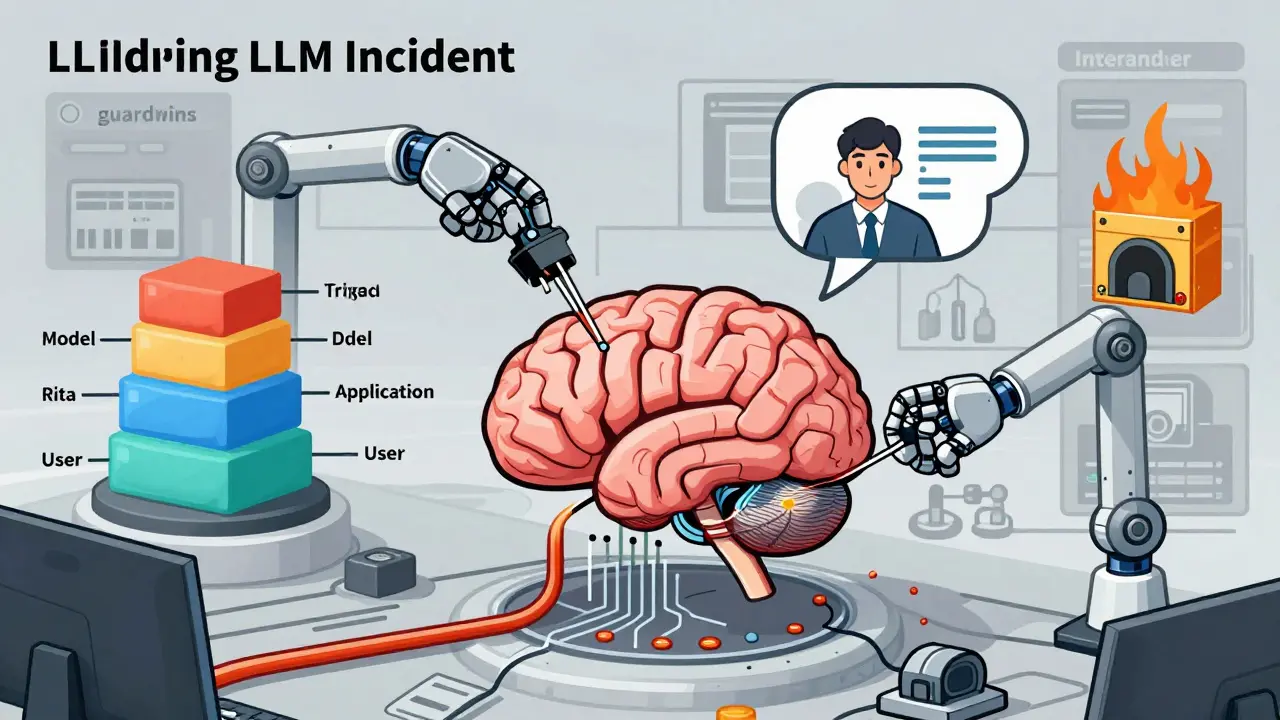
Containment: Cutting Off the Bleeding
When a harmful output is confirmed, you must act fast to limit damage. Containment strategies vary depending on where the breach originated-model layer, application layer, or data layer.
| Layer | Action | Use Case |
|---|---|---|
| Model | Disable endpoint or switch to fallback model | Widespread generation of toxic content or jailbreaks |
| Application | Disable plugins/connectors, revoke API keys | Unauthorized tool usage or data exfiltration via integrations |
| Data | Isolate affected indexes/buckets, restrict access | Compromised fine-tuning datasets or vector stores |
| User | Rate limiting, blocking malicious IPs/accounts | Targeted attacks from specific bad actors |
Crucially, define clear authorization structures beforehand. Who has the power to pull the plug? In high-stakes scenarios, responders need authority to cut connections immediately, even if it disrupts business workflows. Don't wait for committee approval during an active data leak. Implement stricter guardrails temporarily, roll back to a previous safe model version, or block specific prompt classes until the root cause is identified.
Forensic Investigation: Finding the Root Cause
Containment stops the bleeding; forensics finds the wound. You must reconstruct the complete attack chain to prevent recurrence. Gather all relevant data: offending prompts, outputs, user context, model versions, system logs, and guardrail records.
Analyze whether the incident resulted from:
- Adversarial Prompts: Clever jailbreaks or prompt injections exploiting model vulnerabilities.
- Contextual Triggers: Specific conversational flows that confused the model's safety alignment.
- Compromised Data: Poisoned fine-tuning datasets or insecure retrieval sources (RAG systems).
- Access Control Flaws: Weak authentication allowing unauthorized tool execution.
For RAG (Retrieval-Augmented Generation) systems, check if external data sources were tampered with. Secure integration requires encrypting transmissions, authenticating sources, and continuously monitoring inputs for malicious changes. If secrets were exposed, rotate all affected credentials immediately. Verify configuration states using cryptographic checksums to ensure no hidden manipulations remain.
Recovery & Remediation: Patching the Hole
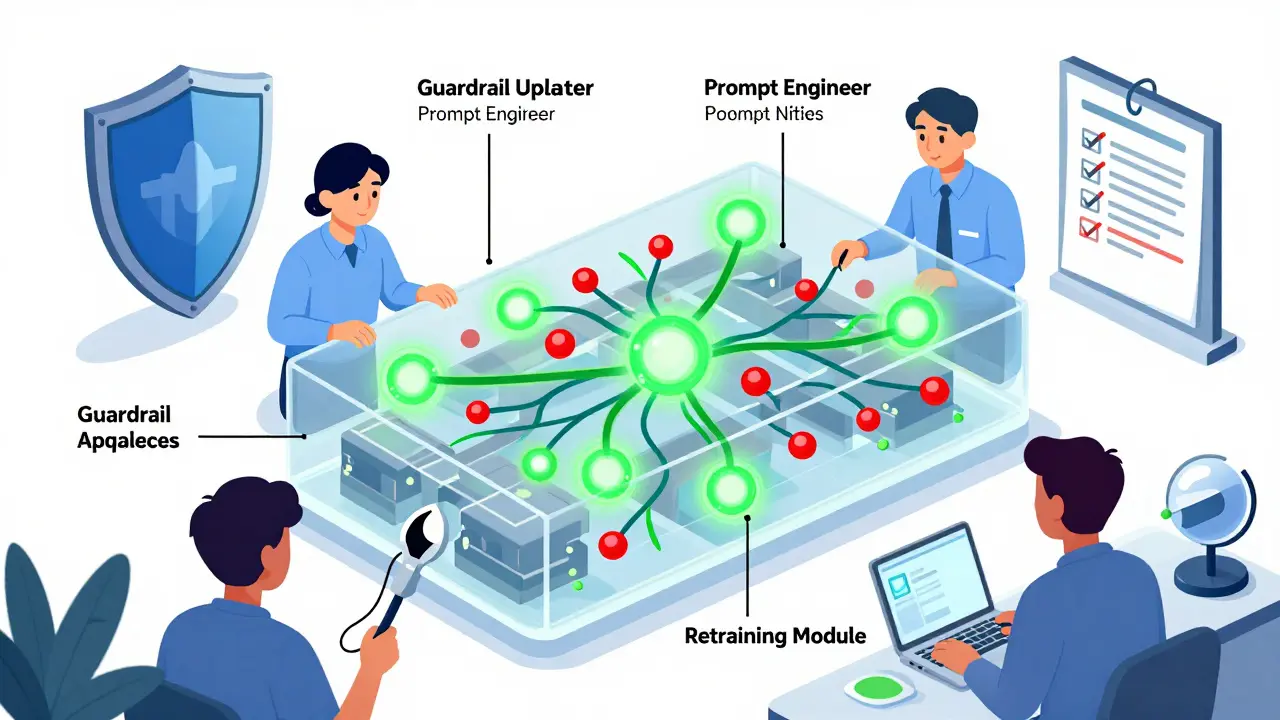
Fixing the issue involves three primary pathways, often used in combination:
1. Guardrail Improvements
Update input sanitizers, output filters, and topic classifiers based on the specific attack vector. This is usually the fastest remediation path. If attackers used Base64 encoding to bypass filters, add detection rules for encoded strings. Remember, attackers adapt, so your defenses must evolve too.
2. Prompt Engineering
Modify system prompts or user templates to guide the model away from unsafe behaviors. Clearer instructions can reduce ambiguity that leads to hallucinations or policy violations. However, this doesn't fix underlying model weaknesses-it only masks them.
3. Model Patching & Retraining
For deep-seated issues, you may need parameter editing to suppress specific behaviors or retrain the model on cleaner data. Be cautious: direct model edits can have unintended side effects. Always test patches in isolated environments before deploying to production.
Implement technical hardening measures: sandbox tool execution environments to prevent privilege escalation, enforce output validation before user delivery, and require human review for high-risk categories like legal text, code changes, or payment instructions.
Building a Resilient Culture
Technology alone won't save you. Incident response for LLMs requires a cultural shift. Train teams to recognize AI-specific threats. Encourage users to report problematic interactions through clear feedback channels. Label AI-generated content transparently to maintain trust.
Regular red-teaming exercises simulate attacks to uncover vulnerabilities before real hackers do. Align your efforts with frameworks like OWASP Top 10 for LLMs and MITRE ATT&CK to stay ahead of emerging tactics. Remember, perfect safety is impossible. Your goal is resilience-the ability to detect, respond, and recover quickly when things go wrong.
What is the difference between traditional cybersecurity incident response and LLM incident response?
Traditional response focuses on malware, server outages, or network breaches with clear binary states (infected/clean). LLM response deals with probabilistic outputs, semantic manipulation, and silent failures like bias or misinformation. Damage comes from data leakage via vulnerable connectors, prompt injection gaining unauthorized access, or employees acting on manipulated outputs without verification.
How can I detect prompt injection attacks early?
Combine content classifiers with rule-based filtering and anomaly scoring. Look for repeated patterns characteristic of injection attempts, unusual spikes in tool use, requests forcing the model to reveal system prompts, or abnormal API behavior. Avoid relying solely on keywords, as attackers easily rephrase malicious intent.
What should I do immediately after detecting a harmful LLM output?
First, triage to confirm severity and scope. Then, contain the incident by disabling the affected model endpoint, switching to a safe fallback, or blocking specific prompt classes. Revoke compromised API keys and isolate affected data sources. Do not delay containment waiting for full investigation.
Can automated tools fully handle LLM incident response?
Not yet. While lightweight LLMs trained on historical incidents can assist with analysis and reduce hallucination errors, human oversight remains critical for complex forensic investigations and ethical decisions regarding containment and recovery. Automation supports speed, but humans provide judgment.
How do I prevent bias-related incidents in my LLM deployment?
Implement rigorous pre-deployment auditing using diverse test datasets. Continuously monitor outputs for discriminatory language or unfair treatment. Use guardrails to flag potentially biased content for human review. Regularly update training data to reflect inclusive perspectives and address identified gaps in model alignment.