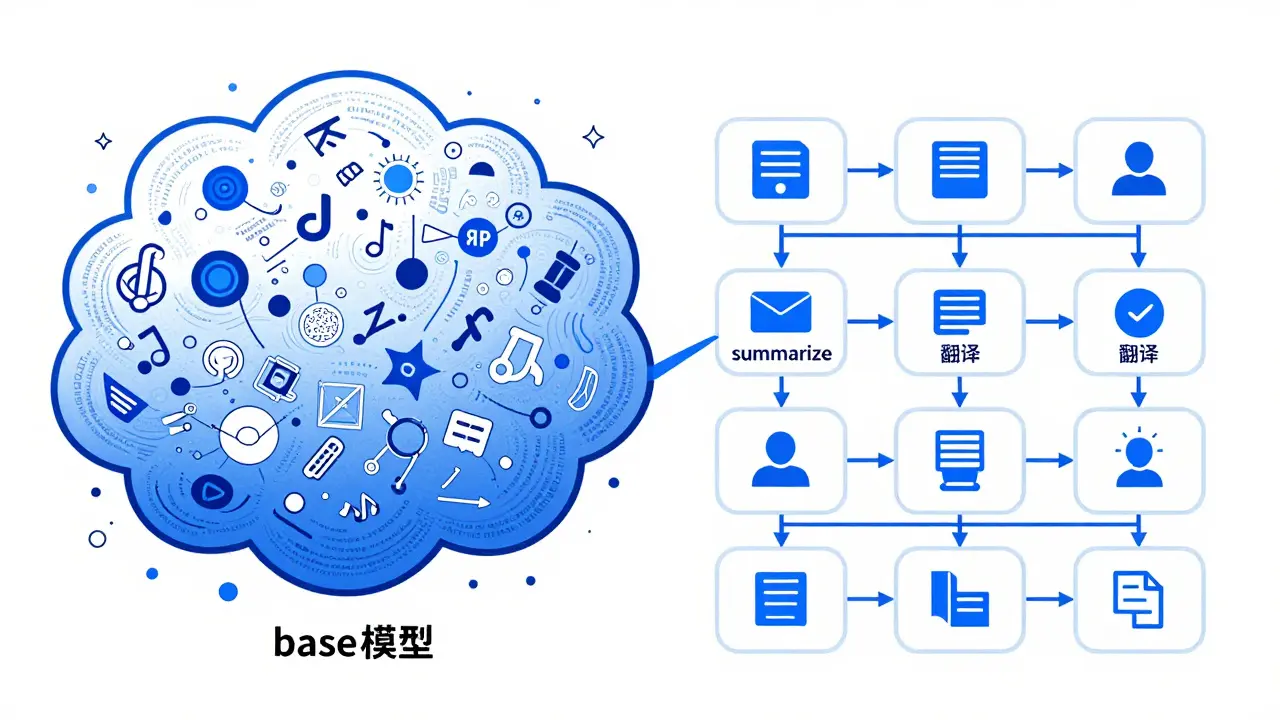
You’ve probably noticed the difference between talking to a raw, base model and chatting with a polished assistant like ChatGPT or Claude. The base model knows everything but acts like a chaotic encyclopedia-it just predicts the next word without caring if you asked it to summarize, translate, or write code. The polished assistant, however, listens. It follows your rules. It respects your constraints. That magic trick isn’t magic at all. It’s called instruction tuning.
If you are building an AI application in 2026, relying on a pre-trained base model is rarely enough. You need the model to do exactly what you say, not just what it thinks sounds good. Instruction tuning is the process that transforms a generic language engine into a reliable employee. It bridges the gap between raw intelligence and useful behavior.
What Actually Is Instruction Tuning?
Think of a base Large Language Model (LLM) as a brilliant but directionless student. They have read every book in the library, but they don’t know how to take a test. If you ask them "Explain quantum physics," they might give you a lecture, a poem, or a list of equations depending on their mood. Instruction teaching teaches them the format of the exam.
Technically, instruction tuning involves fine-tuning a pre-trained model on a dataset composed of specific instructions and their corresponding correct outputs. Instead of training the model to predict the next word in a sentence (next-token prediction), we train it to map a natural language command to a specific response structure. This shifts the model’s objective from "predict text" to "follow directions."
The result? A model that understands nuance. When you say "Summarize this in three bullet points," an instruction-tuned model doesn’t just summarize; it counts the bullets. It adheres to the constraint because that pattern was reinforced thousands of times during its training phase.
Why Base Models Aren't Enough Anymore
In early 2024, many developers tried to use base models directly for enterprise applications. The results were frustrating. Users reported high rates of irrelevant responses and formatting errors. According to data tracked by OneUptime through Q3 2025, enterprises using base models saw significantly higher customer complaint rates compared to those using instruction-tuned versions.
Consider a real-world scenario: a customer service chatbot. A base model might answer a query about shipping delays with a generic apology. An instruction-tuned model, trained on your specific company policies, will provide the exact tracking link, reference the delay reason from your database, and maintain your brand’s tone. Dr. Jane Chen, an NLP researcher at Stanford University, notes that instruction tuning reduces the semantic gap between user intent and model response by 40-60%. That’s not a small margin; it’s the difference between a usable product and a toy.
Furthermore, hallucinations-those confident but wrong answers-are less frequent in tuned models. A comprehensive survey published in the ACM Digital Library in January 2025 found that instruction-tuned models reduce hallucination rates by approximately 28% on average. In factual question-answering scenarios, this improvement jumps to 45%. For businesses where accuracy is non-negotiable, this metric alone justifies the investment in tuning.
Instruction Tuning vs. Multi-Task Fine-Tuning
It’s easy to confuse instruction tuning with multi-task fine-tuning, but they serve different masters. Multi-task fine-tuning optimizes a model for a fixed set of predefined tasks, like sentiment analysis or named entity recognition. It’s specialized. Instruction tuning teaches generalization. It prepares the model to handle novel instructions it hasn’t seen before.
| Feature | Multi-Task Fine-Tuning | Instruction Tuning |
|---|---|---|
| Goal | Specialization in specific tasks | Generalization across diverse prompts |
| Flexibility | Low (fails on unseen tasks) | High (adapts to new instructions) |
| Accuracy Trade-off | Higher accuracy on defined tasks (95%+) | Slightly lower on specific tasks, better overall utility |
| Best Use Case | Closed systems, API endpoints | Chatbots, assistants, open-ended queries |
Here is the trade-off: An instruction-tuned model might achieve 85-90% accuracy across 50 diverse tasks, while a multi-task fine-tuned model could hit 95%+ on its five specialized tasks but fail completely on anything else. In 2025, 78% of enterprise LLM deployments incorporated instruction tuning because businesses realized they needed adaptable assistants, not rigid calculators.

The Technical Workflow: From Data to Deployment
Implementing instruction tuning isn’t just about running a script. It requires a structured workflow involving data collection, model adjustment, and rigorous evaluation. Here is how professionals approach it today.
1. Curating High-Quality Data
The old rule was "more data is better." The new rule, emerging strongly in 2025 and 2026, is "better data is better." You don’t need millions of noisy examples. Recent studies show that carefully curated sets of just 1,000 to 2,000 high-quality instruction-output pairs can outperform larger, messy datasets. Each entry must consist of a clear natural language instruction and an accurate, well-structured output.
Common pitfalls include dataset bias. If your training data only contains formal business emails, your model will struggle when a user asks for a casual joke. Ensure your instruction distribution matches your real-world usage patterns.
2. Efficient Parameter Updates with LoRA
Full fine-tuning used to require massive clusters of GPUs and weeks of compute time. That changed with Low Rank Adaptation (LoRA). LoRA freezes the pre-trained model’s weights and injects trainable low-rank matrices into the transformer layers. This means you only update a tiny fraction of parameters-typically 0.1% to 1%-while maintaining performance close to full fine-tuning.
This efficiency is game-changing. LoRA reduces GPU memory requirements from 80+ GB to just 24-32 GB. This makes instruction tuning feasible on a single high-end consumer GPU, democratizing access for smaller teams and startups. If you are starting out, LoRA is your best friend.
3. Response Rewriting and Self-Distillation
Newer techniques like Self-Distillation Fine-Tuning (SDFT) and SCAR (Self-Correction via Alignment Refinement) are gaining traction. These methods involve the model generating its own responses and then rewriting them to better align with its pre-trained distribution or human preferences. DeepMind’s release of SCAR 2.0 in January 2026 improved response rewriting quality by 22%, reducing the need for massive manual datasets. This automated loop cuts dataset creation costs by up to 63%, according to Openstream.ai.
Challenges and Limitations to Watch
Instruction tuning is powerful, but it’s not a silver bullet. You need to be aware of two major risks: catastrophic forgetting and over-rigidity.
Catastrophic Forgetting: When you fine-tune a model heavily on specific instructions, it can lose its general knowledge. It might become great at summarizing but terrible at basic math. SDFT techniques have helped reduce this issue by approximately 37%, but you still need to monitor general capabilities during evaluation.
Over-Rigidity: Professor Michael Collins of MIT points out that instruction-tuned models can sometimes apply instruction-following patterns inappropriately. If a user makes a typo in their prompt, a highly tuned model might refuse to answer rather than guess the intent, prioritizing literal adherence over helpfulness. Toloka AI’s 2025 user experience report documented this in 18% of negative feedback cases. Users complained that models were too robotic, refusing to deviate from strict formatting even when flexibility would have been more polite.
Additionally, there is a computational cost. Instruction-tuned models typically require 15-25% more inference time than base models because they perform additional cognitive steps to interpret the instruction before generating the response. For latency-sensitive applications, this needs to be factored into your architecture.
The Future: Dynamic and Personalized Tuning
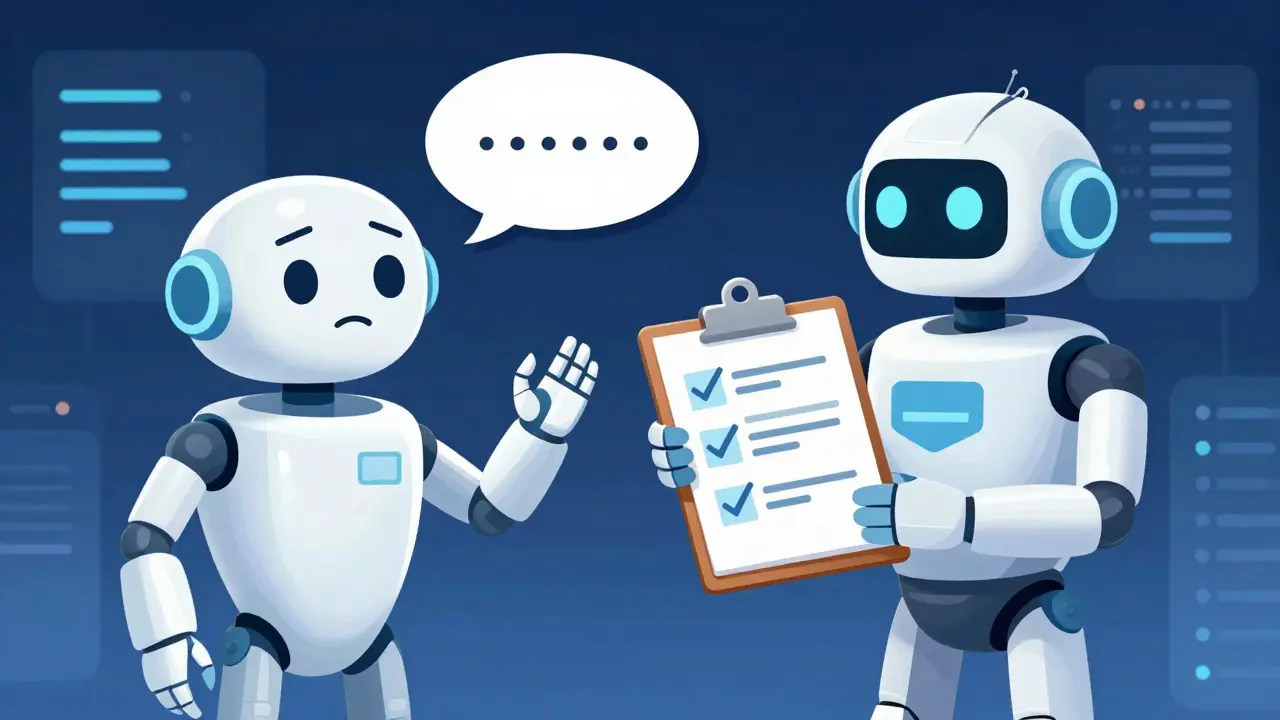
We are moving beyond static tuning. The current frontier is dynamic instruction tuning, where models adapt to individual user preferences in real-time. Google Research announced Project Echo in December 2025, aiming to develop capabilities for enterprise applications that learn user style on the fly. By 2027, analysts predict that 90% of commercial LLM applications will incorporate some form of adaptive instruction tuning.
Another trend is "instruction-aware" pre-training. Future base models may incorporate instruction-following capabilities from day one, blurring the line between pre-training and fine-tuning. However, the tension between reliability and creativity remains. Toloka AI forecasts that balancing these two forces will drive 35% of NLP research funding through 2027.
Getting Started: A Practical Checklist
If you are ready to implement instruction tuning for your project, here is a streamlined path:
- Define Your Scope: Identify the top 10-20 types of instructions your users will give. Don’t try to tune for everything at once.
- Collect Seed Data: Start with 1,000-2,000 high-quality examples. Use humans for the first batch to ensure quality.
- Choose Your Framework: Hugging Face’s Transformers library is the industry standard, rated 4.3/5 stars for its documentation. Consider using LoRA adapters for efficiency.
- Train Iteratively: Run short training cycles. Evaluate frequently. Look for signs of catastrophic forgetting.
- Test for Rigidity: Deliberately break your prompts. Add typos, change formats, and see if the model adapts or crashes.
- Deploy with Monitoring: Track user satisfaction scores. Aim for the 32% improvement benchmark seen in successful enterprise deployments.
Instruction tuning is no longer optional for serious AI builders. It is the bridge between a smart model and a useful tool. By focusing on quality data, efficient techniques like LoRA, and careful evaluation, you can build AI followers that truly understand and execute your vision.
How much data do I need for effective instruction tuning?
Contrary to older beliefs, you do not need millions of examples. Recent advancements in data filtering show that 1,000 to 2,000 high-quality, diverse instruction-output pairs can often outperform larger, noisy datasets. Quality matters far more than quantity. Focus on covering a wide range of tasks and formats within your target domain.
Can I do instruction tuning on a single GPU?
Yes, if you use parameter-efficient fine-tuning methods like Low Rank Adaptation (LoRA). Full fine-tuning typically requires 80+ GB of VRAM, but LoRA reduces this requirement to 24-32 GB, making it possible to run on high-end consumer GPUs like the NVIDIA RTX 4090. This has democratized access to custom model tuning for smaller teams.
What is the difference between instruction tuning and RLHF?
Instruction tuning uses supervised learning on instruction-response pairs to teach the model how to follow commands. Reinforcement Learning from Human Feedback (RLHF) comes after instruction tuning and uses reward models to align the model’s outputs with human preferences, such as safety, tone, and helpfulness. Instruction tuning builds capability; RLHF refines behavior.
Does instruction tuning make the model slower?
Slightly. Instruction-tuned models typically require 15-25% more inference time than base models. This is because the model performs additional processing steps to interpret the instruction and adhere to constraints before generating the final response. For most applications, this latency increase is negligible, but it should be considered for real-time, high-throughput systems.
How do I prevent catastrophic forgetting during tuning?
Catastrophic forgetting occurs when a model loses general knowledge while learning specific tasks. To mitigate this, include a mix of general knowledge questions in your training dataset alongside your specific instructions. Additionally, techniques like Self-Distillation Fine-Tuning (SDFT) help preserve the model’s original capabilities by ensuring new outputs remain consistent with the pre-trained model’s distribution.