
You just got the bill for your AI integration, and it’s higher than you expected. Maybe a rogue agent looped three times too many, or perhaps a simple query triggered a premium model when a basic one would have sufficed. This isn't just an accounting headache; it's a strategic failure in Cost Management for Large Language Models. As we move through 2026, managing these expenses has shifted from a niche engineering concern to a core business function. The era of "just throw compute at it" is over. Now, success depends on understanding the intricate web of token budgets, pricing tiers, and architectural choices that dictate whether your AI project scales profitably or bleeds cash.
The Shift from Pilot to Production Economics
Two years ago, most companies were happy just getting a chatbot to work. Today, enterprises are scaling beyond pilot phases, and the financial reality hits hard. According to research from Andreessen Horowitz in early 2025, token costs dropped by over 70% in a single year. Sounds great, right? But here is the catch: volume exploded faster than prices fell. If you aren't tracking spend per outcome, those savings vanish into inefficient usage. The industry standardized around token-based pricing starting in late 2023. OpenAI set the template, and competitors like Anthropic and Google followed suit. By Q1 2026, this model dominates, used by 87% of commercial providers. But relying solely on per-token rates without a governance framework is dangerous. Organizations that implement strategic cost management see 3.2x higher ROI on their AI investments compared to those treating AI costs as ad-hoc operational expenses. You need to treat tokens like currency-budget them, track them, and optimize their exchange rate against business value.
Decoding the Pricing Landscape: Tokens vs. Subscriptions
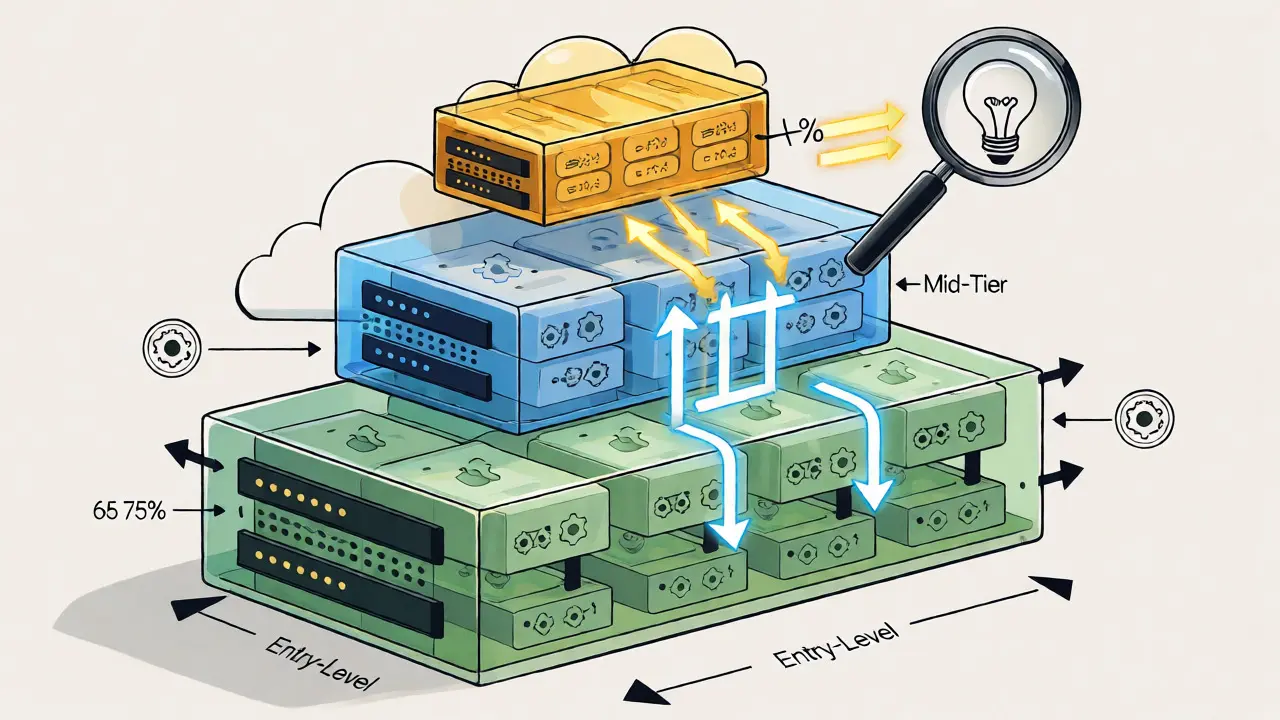
Most developers understand tokens: roughly 750 words equal 1,000 tokens in English. But pricing structures vary wildly. Currently, the market splits into three distinct tiers:
- Entry-Level: Models like GPT-3.5 Turbo or Claude Haiku average $0.50-$2.00 per million tokens. Great for high-volume, low-complexity tasks.
- Mid-Tier: GPT-4 and Claude Sonnet range from $3-$15 per million input tokens. These handle nuanced reasoning but require careful monitoring.
- Premium: Top-tier models like GPT-4 Turbo or Gemini 1.5 Pro cost $7-$15 per million input tokens. Use these only when quality is non-negotiable.
| Provider/Model | Input Price ($/M Tokens) | Output Price ($/M Tokens) | Best Use Case |
|---|---|---|---|
| OpenAI GPT-4 Turbo | $10.00 | $30.00 | Complex reasoning, creative generation |
| Anthropic Claude 3 Opus | $15.00 | $75.00 | High-fidelity analysis, long context |
| Google Gemini 1.5 Pro | $7.00 | $21.00 | Multimodal tasks, large data sets |
| Meta Llama 3 (Hosted) | $0.60 - $1.20 | $0.80 - $1.60 | High-volume, standard queries |
Strategic Levers: How to Cut Costs Without Cutting Corners
You don’t have to choose between quality and cost. Smart architecture can slash bills by 25-50%. The biggest lever is model cascading. Instead of sending every request to the most expensive model, route 65-75% of requests to cheaper models first. Only escalate to premium models when confidence scores drop below a threshold. Ben Zhao, CTO of GetMonetizely, notes that this approach maintains 98% output quality while drastically reducing spend. Another powerful tool is caching. In many applications, users ask similar questions repeatedly. Implementing semantic caching can reduce effective costs by 15-25% because you pay zero tokens for repeated answers. A healthcare startup recently documented a 47% cost reduction simply by achieving a 63% cache hit rate on common queries. Don't ignore prompt engineering. Poorly written prompts consume 30-50% more tokens than necessary. This "prompt inflation" adds up fast. Standardize your templates. Use concise instructions. Set temperature parameters lower for factual tasks to prevent verbose, rambling outputs that waste output tokens. Every word you delete from the system prompt saves money on every single call.
Emerging Models: Per-Action and Specialized Premiums
Token counting isn't the only game in town. Some vendors are moving toward per-action pricing. Harvey AI, for instance, charges $15 per legal document review rather than counting tokens. This simplifies budgeting for non-technical teams who care about outcomes, not infrastructure metrics. However, beware: these models often carry a 20-35% premium over equivalent token-based calculations. You’re paying for convenience and guaranteed outcomes. Specialized models command even steeper premiums due to domain-specific training and compliance needs. BloombergGPT charges 3.2x standard rates for financial analysis, while Med-PaLM 2 costs 4.7x general model rates for medical applications. If you operate in regulated industries like finance or healthcare, these premiums are often justified by liability protection and accuracy requirements. But for general customer service or internal knowledge bases, sticking to general-purpose models with fine-tuning is usually more cost-effective.

Implementation Roadmap: From Chaos to Control
Setting up cost management isn't a one-time fix. It requires a structured approach. Most successful implementations follow three phases:
- Baseline Measurement (Weeks 1-4): Don't guess. Instrument your API calls to measure current cost-per-outcome. Identify which features drive the highest spend.
- Optimization (Weeks 5-12): Implement token budgets, caching layers, and model routing logic. Set hard limits per request to prevent runaway loops.
- Continuous Monitoring (Ongoing): Use automated alerts. AWS recommends triggering alerts at 80% and 95% of budget thresholds. Assign clear ownership of these budgets to product teams, not just IT.
The Future of AI Spend: Value-Based Pricing
We are seeing a shift from pure cost minimization to value-based allocation. Salesforce’s implementation of Einstein GPT increased marketing content ROI by 220% by aligning token budgets with business outcomes rather than just minimizing cost. The goal isn't to spend the least; it's to get the most value per dollar. Looking ahead, expect continued bifurcation. Commodity language tasks will likely fall below $0.25 per million tokens by 2027, driven by open-source adoption and efficient hardware like Groq’s LPU. Meanwhile, premium reasoning capabilities will hold steady at $5-$15 per million tokens. Regulatory pressure, such as the EU’s AI Act, is also forcing transparency. Providers must now break down costs per inference step, giving you better visibility into what you're actually buying.
What is a token in LLM pricing?
A token is the basic unit of text processing for large language models. It can be a word, part of a word, or punctuation mark. Roughly, 1,000 tokens equate to 750 words in English. Providers charge separately for input tokens (what you send) and output tokens (what the model generates).
How can I reduce LLM costs without losing quality?
Implement model cascading, where simple queries go to cheaper models and complex ones to premium models. Use semantic caching for repeated questions. Optimize prompts to remove unnecessary verbosity, which can save 15-25% in token usage.
Are subscription plans better than pay-as-you-go?
Subscriptions provide predictable costs and are ideal for steady, high-volume usage. Pay-as-you-go is better for variable or low-volume usage. Evaluate your traffic patterns; if you exceed your allotment frequently, subscriptions may become more expensive due to overage fees.
Why are specialized models more expensive?
Models like BloombergGPT or Med-PaLM 2 are trained on proprietary, domain-specific datasets and often meet strict regulatory compliance standards. This specialized training and validation process increases development costs, which are passed on to users via higher per-token rates.
What is prompt inflation?
Prompt inflation occurs when poorly engineered prompts use excessive words or redundant instructions, consuming 30-50% more tokens than necessary. This directly increases costs without improving output quality. Standardizing templates helps mitigate this issue.
Sherri Jones
October 19, 2026 AT 08:45This breakdown is incredibly helpful! 📊 The distinction between token-based pricing and subscription models is often overlooked. For anyone starting out, I highly recommend tracking your 'cost per outcome' rather than just total spend. It changes the entire perspective on ROI. Also, don't forget to check if your provider offers semantic caching options; that alone can save you a fortune on repetitive queries! 💡🚀