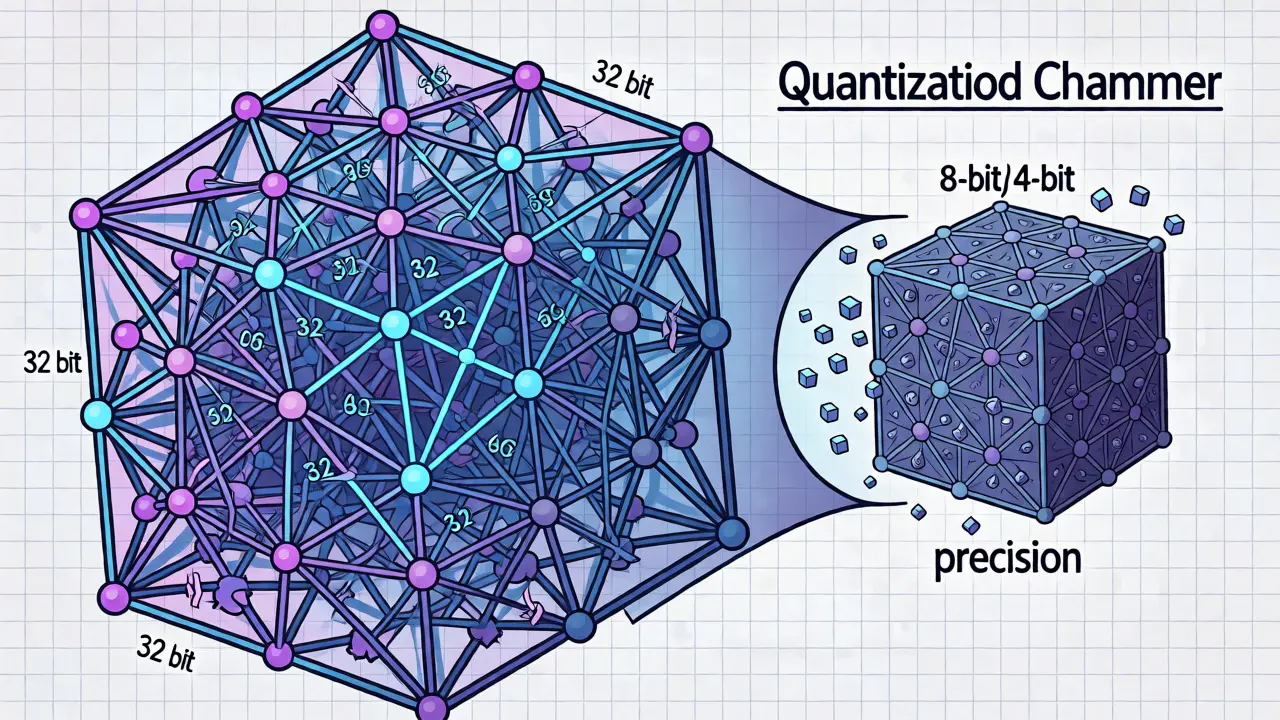
You spent weeks fine-tuning a 7-billion parameter Large Language Model. It performs beautifully on your benchmarks. Then you try to deploy it on a standard GPU or an edge device, and the memory usage crashes your infrastructure. You reach for Post-Training Quantization (PTQ) to shrink the model, but suddenly your chatbot starts hallucinating facts it knew perfectly before. This is the classic dilemma of modern AI deployment: size versus smarts.
Quantization-Aware Training (QAT) is the solution that lets you have both. Unlike PTQ, which chops off precision after training, QAT simulates the loss during training itself. The result? A model that learns to be accurate even when running on low-bit hardware. In late 2025, this technique has moved from academic novelty to industry standard, allowing developers to run massive models like LLaMA-30B on consumer hardware with minimal performance hit.
Why Standard Quantization Fails Big Models
Think about how neural networks process information. They rely on precise floating-point numbers to calculate weights and activations. When you compress a model using standard PTQ, you round these numbers down to integers (like 8-bit or 4-bit). For small computer vision models, this rounding error is negligible. But Large Language Models are different. They are sensitive to tiny numerical shifts because they rely on complex attention mechanisms and long context windows.
A 2018 paper by Jacob et al. at Google first outlined QAT for vision models, but it wasn't until 2022-2023 that teams at Meta AI and Google Research adapted it for LLMs. Why? Because once models crossed the 7-billion parameter threshold, PTQ started causing unacceptable degradation. You might see perplexity scores skyrocket, meaning the model becomes confused by its own output. QAT fixes this by inserting "fake quantization" nodes into the computation graph during backpropagation. The model sees the noise introduced by quantization and adjusts its weights to compensate for it.
The Mechanics of Data-Free Distillation
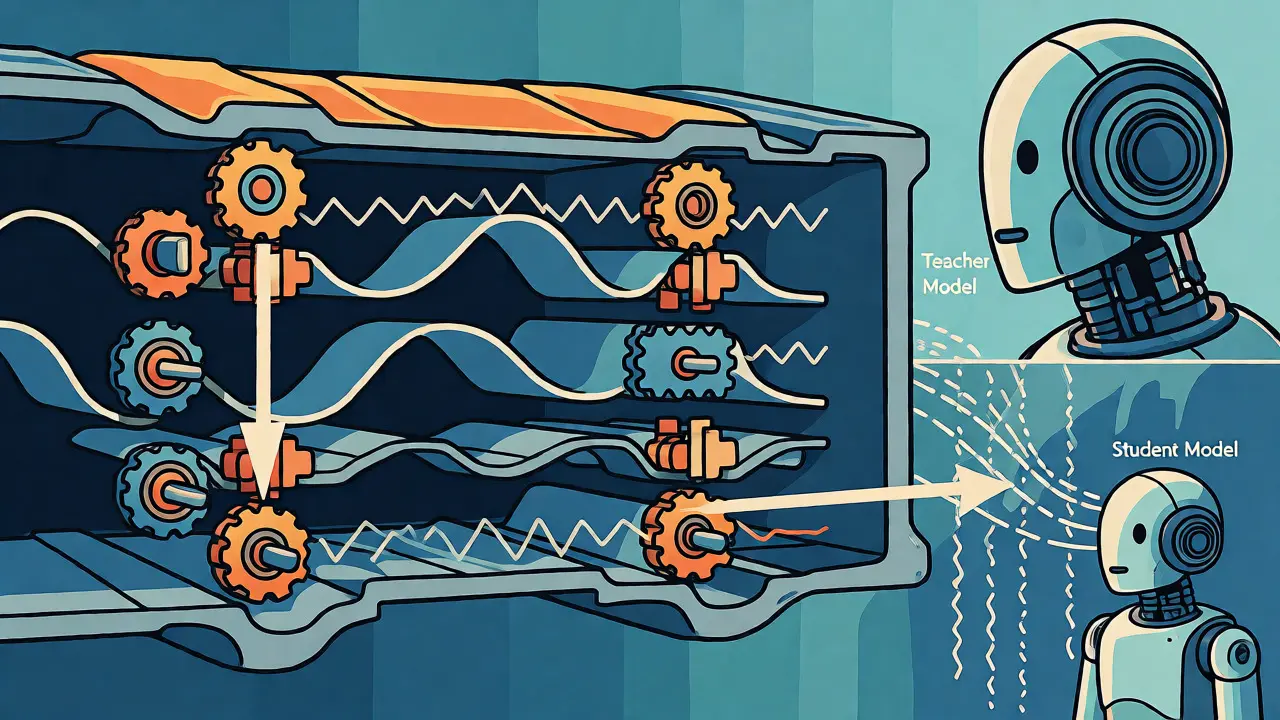
One of the biggest hurdles in traditional QAT was needing the original massive training dataset to retrain the model. Who has access to the full Common Crawl dataset just to tweak a few bits? Recent advancements, particularly from a 2024 ACL findings paper by You et al., introduced data-free distillation. This method uses the pre-trained model's own generations as synthetic training data.
Here is how it works in practice:
- Self-Generation: The high-precision teacher model generates text samples based on a small prompt set.
- Student Training: The quantized student model tries to match these outputs.
- KV Cache Handling: Crucially, modern implementations also quantize the Key-Value (KV) cache. For long sequences, the KV cache can consume 20-30% of inference memory. Ignoring it leads to bottlenecks. By quantizing the KV cache to 4-bit alongside weights, throughput improves by 37% for 8K sequence lengths.
This approach eliminates the dependency on proprietary training data, making QAT accessible to anyone with a single GPU cluster.
QAT vs. PTQ: A Performance Breakdown
Is the extra computational cost worth it? Let's look at the hard numbers. According to PyTorch’s 2024 documentation and benchmarking, QAT preserves up to 96% of the original model's accuracy on tasks like Hellaswag, compared to significant drops seen with PTQ. For Llama3-8B models quantized to 4-bit weights, QAT recovers 68% of the perplexity degradation that PTQ suffers from.
| Metric | Full Precision (FP16) | Post-Training Quantization (PTQ) | Quantization-Aware Training (QAT) |
|---|---|---|---|
| Memory Footprint | ~16 GB | ~4 GB (4-bit) | ~4 GB (4-bit) |
| MMLU Score (Accuracy) | Baseline (e.g., 64.1%) | Significant Drop (~55-58%) | Near Baseline (~63.2%) |
| Perplexity Recovery | 100% | Low (High Perplexity) | 68% Recovery vs PTQ |
| Training Time Cost | N/A | Minutes (Calibration only) | Hours (Fine-tuning required) |
| Long Context Throughput | Standard | Standard (No KV quant) | +37% Faster (With KV quant) |
The trade-off is clear: QAT takes longer. While PTQ requires only minutes of calibration, QAT demands hours of fine-tuning. However, the efficiency gains are substantial. EfficientQAT, a framework proposed by Chen et al. in 2024, reduced computational overhead by 63% compared to naive implementations by splitting training into block-wise and end-to-end phases.
Implementation Pitfalls and Best Practices
If you decide to implement QAT, don't expect it to work out of the box. Practitioners report a steep learning curve, often requiring 40-60 hours of dedicated study to master the nuances of tools like PyTorch torchao. Here are three critical pitfalls to avoid:
- Ignoring Layer Sensitivity: Not all layers react the same way to quantization. Research shows that skipping quantization for the first 3 and last 2 layers can improve WordPerplexity dramatically-from 6766 down to 30 on WikiText benchmarks. Always perform a sensitivity analysis first.
- Hyperparameter Fragility: QAT is sensitive to learning rates. Using AdamW with a learning rate of 2e-5 and cosine decay is a proven starting point. Linear decay often leads to instability.
- Neglecting the KV Cache: If you are deploying for long-context applications (like summarizing books), failing to quantize the KV cache will bottleneck your speed, regardless of how small your weights are.
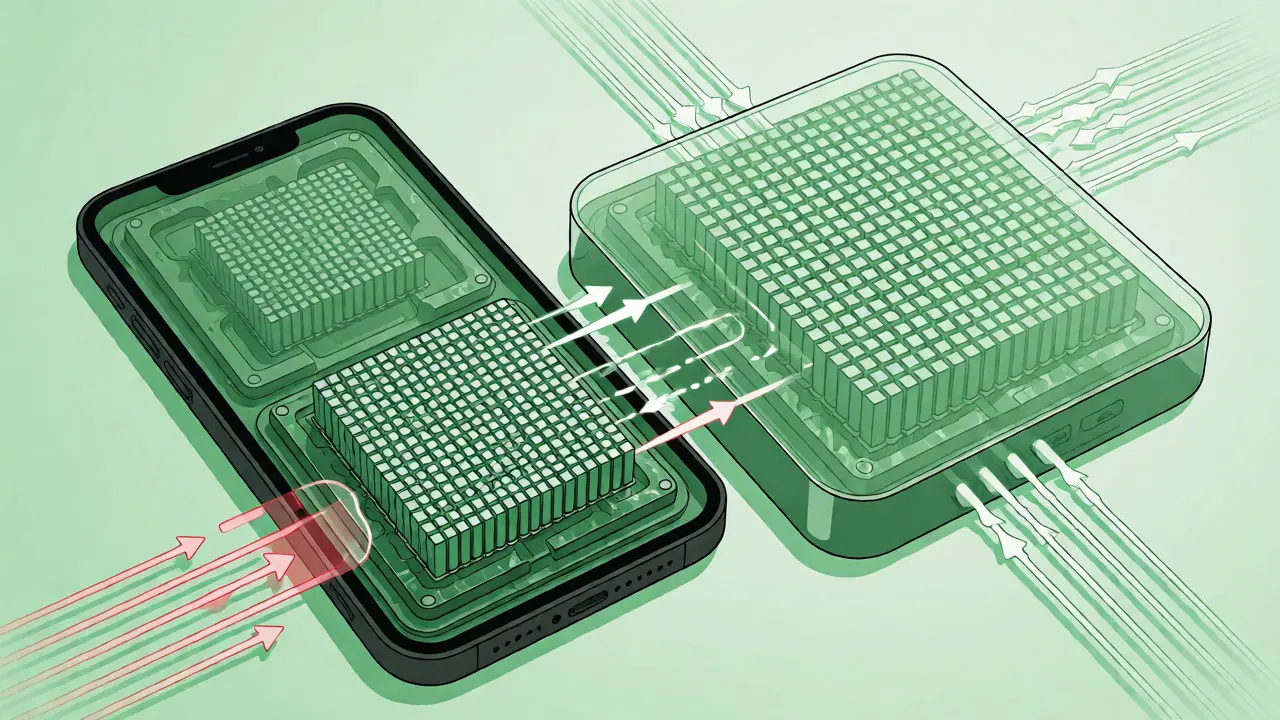
User feedback from Hugging Face forums highlights that while QAT enables deployment on devices like the Raspberry Pi 5, getting it right requires careful tuning. One developer noted that without proper layer selection, response quality dropped by 40% on custom benchmarks.
The Future of Edge Deployment
The market is shifting rapidly. As of late 2024, 37% of organizations using models over 7B parameters had adopted some form of QAT, up from just 12% earlier in the year. Cloud providers like AWS SageMaker and Google Cloud Vertex AI have integrated optimized QAT pipelines, recognizing that inference costs dominate the AI budget.
Looking ahead to 2026, analysts predict QAT will become standard practice for any LLM deployment above 3 billion parameters. Meta AI has already announced plans to integrate QAT directly into Llama training pipelines, potentially reducing the fine-tuning phase from hours to minutes. This shift makes high-quality AI accessible not just in data centers, but on your phone, your car, and your smart home devices.
Does QAT require more memory than PTQ?
Yes, during the training phase, QAT typically requires 2.5x more memory than Post-Training Quantization (PTQ) because it needs to store gradients and optimizer states for the simulated quantization nodes. However, the final deployed model size is identical to PTQ.
Can I use QAT for models smaller than 3 billion parameters?
Generally, no. For models under 3 billion parameters, PTQ usually achieves near-original accuracy without the heavy computational cost of QAT. QAT provides the most benefit for larger models where precision loss is more pronounced.
What is the main advantage of quantizing the KV cache?
Quantizing the Key-Value (KV) cache reduces memory usage during inference, especially for long sequences. Studies show this can improve throughput by 37% for 8K context windows, making real-time interaction with large contexts feasible on limited hardware.
Which frameworks support QAT for LLMs?
The leading frameworks are PyTorch's torchao (which holds a 43% market share), TensorFlow Model Optimization, and specialized libraries like Quanto and AutoGPTQ. Most major cloud platforms now offer managed QAT pipelines.
How long does QAT take compared to standard fine-tuning?
QAT generally takes approximately 1.8x longer than standard fine-tuning due to the additional computation required for simulating quantization effects. For a 7B model, this might mean 8-12 hours on 8x A100 GPUs.