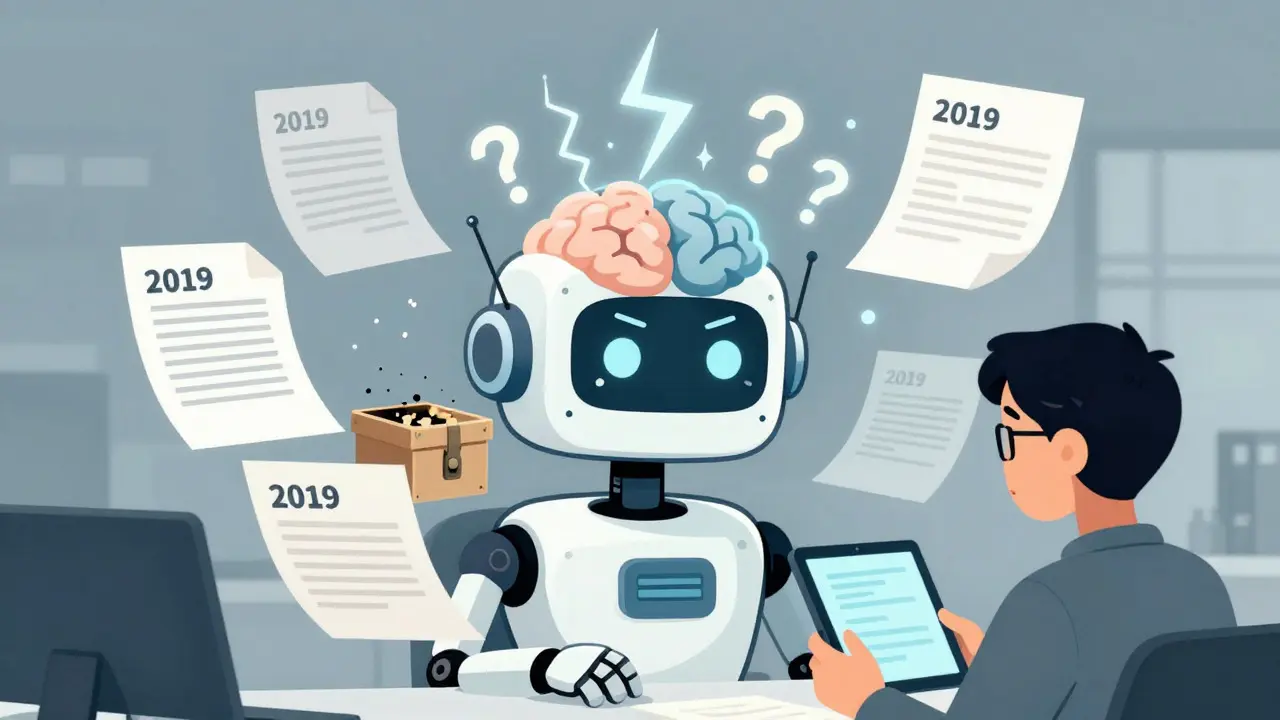
Imagine asking your AI assistant for the latest tax law change and getting a confident answer that cites a statute from 2019. That is the nightmare scenario for anyone deploying Generative AI in production environments. The core problem isn't just accuracy; it's trust. When large language models operate solely on static training data, they become static knowledge repositories. They don't know what happened yesterday, let alone last week. This gap leads to hallucinations, where the model invents facts to fill in blanks. To fix this, we need a way to ground those outputs in verified, up-to-date sources without retraining the entire model from scratch every time a new document arrives.
The solution is Retrieval-Augmented Generation (RAG). Developed by researchers at Meta AI, University College London, and New York University in 2020, RAG transforms how models process information. Instead of relying only on internal memory, the system first retrieves relevant documents from an external database, then uses that context to generate a response. Think of it like an open-book exam: the student (the LLM) can look up specific notes (retrieved documents) before answering the question. This approach reduces hallucination rates by 47-63% according to MIT’s 2023 benchmark study, making it the industry standard for trustworthy AI.
How the RAG Pipeline Works
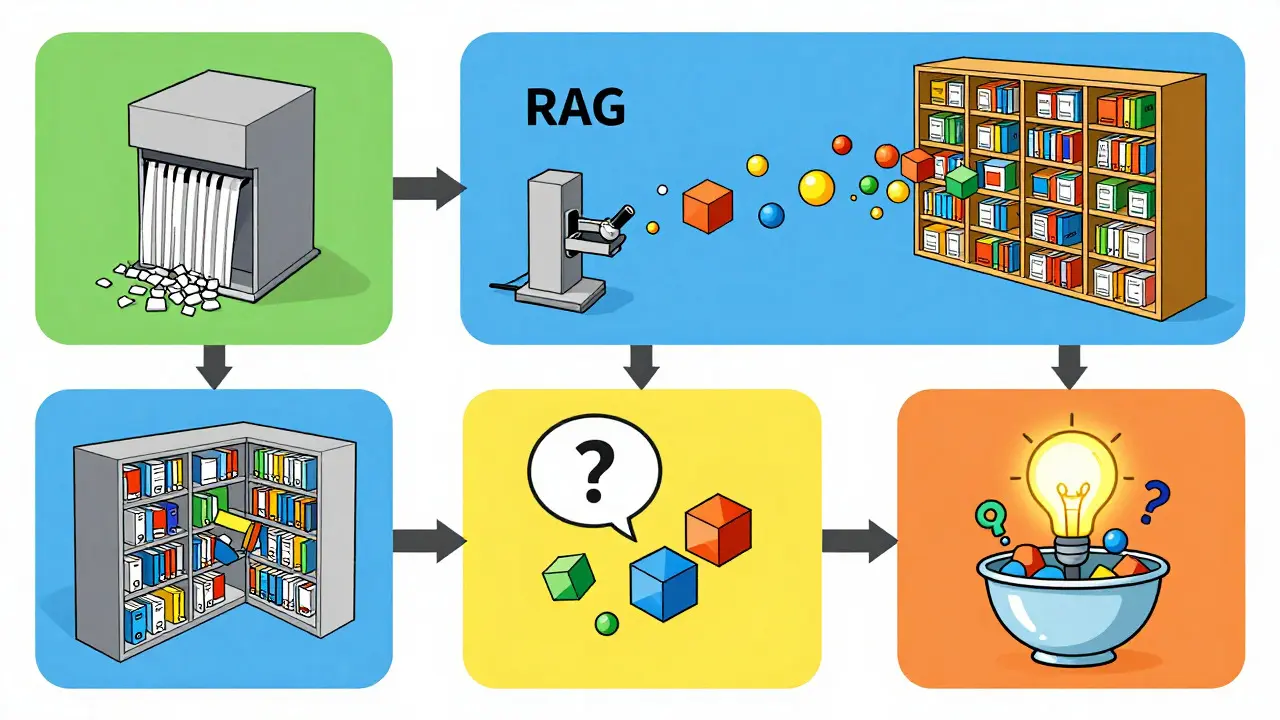
RAG isn't a single step; it's a four-stage pipeline that moves data from raw files to grounded answers. Understanding each stage helps you troubleshoot why your AI might be giving bad answers.
- Ingestion: Your documents (PDFs, web pages, internal wikis) are processed into smaller chunks. Typically, these chunks range from 256 to 512 tokens. Each chunk is converted into a vector embedding using models like OpenAI's text-embedding-3-large or Cohere's Embed Multilingual v3.0. These embeddings are mathematical representations of meaning, stored as 1024-dimensional vectors.
- Storage: These vectors live in a vector database. Popular options include Pinecone, Weaviate, and AWS OpenSearch. As of Q2 2025, systems like Pinecone can handle over 1.2 billion vectors per cluster, ensuring fast access even for massive datasets.
- Retrieval: When a user asks a question, the system converts that query into a vector too. It then performs a similarity search, often using algorithms like HNSW (Hierarchical Navigable Small World), to find the most relevant document chunks. A cosine similarity threshold of 0.78 or higher is commonly used to ensure high relevance.
- Generation: The top 3-5 retrieved chunks are combined with the user's original question into a prompt. An LLM, such as Anthropic's Claude 3.5 or Meta's Llama 3.1, reads this context and generates a final answer that cites or reflects the retrieved information.
This flow ensures that the generation phase is always informed by current, specific data rather than vague generalizations learned during pre-training.
RAG vs. Fine-Tuning: Which Approach Fits Your Needs?
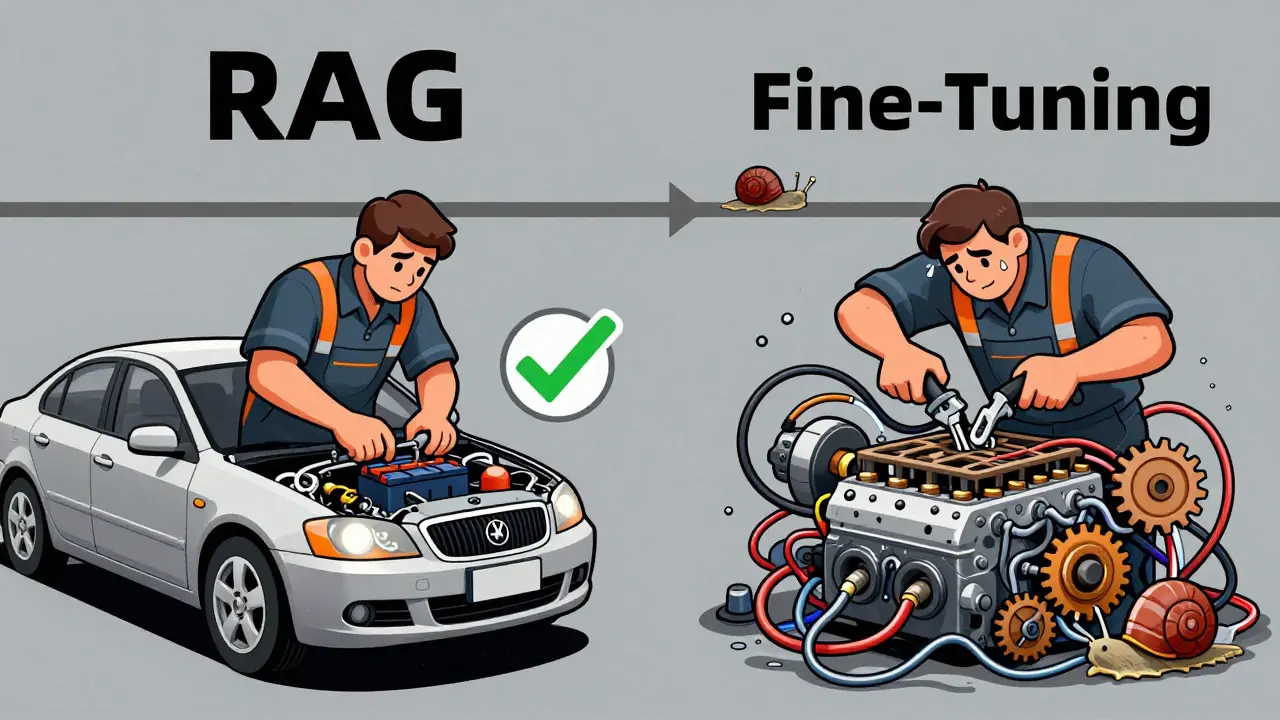
A common question is whether you should fine-tune your model or use RAG. Both have their place, but they solve different problems. Fine-tuning involves retraining the model on new data to change its underlying behavior or style. RAG, on the other hand, adds external knowledge at inference time.
| Feature | Retrieval-Augmented Generation (RAG) | Fine-Tuning |
|---|---|---|
| Cost per Iteration | 5-8% of fine-tuning costs | $50,000+ per model iteration |
| Knowledge Update Speed | Near real-time (minutes/hours) | Slow (days/weeks of retraining) |
| Best For | Frequent updates, factual queries | Domain-specific style, deep structural changes |
| Hallucination Risk | Lower (grounded in sources) | Moderate (depends on data quality) |
| Complex Reasoning | Weaker on multi-hop questions | Stronger on complex contextual logic |
If your data changes frequently-like financial regulations or product inventory-RAG wins because you just update the database. If you need the AI to speak in a very specific legal tone or understand obscure medical terminology deeply, fine-tuning might be necessary. However, for most enterprise applications involving document-heavy tasks, RAG offers a 23-37% cost advantage over pure fine-tuning solutions while maintaining higher freshness.
Key Technical Components and Tools
Building a robust RAG system requires selecting the right tools for each part of the pipeline. The choice of embedding model significantly impacts retrieval accuracy. For example, OpenAI's text-embedding-3-large achieves an 89.2% score on the MTEB benchmark, whereas many open-source alternatives hover around 83.7%. This difference matters when dealing with nuanced queries.
Vector databases form the backbone of storage. ChromaDB has captured 72% market share in the open-source space, making it a popular starting point for developers. For enterprise-scale needs, AWS OpenSearch supports 10,000 queries per second with 95ms latency, which is critical for customer-facing apps. Meanwhile, Pinecone remains a leader in managed services, handling billions of vectors seamlessly.
Don't overlook the importance of chunking strategies. Google's 2024 research validated that 256-512 token chunks work best for most use cases. Adding a 15-20% overlap between chunks improves context continuity by 28%, preventing the AI from missing key details that span across two sections of a document. Additionally, reranking techniques, such as Cohere's Rerank v3.0, can boost precision by 34% by refining the initial retrieval results before they reach the LLM.
Addressing Hallucinations and Trust Issues
While RAG drastically reduces hallucinations, it doesn't eliminate them entirely. Dr. Andrew Ng, founder of DeepLearning.AI, calls RAG "the single most effective technique for reducing hallucinations in production LLM systems today." But Professor Emily M. Bender of the University of Washington warns that RAG can create a "dangerous illusion of accuracy" if retrieval fails silently. In one Microsoft study, 18.7% of cited sources were misaligned with the generated content, meaning the AI cited a source that didn't actually support its claim.
To mitigate this, you need rigorous evaluation metrics. Track not just whether the answer is correct, but whether the retrieved context was actually relevant. Implementing citation tracking allows users to verify claims against the original source. Furthermore, monitor for "retrieval drift," where slightly altered queries pull irrelevant documents. This issue appears in 23% of negative reviews on Capterra, highlighting that query understanding is just as important as document indexing.
Implementation Challenges and Best Practices
Getting RAG working is easy; getting it working well is hard. The average learning curve for developers with NLP experience spans 6-8 weeks. Here are the most common pitfalls and how to avoid them:
- Context Overload: Stuffing too many retrieved chunks into the prompt can confuse the LLM. Limit input to the top 3-5 most relevant documents. Use reranking to filter out noise.
- Latency Issues: Retrieval adds processing time. A developer on Reddit reported latency jumping from 1.2s to 3.8s per query after implementing RAG. Optimize by using efficient vector search algorithms and caching frequent queries.
- Data Freshness: Vector databases aren't automatically updated. For time-sensitive applications, schedule nightly updates or use streaming ingestion methods to keep data current.
- Multi-modal Gaps: Only 32% of RAG systems currently support image-text integration. If your data includes diagrams or charts, consider hybrid approaches or wait for native multimodal support in upcoming models like GPT-5.
Security is another emerging concern. Carnegie Mellon University’s Security Lab demonstrated a 63% success rate in "retrieval poisoning" attacks, where adversaries manipulate knowledge bases to generate misleading outputs. Regularly audit your ingestion pipeline to prevent bad data from entering the vector store.
Market Adoption and Future Trajectories
RAG is no longer experimental. Gartner places it on the 'Plateau of Productivity,' with 78% of enterprises implementing it for customer service applications. The market is projected to reach $14.3 billion by 2027, growing at a compound annual rate of 42.7%. Financial institutions lead adoption at 68%, followed by government agencies at 81% and healthcare organizations at 53%.
Looking ahead, "agentic RAG" architectures are emerging. Pioneered by Microsoft's AutoGen, these systems use multiple AI agents to refine queries and validate retrieved information, reducing error rates by 29%. NVIDIA’s RAG-as-a-Service on DGX Cloud now offers 99.95% uptime with sub-800ms latency, making enterprise deployment more accessible. As models evolve, expect native multimodal RAG capabilities to become standard, allowing AI to ground responses in both text and visual data simultaneously.
For organizations ready to deploy, start small. Pick a specific use case with clear documentation, implement a basic RAG pipeline, and measure impact. The goal isn't just to reduce hallucinations, but to build a system where every answer can be traced back to a verified source. That transparency is what turns a chatbot into a reliable business tool.
What is the main benefit of using RAG over fine-tuning?
RAG allows for near-real-time knowledge updates without the high cost and time associated with retraining models. It is ideal for scenarios where data changes frequently, such as news, financial regulations, or product catalogs, offering significant cost savings compared to fine-tuning.
How does RAG reduce hallucinations in LLMs?
By providing the LLM with specific, relevant context from external sources before generating a response, RAG grounds the output in verified facts. This prevents the model from relying solely on its static training data, which may be outdated or incomplete, thereby reducing the likelihood of invented facts.
What are the typical hardware requirements for running RAG?
Small deployments can run with minimum 16GB RAM. Enterprise implementations typically require powerful GPUs like NVIDIA A100 (80GB VRAM) and network bandwidth of at least 1Gbps to handle high-volume vector searches and LLM inference efficiently.
Which vector databases are most popular for RAG implementations?
ChromaDB leads in open-source adoption with 72% market share. For cloud-native enterprise solutions, AWS OpenSearch and Pinecone are widely used due to their scalability and low-latency performance, capable of handling millions of vectors and thousands of queries per second.
What is 'retrieval drift' and how can it be mitigated?
Retrieval drift occurs when slight variations in user queries result in the retrieval of irrelevant documents. It can be mitigated by using hybrid search (combining keyword and vector search), implementing reranking models to refine results, and optimizing chunking strategies to improve semantic coherence.