
You have a great idea for a SaaS product, but you can't write a single line of code. For years, this was a brick wall. You either had to spend six months learning JavaScript or pay a developer thousands of dollars to build a prototype that might not even work. Now, we've entered the era of "vibe coding," where you describe the feeling, the logic, and the look of an app, and the AI handles the heavy lifting. But not all AI builders are created equal. If you're a non-developer, picking the wrong tool can lead to a frustrating afternoon of staring at a terminal screen you don't understand.
When choosing between Lovable is a chat-first AI full-stack engineer designed specifically to turn plain-language descriptions into production-ready web applications and Bolt.new is a browser-based AI code editor and IDE that generates full-stack applications with a focus on developer control , the difference isn't just in the features-it's in the philosophy. One wants to hide the complexity from you; the other wants to give you a cockpit to manage it.
The Non-Developer's Dilemma: Chat vs. Code
If you've never used a code editor, opening Bolt.new can feel like walking into a cockpit of a Boeing 747. You see a file tree, a terminal, and a code editor. While the AI does the work, the environment is built for people who know what a "package manager" or a "dependency" is. If something goes wrong, you're looking at a console log that looks like ancient Greek.
Lovable takes a completely different approach. It’s built for the non-technical founder. Instead of a code-first IDE, it uses a product-builder interface. You chat with the AI, it builds a feature, and you see it happen in real-time. If you don't like a button's color or a layout's spacing, you don't have to find the CSS file-you just use Visual Edits to point and click. It minimizes the cognitive load, meaning you spend your energy on the product logic rather than fighting with the tool.
Tech Stacks and the "Magic" Under the Hood
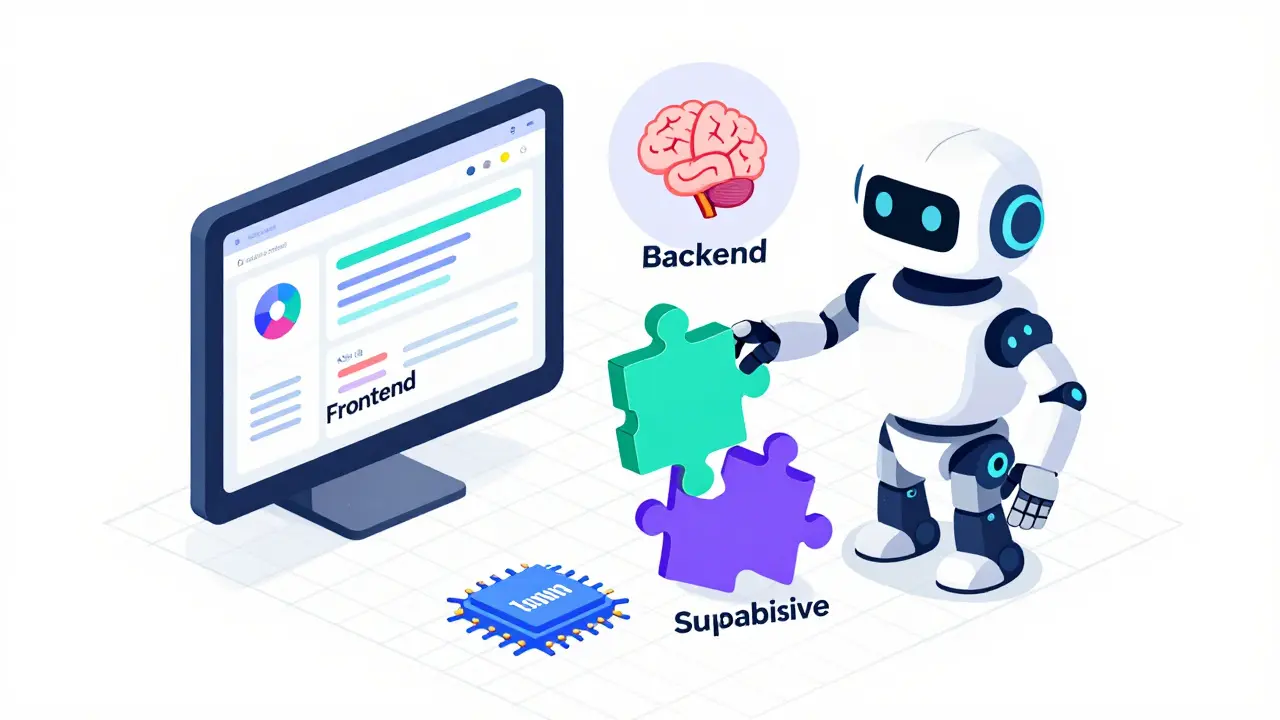
To make a functional app, you need three things: a frontend (what you see), a backend (the brain), and a database (the memory). Both platforms automate this, but they do it differently. vibe coding works best when the AI has a predictable environment to work in.
Lovable uses a curated, fixed stack. It relies on React, TypeScript, and Tailwind CSS for the look, and Supabase (which uses PostgreSQL) for the backend. Because Lovable is hyper-optimized for this specific combination, the code it produces is remarkably clean and organized. It's like a chef who only cooks Italian food-they might not do everything, but they do Italian perfectly.
Bolt.new is more of a generalist. It supports Next.js, Vue, Svelte, and Astro. This is a dream for a developer who has a preference, but for a non-developer, it's often just noise. Why choose between five frameworks when you just want your app to work?
| Feature | Lovable | Bolt.new |
|---|---|---|
| Primary Interface | Chat-first / Visual | IDE / Code-first |
| Learning Curve | Very Low (Hours) | Moderate (Days) |
| Backend Integration | Native Supabase (Deep) | Bolt Cloud / Flexible |
| Framework Choice | Fixed (Optimized) | Multiple (Flexible) |
| Collaboration | Multiplayer / GitHub Sync | Individual / Git based |
Speed to MVP: From Idea to Live URL
When you're validating a business idea, speed is the only metric that matters. Bolt.new is incredibly fast at scaffolding. If you prompt it to create a dashboard, it will spit out the files and the preview almost instantly. However, the "last mile"-getting the app to actually function with secure user logins and a database-can be a struggle for a non-coder in Bolt.new.
Lovable prioritizes the "production-ready" aspect. Because of its deep integration with Supabase Auth and Row Level Security (RLS), you can actually build a secure SaaS prototype in a single afternoon. You aren't just building a mockup; you're building a system where users can sign up, save data, and log out. For a non-technical founder, this is the difference between a fancy demo and a real business.
Collaboration and Growing Pains
What happens when your app gets too big for a single prompt? This is where the workflow diverges. Bolt.new requires you to manage a file tree. You have to tell the AI which file to edit or navigate the folder structure yourself. It's a professional workflow, but it's an obstacle for beginners.
Lovable introduces multiplayer collaboration. You and a teammate can work on the app together in real-time, similar to a Google Doc. Furthermore, its two-way GitHub synchronization means that if you eventually hire a professional developer, they can jump into the code via GitHub, make advanced changes, and those changes can flow back into the Lovable environment. You don't get locked into a proprietary "black box."
Pricing and Value Scaling
Both platforms use models that can get expensive as your project grows, but the way they charge differs. Bolt.new is great for quick experiments. However, as a project gains complexity, Lovable's credit-based model tends to scale better. A key advantage for non-developers is Lovable's "Visual Edits." If you just want to move a button or change a font, you can do it visually without burning through AI credits. In Bolt.new, almost every change is a prompt, which can eat your budget faster during the polishing phase.

When to Choose Which?
If you are a professional developer or someone who loves tinkering with the internals of a system, Bolt.new is your tool. The ability to switch AI models-like moving to Claude Opus 4.6 when a logic problem gets too complex-is a superpower that developers crave.
But if you are a founder, a marketer, or an entrepreneur who just wants to ship a product without becoming a full-time engineer, Lovable is the clear winner. It removes the friction between "I have an idea" and "Here is the link to my app." It doesn't just write code; it manages the product development process for you.
Can a complete beginner actually launch a business with Lovable?
Yes. Unlike basic AI generators that only provide a UI, Lovable integrates a full backend via Supabase. This means you can handle user authentication and data storage, which are the core requirements for any SaaS business, without writing the backend code yourself.
Is Bolt.new completely impossible for non-coders?
Not impossible, but it's harder. You will encounter technical terms like "npm install" or "deployment errors" in the terminal. If you are willing to learn the basics of how a file system works in web development, you can use it, but your progress will be slower than in a chat-first tool.
How does this compare to v0 by Vercel?
v0 is primarily a UI component generator. It's amazing for making a beautiful landing page or a specific button, but it doesn't provision a database or a full backend. Lovable and Bolt.new are "app builders," whereas v0 is more of a "component builder." If you need a functioning app with users, you'll need one of the latter two.
What happens if I want to move my app off these platforms?
Both allow you to export your code. Lovable's two-way GitHub sync makes this especially easy. Since they use standard technologies like React and Tailwind, any professional developer can take that code and host it on a traditional server or a cloud provider like AWS or Vercel.
Which one is faster for building a prototype?
For a visual mockup, Bolt.new is lightning fast. But for a functional MVP (Minimum Viable Product) that actually stores data and manages users, Lovable is faster because it removes the manual setup of the backend infrastructure.
Next Steps for Your Project
If you're still undecided, try this simple test: spend 30 minutes in both. If you find yourself instinctively trying to ignore the file tree and just "talk" to the app, go with Lovable. If you find yourself curious about why the AI chose a specific file structure or you want to tweak the package.json file, Bolt.new is your home. For most non-developers, the path to success is the one with the least amount of technical friction.
James Winter
April 14, 2026 AT 00:23Bolt.new is better. Stop pretending beginners need a hand-held experience.
Jennifer Kaiser
April 14, 2026 AT 14:50The real question is what happens to the human spirit when we stop struggling with the tools of creation. If the friction is gone, does the final product lose its soul? I think there's a profound value in that "frustrating afternoon" because that's where the actual learning happens and where the founder's vision is truly tested against reality.
TIARA SUKMA UTAMA
April 14, 2026 AT 22:13I tried Lovable. It's fast.
Jasmine Oey
April 16, 2026 AT 14:09Omg I totally agree that the vibe coding movement is just so revolutionary!!! Even if some people think it's too simple, like, who actually cares about a package manager when you can just manifest your app into existence? It's honestly just so much more elegant to just chat your way to a SaaS than to slog through some boring IDE that looks like it's from 1995 lol.
Cynthia Lamont
April 16, 2026 AT 17:00The grammar in this whole discussion is absolutely appalling. Also, calling it "vibe coding" is just a lazy way to describe prompt engineering. It's not a new philosophy, it's just a wrapper for existing LLMs. The claim that Lovable is "hyper-optimized" is a stretch at best. It's just a locked ecosystem!
Aimee Quenneville
April 17, 2026 AT 12:40lol imagine caring this much about a code editor... just use whatever makes you happy!!!!
Kirk Doherty
April 17, 2026 AT 17:02lovable seems chill for prototypes
Dmitriy Fedoseff
April 18, 2026 AT 22:01We must recognize that the democratization of technology is a double-edged sword. While these tools lower the barrier to entry, they risk creating a generation of creators who possess no fundamental understanding of the architecture they deploy. To build without knowing how to code is to build a house on sand, ignoring the timeless necessity of structural integrity and technical discipline in the pursuit of excellence.
Marissa Martin
April 20, 2026 AT 00:59I suppose it's fine if people want to take the easy route, though I personally feel it's a bit dishonest to call oneself a founder if you can't even explain how your database works.