It is easy to get lost in the hype when a new Generative AI model drops. The marketing slides are always shiny, claiming that the latest version can write poetry, solve complex math problems, and generate photorealistic images of cats wearing tuxedos. But how do we actually know if these claims hold water? You cannot trust a model just because it sounds confident. You need proof. That is where evaluation benchmarks come in.
Benchmarks are the standardized tests that measure what an AI model can truly do. They separate the models that genuinely understand concepts from those that are just good at guessing based on patterns they saw during training. As we move into late 2026, the landscape of these tests has shifted dramatically. We have moved past simple multiple-choice questions into sophisticated assessments of reasoning depth and visual fidelity. Understanding these metrics is no longer just for researchers; it is essential for anyone building or buying AI solutions.
The Evolution of Language Model Testing: From MMLU to MMLU-Pro
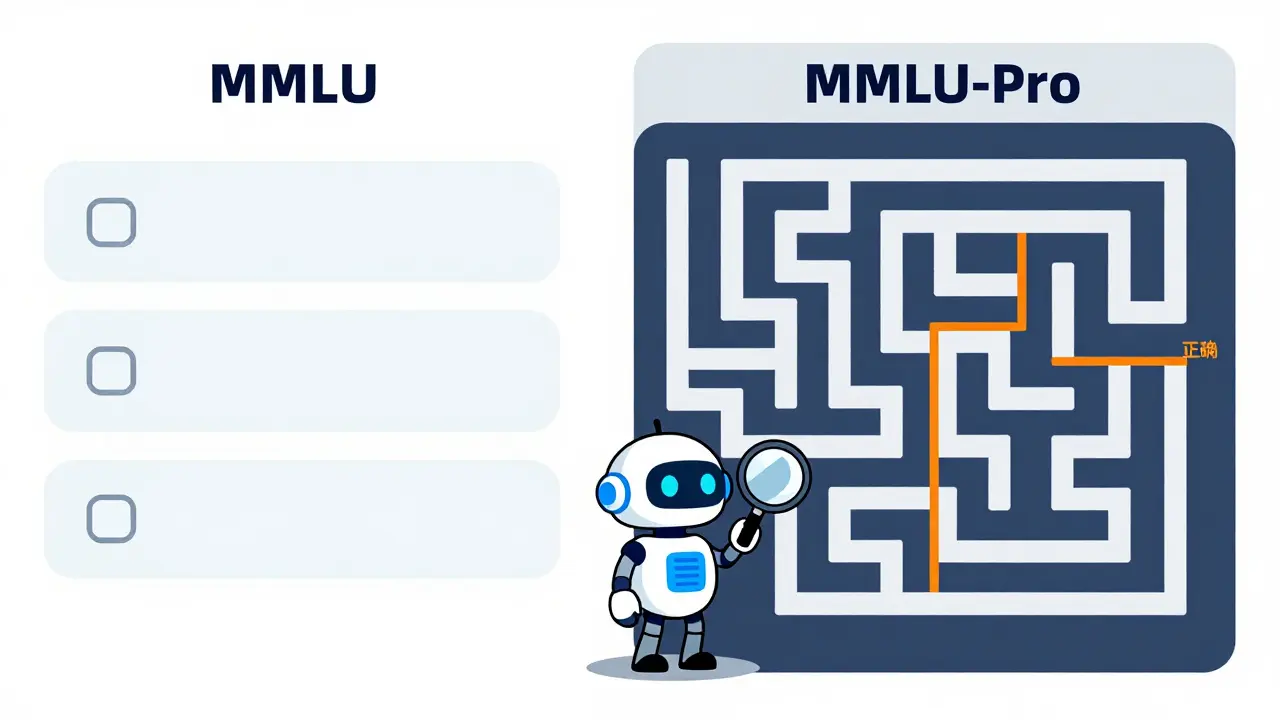
For years, the gold standard for testing language understanding was MMLU (Massive Multitask Language Understanding). Launched earlier in the decade, MMLU tested models across 57 subjects ranging from elementary mathematics to professional ethics. It provided a broad snapshot of general knowledge. However, as models improved, scores started to saturate. When every top-tier model scores above 85%, the benchmark loses its ability to tell you which one is actually better.
This saturation led to the creation of MMLU-Pro (An advanced variant of MMLU designed to reduce bias and increase difficulty). Released to address the limitations of the original, MMLU-Pro expanded the test significantly. Instead of four answer choices, it presents ten. This small change makes a massive difference. With four options, a model can guess correctly 25% of the time by pure chance. With ten options, random guessing drops to 10%. More importantly, it forces the model to engage in deeper reasoning rather than relying on surface-level keyword matching.
The data shows a stark contrast in performance. On the original MMLU, many frontier models clustered tightly together. On MMLU-Pro, the gaps widen. For example, while some models maintained high scores, others saw significant drops. A model like GPT-4 might score around 88.7% on standard MMLU but drop to roughly 72.6% on MMLU-Pro. This 16-point drop reveals that nearly a fifth of its previous "correct" answers were likely lucky guesses or pattern matches rather than true understanding. MMLU-Pro exposes the fragility of superficial intelligence.
Why Reasoning Matters More Than Recall
The shift from MMLU to MMLU-Pro highlights a critical trend in AI development: the value of reasoning over recall. Early large language models (LLMs) were essentially giant autocomplete engines. They predicted the next word based on statistical probability. If you asked them a question they had seen before, they could recite the answer perfectly. But if you changed the phrasing slightly, they often failed.
MMLU-Pro is designed to be robust against this kind of prompt sensitivity. Research indicates that MMLU-Pro shows only about 2% variance under different prompt variations, compared to much higher instability in older benchmarks. This means the results are reliable. If a model scores well on MMLU-Pro, it is because it understands the underlying logic, not because it memorized a specific question format.
This reliability is crucial for chain-of-thought prompting. In simpler tests, asking a model to "think step-by-step" sometimes hurt performance because the extra steps introduced errors. In MMLU-Pro, chain-of-thought consistently improves accuracy. This proves that the benchmark rewards genuine logical deduction. For developers, this signals that investing in reasoning capabilities is paying off. It is not enough for a model to know facts; it must be able to manipulate those facts logically to arrive at new conclusions.
| Model Example | MMLU Score (%) | MMLU-Pro Score (%) | Performance Drop | Reasoning Indicator |
|---|---|---|---|---|
| GPT-4 (Mixed) | 88.7% | 72.6% | -16.1% | High reliance on pattern matching |
| Llama 3 70B | 82.0% | 56.2% | -25.8% | Significant gap in deep reasoning |
| Claude Opus 4.5 | ~89% | ~89.5% | Minimal/Negative | Strong reasoning consistency |
Note that the exact scores vary by specific version and testing conditions, but the trend remains consistent: models with stronger architectural reasoning components suffer less degradation when moving to harder benchmarks. This metric helps buyers decide whether a model is suitable for complex tasks like legal analysis or code debugging, where a single wrong guess can be costly.
Beyond Text: Evaluating Image Fidelity and Multimodal Capabilities
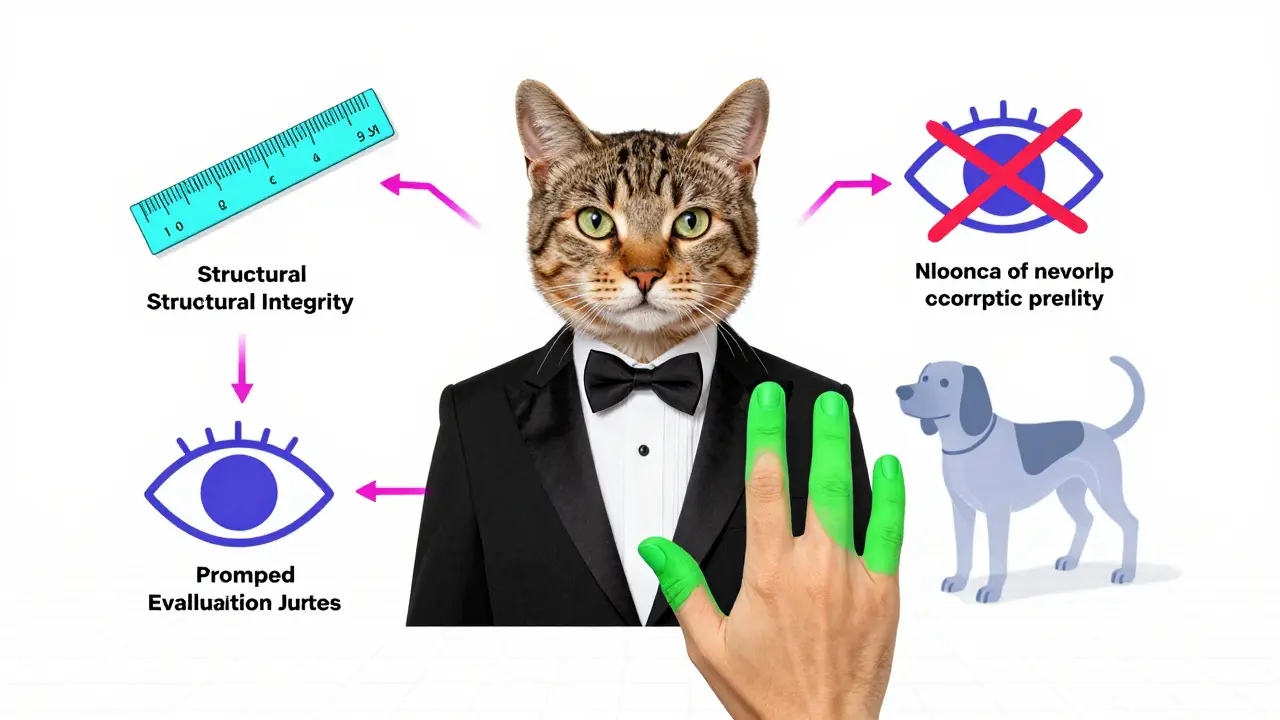
While MMLU dominates the text world, generative AI has exploded into other modalities. Image generation models like Midjourney, DALL-E 3, and Stable Diffusion 3 require entirely different evaluation frameworks. You cannot judge a picture with a multiple-choice test. Here, the focus shifts to Image Fidelity Metrics (Quantitative measures assessing the realism, detail, and structural integrity of generated images).
Historically, image quality was measured using metrics like FID (Fréchet Inception Distance). FID calculated the distance between the distribution of real images and generated images in a feature space. Lower FID scores meant the generated images looked more statistically similar to real photos. However, FID had a major flaw: it did not care about semantic correctness. An image could have a low FID score (looking realistic) but still contain nonsense, like a dog with six legs or text that was gibberish.
In 2026, the industry has largely moved toward human-aligned metrics and specialized perceptual evaluations. Tools now assess:
- Structural Integrity: Does the anatomy make sense? Are hands rendered with five fingers?
- Prompt Adherence: Did the model include all requested elements? If you asked for a red car, is it red?
- Aesthetic Quality: Is the lighting natural? Is the composition pleasing?
- Text Rendering: Can the model generate legible, correct text within the image?
Newer benchmarks use a combination of automated computer vision checks and crowdsourced human ratings. For instance, a model might pass an automated check for object presence but fail a human review for texture realism. This hybrid approach provides a more holistic view of image fidelity. It acknowledges that "realism" is subjective and context-dependent. A cartoon style does not need to look photorealistic, but it needs to be stylistically consistent.
The Problem of Data Contamination
No discussion of benchmarks is complete without addressing contamination. If a model trains on the same dataset used to test it, it will ace the test by memorization, not intelligence. This is known as data contamination. It inflates scores and creates a false sense of progress.
To combat this, researchers developed variants like MMLU-CF (Contamination-Free Massive Multitask Language Understanding). These versions exclude any data points that appear in common training corpora. Scores on MMLU-CF are typically lower than on standard MMLU, but they are far more honest. They reflect a model's ability to generalize to new, unseen problems.
When evaluating a model for your business, always ask about the contamination controls. A high score on a contaminated benchmark tells you nothing about how the model will perform on your unique, proprietary data. You want a model that learns principles, not one that recites trivia.
Choosing the Right Benchmark for Your Needs
Not all benchmarks serve the same purpose. Selecting the right one depends on your specific use case. Here is a quick guide to help you navigate the options:
- General Knowledge & QA: Use MMLU-Pro. It offers the best balance of breadth and difficulty for assessing general competence.
- Complex Reasoning & Math: Look for GSM8K or MATH benchmarks. These test multi-step logical deduction.
- Code Generation: HumanEval and MBPP are the standards here. They test whether the code actually runs and passes unit tests.
- Image Realism: Rely on human-aligned aesthetic scores and prompt adherence metrics rather than just FID.
- Safety & Alignment: Use benchmarks like TruthfulQA or specialized red-teaming suites to ensure the model avoids harmful outputs.
Remember that benchmarks are snapshots in time. They capture a model's performance at a specific moment. As models evolve, so do the benchmarks. The goal is not just to chase higher numbers but to understand what those numbers represent in terms of real-world capability.
Future Trends in AI Evaluation
As we look ahead, the field of AI evaluation is becoming more dynamic. Static datasets are being replaced by dynamically generated questions. Imagine a benchmark that uses an AI agent to create new, never-before-seen questions tailored to probe specific weaknesses in a model. This prevents memorization and ensures continuous challenge.
We are also seeing the rise of agentic benchmarks. These evaluate models not just on single answers, but on their ability to plan, execute, and correct errors over long sequences of actions. Can the model browse the web, verify information, and then write a report? These end-to-end evaluations provide a much richer picture of utility than isolated multiple-choice questions ever could.
Ultimately, the best benchmark is the one that mirrors your actual workflow. If you are building a customer support bot, test it with real customer queries. If you are generating marketing copy, test it for brand voice and conversion potential. Standardized benchmarks give you a baseline, but custom evaluation gives you confidence.
What is the difference between MMLU and MMLU-Pro?
MMLU is a broad knowledge test with 57 subjects and four answer choices per question. MMLU-Pro is an enhanced version with 12,000 graduate-level questions and ten answer choices. MMLU-Pro is designed to be harder, reducing the impact of guessing and forcing models to demonstrate deeper reasoning skills. It also shows less sensitivity to prompt variations, making it a more reliable metric for comparing advanced models.
Why do models score lower on MMLU-Pro compared to MMLU?
The larger number of answer choices in MMLU-Pro makes random guessing much less effective. Additionally, the questions are more difficult and require nuanced understanding. A score drop indicates that the model was relying on surface-level patterns or lucky guesses on the easier MMLU test. A smaller drop suggests stronger genuine reasoning abilities.
What are image fidelity metrics?
Image fidelity metrics are quantitative and qualitative measures used to assess the quality of AI-generated images. They go beyond simple statistical similarity (like FID) to include structural integrity (e.g., correct number of limbs), prompt adherence (including all requested elements), aesthetic appeal, and text rendering accuracy. Modern evaluations often combine automated checks with human judgment.
How does data contamination affect benchmark results?
Data contamination occurs when a model's training data includes the same questions found in the benchmark. This leads to inflated scores because the model is recalling answers rather than solving problems. Contamination-free variants like MMLU-CF remove this overlap, providing a truer measure of a model's generalization and reasoning capabilities.
Is chain-of-thought prompting useful for MMLU-Pro?
Yes, chain-of-thought prompting is highly effective for MMLU-Pro. Unlike the original MMLU, where step-by-step reasoning sometimes degraded performance, MMLU-Pro rewards logical deduction. Models that break down problems into intermediate steps consistently achieve higher accuracy on MMLU-Pro, demonstrating that the benchmark successfully captures reasoning depth.