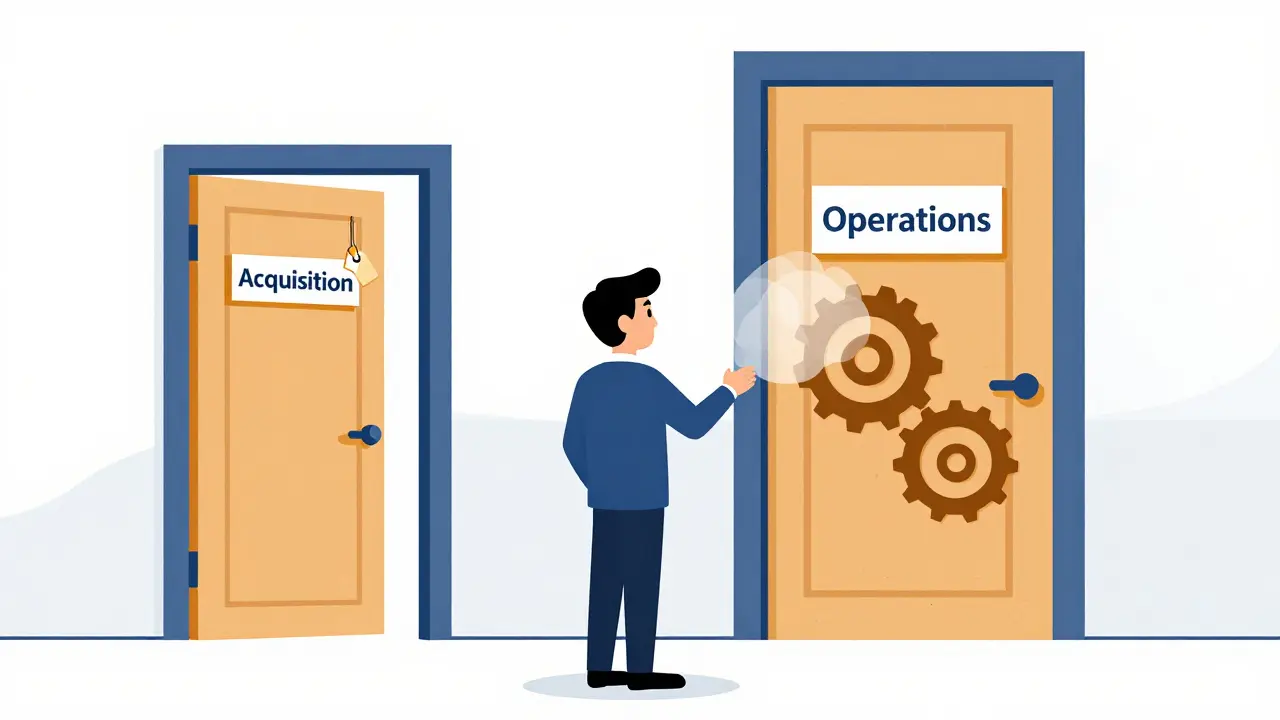
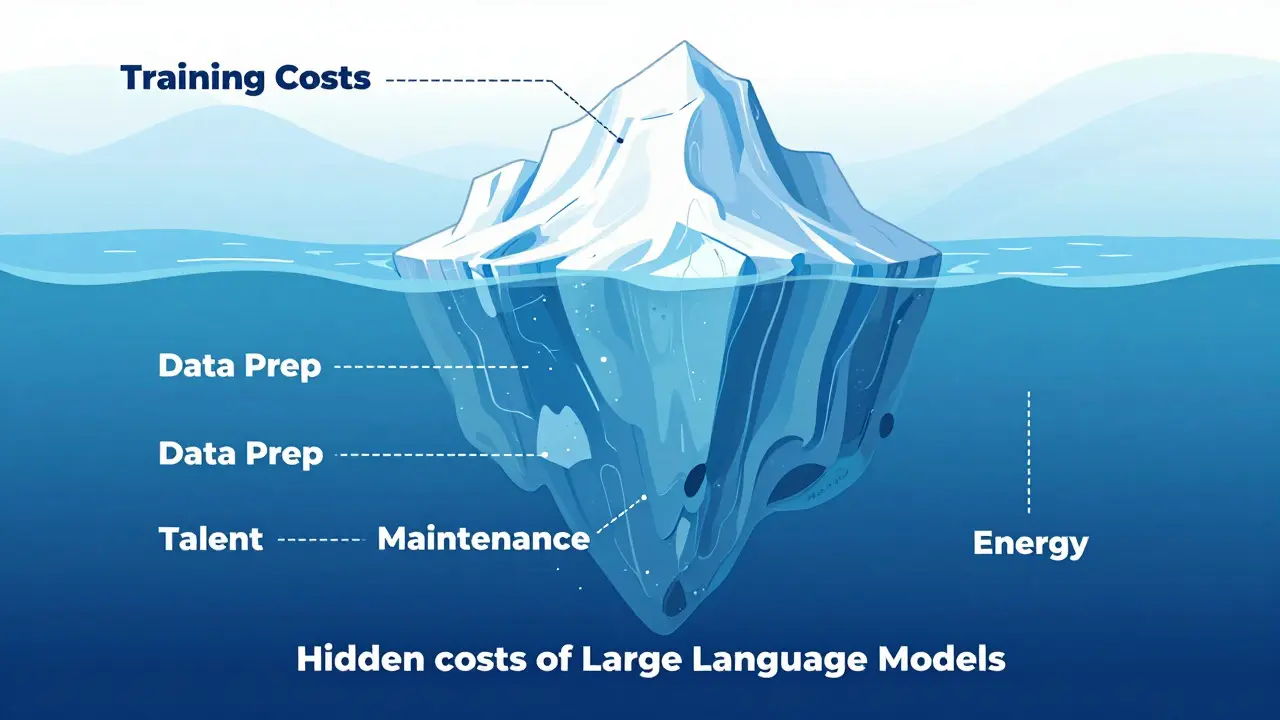
Most leaders think they know the price tag of a Large Language Model. They see the headline numbers: $100 million for training GPT-4, or $25,000 for a single NVIDIA H100 GPU. But those are just the entry fees. The real financial shock comes later, when the model is running in production, burning through electricity, data storage, and engineering hours day after day. If you are planning to scale an LLM, looking only at acquisition costs is like buying a house but ignoring the mortgage, taxes, and maintenance for the next thirty years.
Total Cost of Ownership (TCO) is the framework that reveals the true expense. It forces us to look at the entire lifecycle-from the first line of code to the final server shutdown. For AI systems, initial development usually accounts for only 15 to 25 percent of the total lifetime cost. The remaining 75 to 85 percent happens during operations. Understanding this split is not just an accounting exercise; it is the difference between a profitable AI strategy and a budget-busting disaster.
The Anatomy of LLM Costs
To calculate TCO accurately, we need to break down where the money actually goes. The standard formula includes Acquisition, Operating, Maintenance, Disposal, and Hidden costs. In the context of Large Language Models, which are advanced AI systems trained on vast datasets to understand and generate human language, these categories take on specific, heavy weights.
- Acquisition Costs: This is your upfront spend. It covers the hardware purchase, the initial cloud setup, and the massive compute required for pre-training or acquiring a model checkpoint. For a custom model, this is the most visible cost.
- Operating Costs: This is the recurring burn rate. It includes GPU inference costs, data storage, bandwidth, and the energy required to keep servers cool. This category grows as user adoption increases.
- Maintenance Costs: Models degrade over time-a phenomenon known as drift. You must retrain them, update safety filters, and patch security vulnerabilities. This requires ongoing engineering talent.
- Data Preparation: Often overlooked, this is typically the largest single effort, consuming 60 to 80 percent of project resources. Cleaning, labeling, and curating high-quality data is expensive labor-intensive work.
- Hidden Costs: These include talent diversion (pulling senior engineers from other projects), currency exchange risks if vendors charge in USD while you earn in another currency, and unbudgeted contingencies.
When you map these out, you realize that "buying" an LLM is rarely a one-time transaction. It is a subscription to complexity. A company might spend $5 million on training, but if their inference costs run $200,000 a month for three years, the operational bill dwarfs the initial investment.
Training vs. Fine-Tuning: The Compute Cliff
If you decide to build a model from scratch, you are entering the realm of exponential scaling laws. The cost to train models has skyrocketed since the introduction of the Transformer architecture in 2017, which cost roughly $900. By 2020, GPT-3 required an estimated $500,000 to $4.6 million. Today, the numbers are staggering. Reports suggest that training OpenAI's GPT-4 cost more than $100 million, with compute alone reaching $78 million. Google's Gemini Ultra estimates push even higher, toward $191 million in training compute.
Why so much? Because modern models require thousands of GPUs running in parallel for weeks or months. Let's look at the hardware math. A single NVIDIA H100 GPU costs between $25,000 and $40,000. A cluster of 1,000 units-often needed for serious training runs-requires $25 to $40 million in capital expenditure before you even plug them in. If you rent instead of buy, cloud rates for A100 or H100 GPUs range from $1.50 to $2.00 per hour. Running 1,000 GPUs for a month can easily exceed $2 million in monthly rental fees alone.
This is why most organizations avoid full-scale pre-training. Instead, they turn to fine-tuning. Taking a large open-source model like LLaMA 2 (70 billion parameters) and adapting it to your specific domain costs tens of thousands of dollars, not hundreds of millions. Tools like DeepSpeed and Fully Sharded Data Parallel (FSDP) allow teams to shard models across limited hardware, making this process significantly more efficient. For 90 percent of enterprise use cases, fine-tuning offers the best balance of performance and TCO.
Build vs. Buy: API Access vs. Self-Hosting
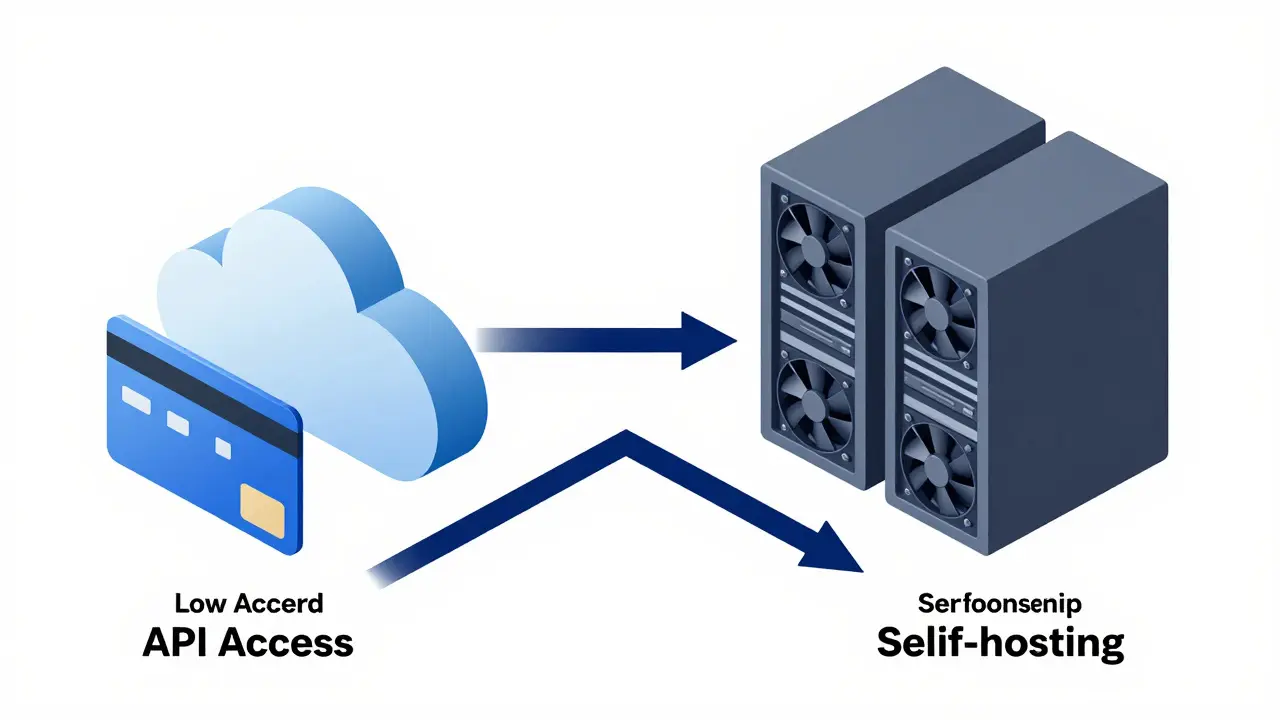
Once you have a model, you face a critical architectural decision that defines your long-term economics: do you host it yourself, or do you pay per token via an API?
The Pay-Per-Token Model Using hosted APIs from providers like OpenAI, Google, or Anthropic eliminates the need for upfront infrastructure. There is no hardware procurement, no data center cooling, and no team dedicated to keeping servers online. You pay only for what you use. This is ideal for startups, proof-of-concept projects, or applications with variable, unpredictable traffic. It democratizes access, allowing small teams to leverage state-of-the-art intelligence without a $10 million capex budget. However, as volume scales, the marginal cost per token adds up. For high-frequency internal tools or customer-facing apps with millions of daily queries, the cumulative API bill can eventually exceed the fixed cost of self-hosting.
The Self-Hosted Model Hosting proprietary or open-source models internally gives you control over latency, privacy, and data sovereignty. You own the stack. While the initial CAPEX is high, the marginal cost of additional inference drops significantly once the hardware is paid for. This approach becomes economically advantageous when usage is sustained and high-volume. It also protects you from vendor lock-in and potential API price hikes. But it comes with a steep operational tax: you need skilled MLOps engineers to manage updates, monitor health, and optimize throughput. If your utilization rate is low, you are paying for idle GPUs, which destroys your ROI.
| Factor | Pay-Per-Token (API) | Self-Hosted (Proprietary/Open Source) |
|---|---|---|
| Upfront Cost | Near zero | High ($25k+ per GPU) |
| Ongoing Cost Structure | Variable (scales with usage) | Fixed (hardware/depreciation) + Variable (energy) |
| Technical Overhead | Low | High (requires MLOps team) |
| Data Privacy | Dependent on vendor policy | Full control (on-prem/private cloud) |
| Best For | Startups, sporadic usage, rapid prototyping | High-volume enterprises, strict compliance needs |
The Hidden Drain: Data and Talent
We often focus on compute because it has a clear price tag. But two other factors silently inflate TCO: data quality and human capital.
Data preparation is the unsung hero-and villain-of AI projects. Garbage in, garbage out. To get reliable results from an LLM, you need clean, relevant, and unbiased data. Collecting, cleaning, labeling, and storing this data consumes 60 to 80 percent of the total project effort. If you underestimate this, your timeline slips, and your budget blows out. High-quality datasets are scarce and expensive. You may need to license commercial data sources or hire annotators, both of which add significant line items to your TCO model.
Talent is equally costly. AI projects don't just need developers; they need specialized ML engineers, data scientists, and prompt engineers. These professionals command premium salaries. Moreover, there is an opportunity cost. When you pull your best engineers to build and maintain an LLM system, they are not working on your core product features. This diversion can slow down innovation elsewhere in the company. Always account for the full salary burden, including benefits and overhead, not just the hourly rate.
Strategic Steps to Calculate Your TCO
How do you build a realistic model for your organization? Follow these steps to avoid the common pitfall of underestimating long-term expenses.
- Define the Horizon: Evaluate costs over a three-to-five-year period. Short-term views miss the cumulative impact of operational expenses.
- Estimate Data Effort: Allocate 60-80 percent of your initial project budget to data preparation. Treat this as a non-negotiable baseline.
- Model Inference Loads: Don't guess. Use pilot data to estimate tokens per user per day. Multiply by projected growth. Compare this against current API prices vs. projected self-hosted marginal costs.
- Include Contingency: Add a 15 to 25 percent buffer for unexpected issues. AI projects rarely go exactly to plan. Hardware failures, model drift, and regulatory changes will happen.
- Account for Currency Risk: If you are buying hardware or services in USD but generating revenue in another currency, factor in exchange rate volatility into your five-year projection.
- Compare Total Value, Not Just Price: When choosing between vendors, look at the total package. Does the cheaper API offer better accuracy, reducing the need for post-processing? Does the more expensive self-hosted option provide faster inference, improving user retention? Context matters.
Finally, start small. Run a focused pilot project. Measure the actual TCO of that pilot. Then, extrapolate. Real-world data is infinitely more valuable than theoretical spreadsheets. As you scale, refine your model. The goal is not to find the cheapest option, but the most sustainable one that aligns with your business goals and risk tolerance.
What is the typical breakdown of costs in an LLM project?
In most AI projects, initial development and deployment represent only 15 to 25 percent of the total lifetime cost. The remaining 75 to 85 percent comes from ongoing operations, including inference compute, data management, monitoring, and retraining. Data preparation alone often consumes 60 to 80 percent of the total project effort during the initial phase.
How much does it cost to train a modern Large Language Model?
Training costs vary wildly based on model size. The original Transformer architecture cost about $900 in 2017. GPT-3 cost between $500,000 and $4.6 million. Recent frontier models like GPT-4 are estimated to have cost over $100 million, with some reports citing $78 million in compute alone. Google's Gemini Ultra estimates reach up to $191 million. These costs reflect the need for thousands of high-end GPUs running for extended periods.
Is it cheaper to self-host an LLM or use an API?
It depends on volume and duration. For low to medium usage, or short-term projects, pay-per-token APIs are cheaper because they eliminate upfront hardware costs. For high-volume, sustained usage, self-hosting often becomes more economical over time, despite the high initial capital expenditure on GPUs and infrastructure. The break-even point varies by organization but typically occurs after several months of heavy usage.
What are the hidden costs of implementing LLMs?
Hidden costs include talent diversion (opportunity cost of pulling engineers from other projects), currency exchange risks for international contracts, unbudgeted contingencies for technical issues, and the ongoing cost of model monitoring and retraining to prevent drift. Data preparation is also frequently underestimated, consuming far more time and money than initially planned.
How can I reduce the TCO of my LLM project?
You can reduce TCO by using fine-tuning instead of training from scratch, optimizing data pipelines to minimize manual cleaning, leveraging efficient distributed training frameworks like DeepSpeed, and carefully matching your deployment strategy (API vs. self-hosted) to your actual usage patterns. Starting with a pilot project helps gather real data to refine cost estimates before full-scale rollout.