Remember when building a simple to-do app took you three days of wrestling with database schemas and API endpoints? Those days are fading fast. In 2026, vibe coding is an emerging software development practice that uses artificial intelligence (AI) to generate functional code from natural language prompts. It’s not just hype; it’s a shift in how we build software. You describe what you want in plain English, and the AI writes the backend, frontend, and database logic for you.
If you’re wondering whether this actually works for real projects-or if it’s just another tech bubble-you’re asking the right question. The short answer: yes, it works, but only if you treat it like engineering, not magic. This guide breaks down what vibe coding really delivers for full-stack applications, where it fails, and how to structure your workflow so you ship faster without creating a maintenance nightmare.
The Reality of Vibe Coding Speed
Let’s talk numbers first, because that’s usually why people jump into vibe coding. According to data from Wasp.dev in late 2025, developers using structured vibe coding workflows reported building complex apps 20 to 50 times faster than traditional methods. That sounds insane, but it checks out when you look at the breakdown.
In a traditional setup, implementing a single feature-like user authentication with email verification-might take 4 to 8 hours. You set up routes, write validation logic, connect to the database, and handle error states. With vibe coding, that same "vertical slice" (a complete feature from UI to database) takes about 15 to 30 minutes. Why? Because the AI handles the boilerplate. It generates the Prisma schema, the Next.js page component, and the API route in one go.
However, don’t expect this speed on every task. For standard CRUD operations (Create, Read, Update, Delete), AI success rates sit around 88% on the first try. But push into complex edge cases-like handling race conditions in concurrent transactions or optimizing heavy data aggregations-and that speed advantage shrinks to just 2x or 3x. You’ll spend more time debugging the AI’s assumptions than writing code yourself.
| Task Type | Traditional Time | Vibe Coding Time | Success Rate (First Pass) |
|---|---|---|---|
| User Authentication | 4-8 hours | 15-30 minutes | 85% |
| CRUD Dashboard | 6-10 hours | 20-40 minutes | 90% |
| Complex Data Algorithm | 1-2 days | 1-3 hours | 45% |
| UI Component Library Setup | 2-4 hours | 10-15 minutes | 95% |
How the Tech Actually Works Under the Hood
Vibe coding isn’t just autocomplete on steroids. It relies on two distinct loops working together. First, there’s the low-level iterative loop. Here, you refine specific code segments. If the AI messes up a CSS grid layout, you prompt it to fix just that part. This usually takes 3 to 5 iterations per component.
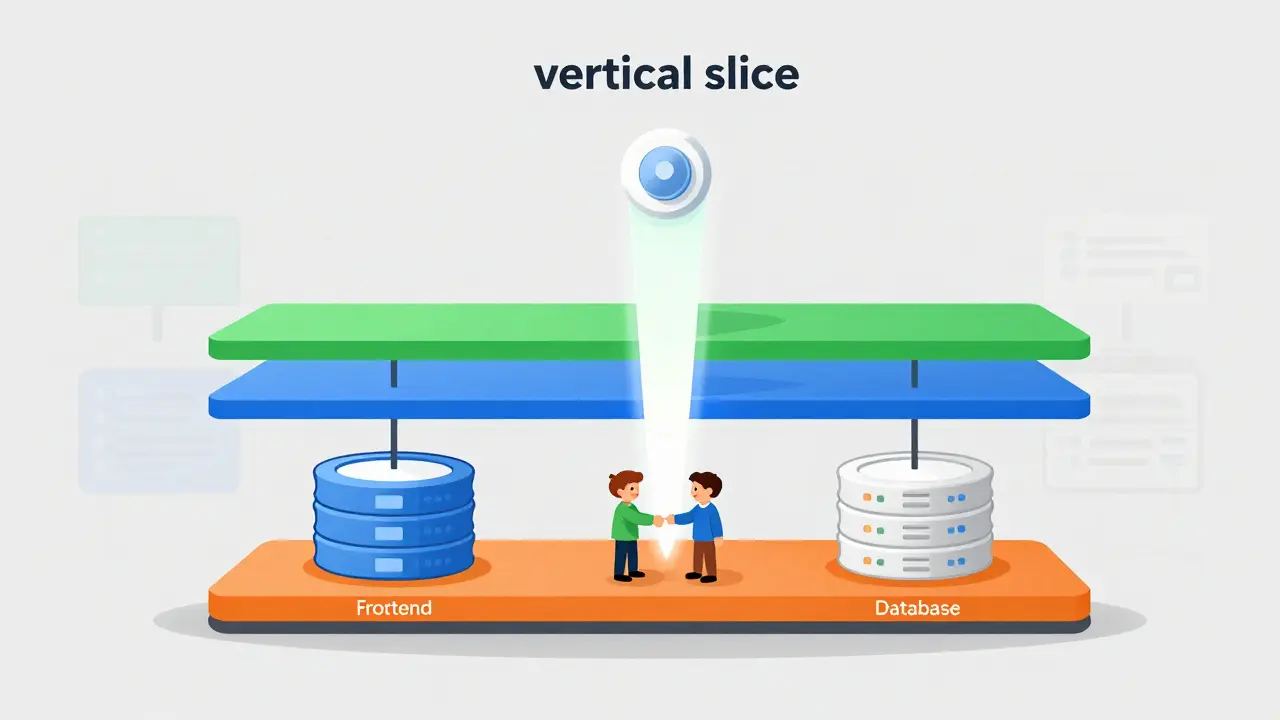
Second, and more importantly, is the high-level lifecycle loop. This is where you build and deploy complete applications. Instead of writing files one by one, you define vertical slices. A vertical slice is a thin layer of functionality that goes all the way through the stack-from the button click in the browser to the record saved in the database.
Modern tools like GitHub Copilot with Copilot X use massive context windows. As of early 2026, these systems can hold up to 1 million tokens of context. That means the AI remembers your entire project structure, including your database schema and previous components, while generating new code. Platforms like Emergent.sh take this further with multi-agent orchestration, where different AI agents handle frontend, backend, and database tasks simultaneously.
The key technical enabler here is the framework choice. AI models perform significantly better with "batteries-included" frameworks. If you ask an AI to build a React app with Express, Prisma, and Tailwind separately, it often loses track of dependencies. But if you use a unified framework like Wasp (which bundles React, Node.js, and Prisma) or Laravel, the AI has a predefined mental model. Survey data from Stack Overflow’s Q3 2025 report showed a 40% higher success rate for AI-generated code in these unified environments compared to custom stacks.
The Vertical Slice Methodology: Your Best Friend
If you want vibe coding to work, you need to stop thinking in layers (all frontend, then all backend) and start thinking in slices. This is the core strategy recommended by experts like the team at Wasp.dev.
Here is how you apply the vertical slice method:
- Define the smallest useful feature. Don’t say “build me a social network.” Say “build a login page that saves users to a Postgres database.”
- Prompt for the end-to-end flow. Ask the AI to create the UI component, the API endpoint, and the database model in one go.
- Test immediately. Run the app. Does clicking the button save the data? If yes, move on. If no, iterate on the specific broken link.
- Repeat. Add the next slice, like “add password reset functionality,” which builds on the existing auth slice.
This approach keeps the AI’s context focused. When you try to build an entire system at once, the AI hallucinates connections between modules that don’t exist. By slicing vertically, you ensure each piece is functional before adding complexity. Matt Palmer, Head of Developer Relations at Replit, demonstrated this in late 2025, showing how he built a full-stack application with client-server communication in under 30 minutes using this exact conversational, slice-by-slice technique.
Where Vibe Coding Fails (And How to Fix It)
It’s easy to get carried away with the speed. But vibe coding has blind spots. The biggest one? Edge cases. GitHub’s internal analysis found that AI implementations correctly anticipate only 62% of potential edge scenarios without explicit prompting. The AI assumes happy paths. It doesn’t think about what happens if the network drops mid-upload or if two users edit the same record at the same time.
Another major pain point is architectural consistency. In Reddit’s r/programming discussions from late 2025, 78% of developers noted that context window limitations cause the AI to “forget” earlier parts of the conversation in complex projects. You might have a consistent folder structure in Module A, but the AI starts dumping everything into `utils.js` in Module B because it lost track of your rules.
To mitigate this, you must act as the architect, not just the prompter. Microsoft’s developer blog emphasizes that you need to “architect entire systems, not just functions.” This means:
- Set strict rules upfront. Create a
README.mdor a.cursorrulesfile that defines your coding standards, folder structure, and naming conventions. Reference this file in every major prompt. - Review imports and dependencies. AI sometimes invents library functions that don’t exist (hallucination). Always check that imported packages are actually installed.
- Handle security manually. Never trust AI-generated authentication logic blindly. Verify that sensitive data is hashed and that API routes are properly protected.
DZone contributors warned that “pure vibe coding without technical oversight” led to 38% higher failure rates in production deployments. The AI is a powerful junior developer, not a senior engineer. It needs direction.
Tools of the Trade in 2026
The ecosystem for vibe coding has matured rapidly. Here is what the landscape looks like right now:
- GitHub Copilot X: Released in January 2026, this update improved full-stack understanding, reducing context switching by 41%. It’s the dominant choice for IDE-integrated coding, with over 1.2 million paid subscribers. Use Sonnet 4.5 or similar advanced models for complex reasoning tasks.
- Emergent.sh: A specialized platform for vibe coding with a 1M token context window. It excels at multi-agent orchestration, making it ideal for larger, more complex applications where different parts of the stack need independent attention.
- Replit: Great for beginners and rapid prototyping. With 4.7 million active monthly users, it offers a frictionless environment where you can type a prompt and see a running app instantly. Less control, but much lower barrier to entry.
- Wasp: Not an AI tool itself, but a framework designed for vibe coding. Its vertical slice templates improved implementation success rates by 28% in late 2025. If you are serious about full-stack AI development, pairing Wasp with an AI assistant is a winning combo.
For most professional developers, the sweet spot is VS Code + GitHub Copilot. For solo founders or non-technical founders, Replit or Emergent provide a smoother experience with less configuration overhead.
Is Vibe Coding Here to Stay?
The market says yes. The global vibe coding tools market hit $1.2 billion in Q4 2025, growing 37% quarter-over-quarter. Forty-two percent of Fortune 500 companies were piloting these workflows by the end of 2025. Forrester predicts vibe coding will account for 30% of all new application development by 2028.
But there is a catch. Regulatory concerns are rising. Fifty-seven percent of enterprises are now implementing specific policies governing AI-generated code due to IP ownership questions. Who owns the code if the AI trained on proprietary libraries? These legal gray areas mean that while individual developers and startups will embrace vibe coding fully, large corporations will move cautiously.
Furthermore, maintainability remains a concern. A survey by InfoQ found that while 73% of technical leads view vibe coding as a permanent toolkit addition, 61% worry about the long-term maintainability of AI-generated codebases. If you leave for a job, will your successor understand the spaghetti code the AI produced? Documentation becomes critical. Emergent scores highly (4.6/5) for AI-assisted documentation generation, which helps bridge this gap.
Ultimately, vibe coding is not replacing developers. It is augmenting them. It removes the drudgery of boilerplate, allowing you to focus on architecture, user experience, and business logic. The developers who thrive in 2026 won’t be those who code the fastest, but those who can best direct AI systems to build robust, scalable applications.
What is vibe coding exactly?
Vibe coding is a development practice where you use AI to generate functional code from natural language prompts. Instead of writing syntax line-by-line, you describe the desired outcome (e.g., "create a user login page connected to a database"), and the AI produces the full-stack code, including frontend, backend, and database schemas.
Do I need to know how to code to use vibe coding?
You don't need to be an expert, but some technical understanding helps. Microsoft notes that beginner-to-intermediate developers benefit most. While you can start with no code, knowing basic concepts like APIs, databases, and HTTP requests allows you to debug issues and customize the output effectively. Pure no-code users may struggle when the AI encounters complex edge cases.
Which AI tools are best for full-stack vibe coding in 2026?
GitHub Copilot X is the industry standard for integrated development, especially with VS Code. For dedicated vibe coding platforms, Emergent.sh offers advanced multi-agent orchestration and large context windows. Replit is excellent for quick prototypes and beginners. Frameworks like Wasp are also highly recommended because they provide the structured environment AI models need to succeed.
What is the "vertical slice" method?
The vertical slice method involves building features end-to-end rather than layer-by-layer. Instead of building all your UI components first, then all your database models, you build one complete feature (e.g., user registration) that touches the UI, API, and database. This keeps the AI's context focused and ensures each part works together before moving to the next feature.
Can AI replace senior developers?
No. While AI accelerates routine tasks, it struggles with complex architecture, security nuances, and edge case planning. Senior developers are needed to oversee the system design, review AI-generated code for vulnerabilities, and ensure long-term maintainability. Vibe coding augments human expertise rather than replacing it.
How do I avoid common pitfalls in vibe coding?
To avoid pitfalls, always define clear architectural rules upfront (e.g., folder structure, naming conventions). Use batteries-included frameworks like Wasp or Laravel to give the AI a consistent mental model. Regularly test each vertical slice before proceeding. Finally, never skip manual review of security-critical code like authentication and payment processing.