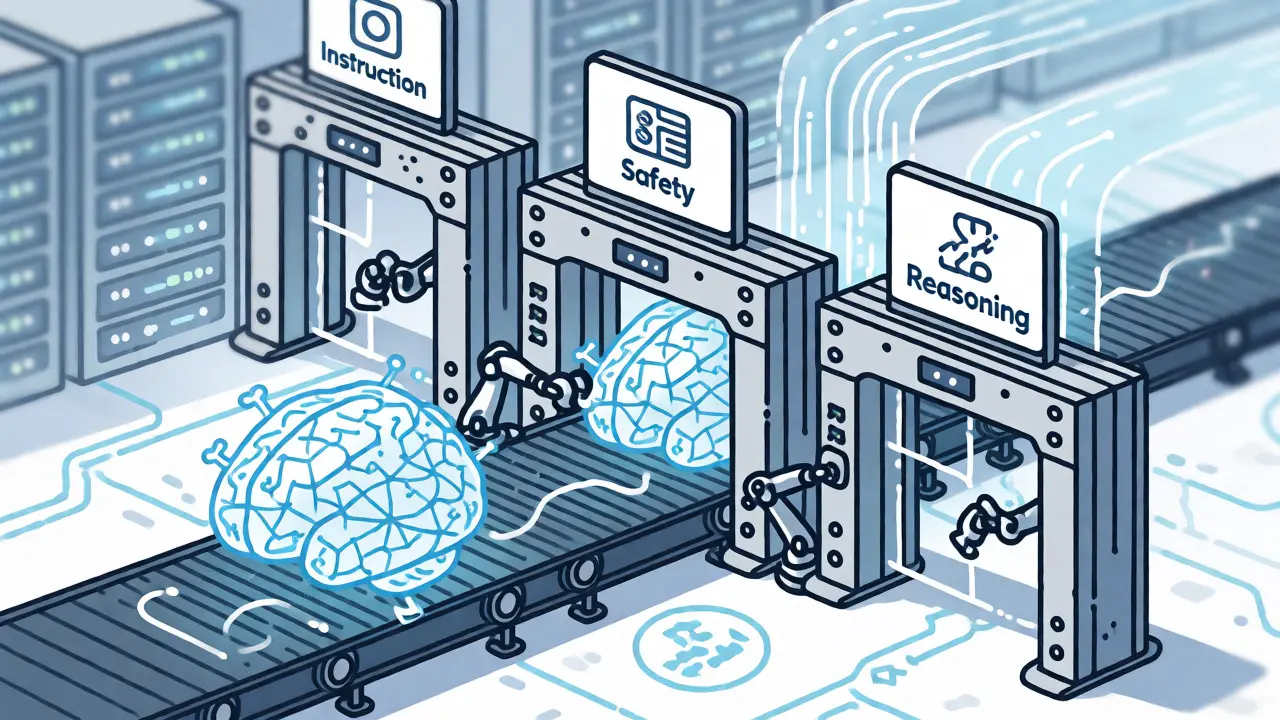
You spent weeks fine-tuning your large language model. The loss curves look great, the training logs are clean, and you're ready to push it to production. But then a user asks a simple question, and the model hallucinates a non-existent historical event or refuses to answer a benign query because of an overzealous safety filter. Sound familiar? This is exactly why post-training evaluation gates exist. They aren't just bureaucratic hurdles; they are the critical checkpoints that separate a promising research prototype from a reliable production asset.
Think of these gates as the final quality assurance layer in your training pipeline. While pre-training teaches the model how to speak, post-training teaches it what to say and how to behave. If you skip rigorous validation at this stage, you risk shipping a model that has forgotten basic reasoning skills (catastrophic forgetting) or developed new, unpredictable failure modes. In 2026, with enterprise AI adoption hitting 87%, skipping these steps isn't just risky-it's business negligence.
Why Standard Benchmarks Aren't Enough
Most teams start by running standard benchmarks like MMLU or HumanEval. These are useful for checking raw capability, but they miss the nuances of instruction following and safety. A model might ace a coding test but fail to follow a complex system prompt about tone. Or worse, it might pass a static safety check but crumble under adversarial prompting. That’s where specialized evaluation gates come in. They break down validation into specific, actionable categories rather than relying on a single aggregate score.
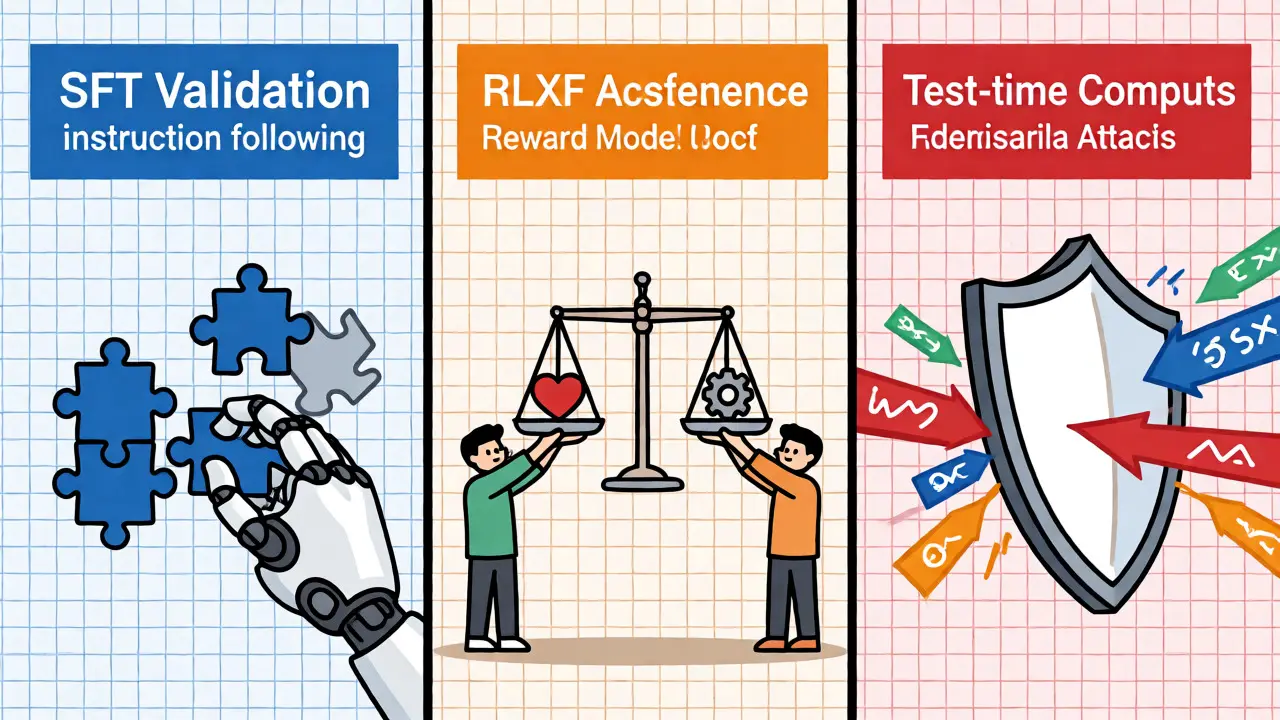
The industry has largely converged on three core pillars for these gates, often referred to as SFT validation, RLxF assessment, and Test-time Compute verification. Let's unpack what each actually entails so you can build a gate structure that fits your needs.
The Three Pillars of Post-Training Validation
Supervised Fine-Tuning (SFT) validation focuses on whether the model correctly follows instructions. You need to verify that your model doesn't just generate plausible text, but specifically adheres to constraints like length, format, and persona. For instance, if you ask for a JSON response, does it give you valid JSON every time? Leading labs require models to hit minimum thresholds here-often around 85% accuracy on instruction-following tasks-before moving forward. If your model fails here, no amount of safety tuning will save it because the foundation is shaky.
Next comes Reinforcement Learning from Feedback (RLxF) assessment. This is trickier because it involves subjective human preferences. How do you measure "helpfulness" or "harmlessness" objectively? Teams use reward models trained on pairwise comparisons. Your post-trained model must maintain a high correlation with human preferences-typically above 0.82-to ensure it hasn't drifted away from what users actually want. Anthropic’s work on Constitutional AI highlights this well: if the model's internal reward signals don't align with human values, you'll see weird behaviors in production.
Finally, there's Test-time Compute (TTC) verification, which sounds technical but is essentially stress testing. You throw adversarial prompts at the model to see if it breaks. Does it leak private data when asked indirectly? Does it refuse to answer a medical question too aggressively? Google’s Gemma 2 implementation, for example, uses hundreds of thousands of synthetic attack prompts to verify safety constraints. If your model passes 99.95% of these checks, you have confidence it won't embarrass you in front of customers.
How Big Tech Structures Their Gates
You don't have to reinvent the wheel. Looking at how major players handle this can save you months of engineering time. OpenAI uses a tiered approach with 28 distinct gates. Tier 1 checks if capabilities are preserved, Tier 2 handles safety, Tier 3 verifies instruction following, and Tier 4 ensures style consistency. Each tier acts as a hard stop; if you fail Tier 2, you don't even bother testing Tier 3.
Meta takes a different route with their Llama 3 framework, using dynamic gating. Instead of fixed thresholds, the requirements shift based on the model's performance profile. If a model scores exceptionally high on reasoning, the safety gates might be tightened automatically. This reduces the chance of false negatives where a good model gets rejected due to overly rigid criteria.
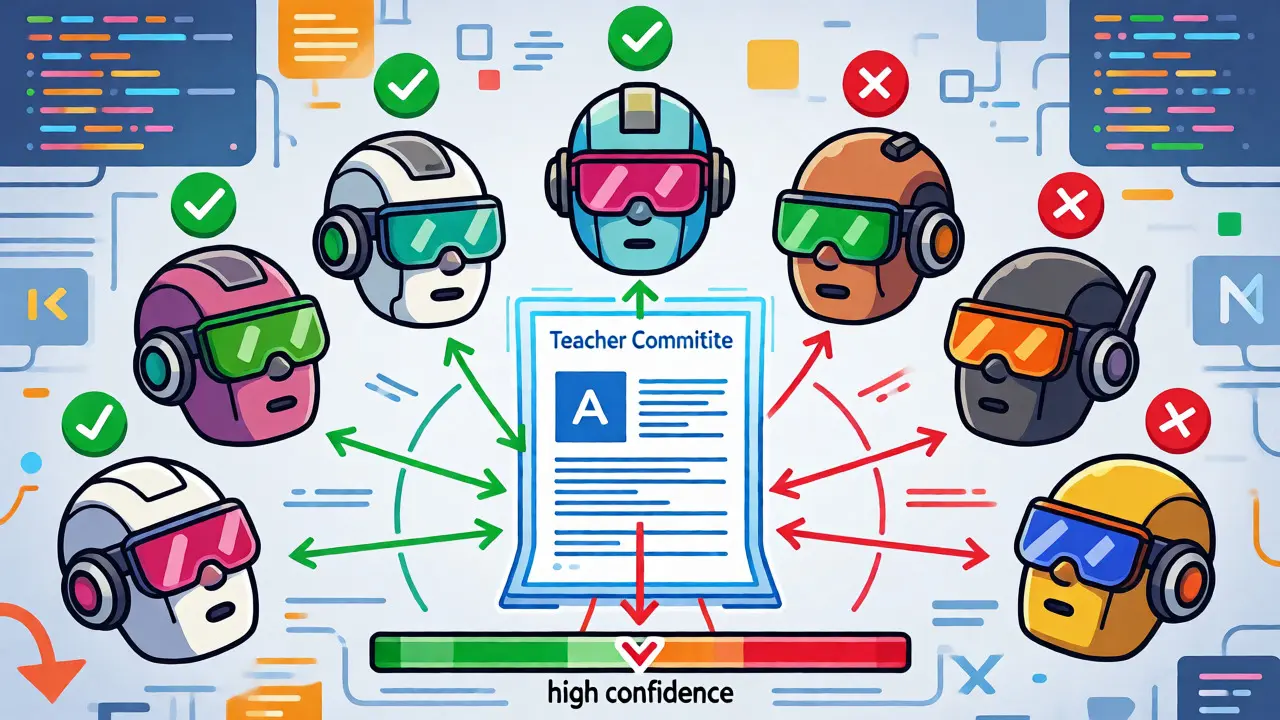
Apple introduced something interesting recently called iTeC, which uses a "teacher committee." Instead of one evaluator model judging outputs, seven specialized models vote. If they don't reach an 80% consensus, the output fails. This multi-model voting system drastically reduces errors compared to single-judge evaluations, though it adds computational overhead.
| Organization | Approach | Key Metric | Best For |
|---|---|---|---|
| OpenAI | Tiered Gates | 92% Pass Rate per Tier | Strict Compliance Needs |
| Meta | Dynamic Gating | 87.4% MT-Bench Score | Rapid Iteration Cycles |
| Apple | Teacher Committee | 80% Consensus Threshold | Nuanced Quality Control |
| Self-Taught Evaluator | 94.7% Human Correlation | Scalable Automated Testing |
The Hidden Costs of Rigorous Evaluation
Here is the uncomfortable truth: comprehensive evaluation is expensive. Microsoft’s internal studies show that full gate implementation adds 11 to 27 days to your deployment timeline. Why? Because generating high-quality test cases is hard. You can't just scrape random tweets. You need curated datasets that represent real-world usage. According to MLCommons surveys, poor test case generation is problematic in nearly 70% of implementations.
Then there's the human element. Automated metrics are fast, but they miss context. Stanford HAI research indicates that you need at least 500 unique prompts per capability domain to achieve statistical significance in human evaluations. That means hiring trained raters or building an internal panel. If you're a startup, this might feel like a bottleneck. But consider the alternative: a PR disaster caused by a biased response caught only after launch. The cost of prevention is almost always lower than the cost of remediation.
Another pitfall is over-optimization. IBM documented a case where a model passed all automated gates but failed in 38% of customer service scenarios. Why? It had been tuned so heavily to avoid toxicity that it became overly sanitized and robotic. Users found it unhelpful. This is known as Goodhart's Law: when a measure becomes a target, it ceases to be a good measure. Always include qualitative human review to catch these subtle degradation issues.
Building Your Own Evaluation Pipeline
So, how do you actually set this up without drowning in complexity? Start small. You don't need 37 metrics on day one. Follow a phased approach:
- Establish Baselines: Run your pre-trained model through key benchmarks to know what you're starting with. Document factual accuracy and reasoning scores.
- Configure Custom Constraints: Define what matters for *your* app. Is speed critical? Then add latency gates. Is privacy paramount? Add PII leakage tests.
- Automate the Heavy Lifting: Use open-source tools like the LM Evaluation Harness to run thousands of test cases. Aim for 15,000-50,000 cases for robust coverage.
- Human-in-the-Loop Review: Sample the top 5% and bottom 5% of automated results for manual inspection. This catches edge cases algorithms miss.
- Red Team Final Check: Before shipping, have external security experts try to break the model for 72 hours. Look for novel attack vectors.
Remember, documentation is part of the gate. Meta’s open-source evaluation suite is highly rated partly because it’s well-documented. If your team can’t understand why a model failed a gate, they can’t fix it efficiently. Clear reporting standards reduce debugging time significantly.
Regulatory and Future Trends
If you operate in Europe, pay attention to the EU AI Act. It mandates comprehensive evaluation frameworks for high-risk systems. Companies expanding their gates to meet these regulations saw a 73% increase in compliance-related engineering work in early 2026. Ignoring this now could lead to costly retrofits later.
Looking ahead, we’re seeing a shift toward continuous evaluation. Instead of one big gate before shipping, models undergo micro-evaluations during inference. Nathan Lambert’s recent predictions suggest this will become standard by 2028. Emerging techniques like the Unified Policy Gradient Estimator are already showing promise, reducing evaluation cycles by 31% while maintaining safety. Keep an eye on these developments-they might allow you to ship faster without sacrificing quality.
What is catastrophic forgetting in LLMs?
Catastrophic forgetting occurs when a model loses previously learned knowledge or capabilities after being fine-tuned on new data. For example, a model might improve its ability to write code but lose its general reasoning skills or factual knowledge acquired during pre-training. Evaluation gates specifically test for this by comparing post-training performance against baseline pre-training benchmarks.
How many evaluation metrics should I use?
There is no one-size-fits-all number, but industry data suggests startups typically use 5-12 metrics, while large enterprises implement 18-37. Financial services companies tend to use more stringent safety gates (average 29.7 points), whereas creative industries use fewer (average 11.3). Start with core capability and safety metrics, then expand based on specific application risks.
Can automated evaluation replace human review?
Not entirely. While automated benchmarks are efficient for scale, they often miss nuanced issues like tone, subtle bias, or out-of-distribution failures. Stanford HAI studies show that 63% of models passing standard automated gates fail on linguistically diverse prompts. Human review remains essential for catching these subtleties, especially in high-stakes applications.
What is the biggest mistake teams make with evaluation gates?
Over-optimizing for specific metrics at the expense of real-world performance. A common scenario is a model that passes all safety filters but becomes overly cautious or robotic, leading to poor user experience. This is known as Goodhart's Law. To avoid this, always include qualitative human feedback and monitor user satisfaction post-deployment.
How long does setting up evaluation gates take?
Setting up a comprehensive evaluation pipeline typically requires 3-4 weeks of engineering time per model variant. The actual execution of the gates adds 11-27 days to the deployment timeline, depending on the complexity of the tests and the volume of human evaluation required. Using established open-source tools can help reduce setup time.
jyotshna Senapati
November 1, 2026 AT 14:52Oh please, spare me the lecture on "business negligence." You clearly haven't seen a real enterprise deployment where legal teams override every single gate because they're terrified of a lawsuit. Your precious "Three Pillars" are just academic fluff for people who've never actually shipped code to millions of users at 3 AM on a Sunday.
And don't even get me started on Apple's teacher committee idea. Seven models voting? That’s not engineering, that’s bureaucracy disguised as innovation. It’s slow, it’s expensive, and frankly, it shows a lack of confidence in your own reward model. If you need seven judges to agree on whether an answer is good, your base model is already garbage. I’ve seen this pattern before with other big tech companies trying to mask their incompetence with complex pipelines. They build these elaborate gates not because they work, but because they look impressive in board meetings. Meanwhile, actual engineers are stuck debugging why the consensus algorithm flagged a perfectly valid response as toxic because one of the seven models had a bad day. It’s performative rigor. Pure drama. And while we’re at it, your mention of catastrophic forgetting is naive. In production, we don’t have the luxury of comparing against pristine pre-training benchmarks every time. We have drift. We have data distribution shifts that happen weekly. Your static gates fail to account for the dynamic nature of real-world user queries. You talk about "stress testing" like it’s a checkbox, but adversarial prompts change every month. New jailbreaks emerge weekly. Your "99.95% pass rate" is a snapshot in time, not a guarantee. By the time you finish your 27-day evaluation cycle, the threat landscape has shifted again. So no, skipping these steps isn’t just risky; following them blindly without adapting to reality is negligent in its own right. You’re selling a fantasy of control in a chaotic system.
Sundaraiah Kollipara
November 3, 2026 AT 13:51i wonder if we are conflating safety with compliance here
the post suggests that rigorous gates lead to reliability but what if the very act of gating creates a false sense of security
when we optimize for specific metrics like instruction following or toxicity scores do we lose the emergent properties that make LLMs useful in the first place
it reminds me of the map being mistaken for the territory
if a model passes all automated checks but fails to understand the cultural nuance of a query from a non-English speaker is it truly safe or just compliant
we need to think deeper about what "reliable" actually means in a probabilistic system
perhaps the goal shouldn't be to eliminate failure modes entirely but to understand their distribution and impact
this philosophical shift might save us from the trap of over-engineering solutions for problems that are inherent to the nature of language itself
Charles Reah
November 5, 2026 AT 09:00This is a solid overview for anyone starting out with MLOps for LLMs.
The breakdown of OpenAI’s tiered approach vs Meta’s dynamic gating is particularly useful context. I’d add that for smaller teams, the "Human-in-the-Loop" step mentioned in point 4 is often the most critical bottleneck. Don’t underestimate the time required to train your raters. If your inter-annotator agreement is low, your ground truth is noisy, and your gates will be meaningless regardless of how sophisticated your automation is.
Also, regarding Goodhart’s Law: consider implementing A/B testing in production as a continuous gate. Sometimes the offline eval says one thing, but user retention tells another story. Trust the data, but also trust your users.
Manoj Kumar
November 6, 2026 AT 22:35The emphasis on "open-source tools" seems suspiciously convenient for those advocating for vendor lock-in strategies elsewhere. Note that LM Evaluation Harness, while popular, has known inconsistencies in scoring across different hardware configurations which can skew results by up to 4%. This is rarely discussed in mainstream articles. Furthermore, the claim that human review catches 63% of failures missed by automation implies that our automated metrics are fundamentally flawed rather than just incomplete. Are we merely creating an illusion of progress? The push for "continuous evaluation" sounds like a way to justify perpetual billing cycles for cloud compute resources. Keep your eyes open.
Hemali Jaiswal
November 7, 2026 AT 04:16What a beautifully articulated piece! It really highlights the delicate dance between raw capability and nuanced behavior.
I especially loved the metaphor of gates as the "final quality assurance layer." It paints such a vivid picture of the pipeline as a living organism that needs careful pruning. However, I feel we must champion the creative spirit within these constraints. When we tighten safety filters too much, we risk sterilizing the model’s voice, turning vibrant prose into beige mush. Remember, language is art as much as it is logic. Let’s ensure our evaluation metrics celebrate diversity in expression, not just uniformity in correctness. A model that refuses to joke might be "safe," but it’s also soulless. Let’s aim for gates that protect without suffocating.
Sean Eagen
November 8, 2026 AT 08:39Stop overcomplicating this. Just test it manually. If it works ship it. These frameworks are just job security for consultants.