
You’ve probably seen the hype around massive Large Language Models (LLMs) that can solve complex math problems or write code by "thinking" step-by-step. It’s impressive, sure. But running a 70-billion-parameter model on your laptop? That’s like using a sledgehammer to crack a nut. The real question isn’t just whether big models can reason-it’s whether we can teach those skills to smaller, faster, and cheaper models without losing the magic. This process is called distilling reasoning, and it’s changing how we deploy AI in resource-constrained environments.
Here’s the core problem: Big models are expensive and slow. Small models are cheap and fast but often struggle with logic. Can a tiny model learn to think like a giant one? Recent research suggests yes, but not in the way you might expect. It turns out, teaching a small model how to structure its thoughts matters more than forcing it to memorize every specific fact from the teacher model. Let’s break down how this works, what the data says, and where the pitfalls lie.
The Basics of Chain-of-Thought Distillation
Chain-of-Thought (CoT) is a prompting technique where a language model generates intermediate reasoning steps before providing a final answer. Think of it as showing your work on a math test. Instead of just guessing '42', the model writes out 'First, I add X and Y, then multiply by Z...'.
Knowledge Distillation is a machine learning technique where a smaller student model learns from the outputs of a larger teacher model. When you combine these two, you get CoT distillation. You take a powerful teacher model (like GPT-4 or DeepSeek R1), ask it to solve thousands of problems while explaining its steps, and then train a smaller student model (like Mistral-7B or TinyLlama) to mimic that behavior.
The goal is simple: transfer the reasoning capability, not just the knowledge. A standard distilled model might know that Paris is in France because it memorized that fact. A CoT-distilled model knows that Paris is in France because it learned the logical path: 'France is in Europe -> Paris is the capital of France -> Therefore, Paris is in Europe.' This structural understanding helps the small model generalize to new problems it hasn't seen before.
Why Structure Beats Content Fidelity
One of the most counterintuitive findings in recent studies is that the exact correctness of each reasoning step doesn’t matter as much as the overall structure. Dr. Xiang Li from Snorkel.ai highlighted this in 2025, stating that "the details don't even have to be correct." This sounds wrong, right? If the steps are wrong, shouldn't the answer be wrong?
Not necessarily. Researchers found that if a small model learns the *pattern* of reasoning-breaking a problem into parts, evaluating options, synthesizing conclusions-it can often self-correct or arrive at the right answer even if individual steps in the training data were slightly off. Experiments showed that deleting 67% of reasoning steps reduced accuracy by only 12.8%, whereas randomly adding 67% extra steps dropped performance by 14.3%. This tells us something critical: the architecture of thought is fragile if cluttered, but robust if streamlined.
This insight changes how we build datasets. You don’t need perfect, human-verified reasoning chains for every example. You need diverse, structurally sound examples. This makes data generation much faster and cheaper. You can let the teacher model generate messy drafts, filter them for structural integrity rather than factual perfection, and still get excellent results.
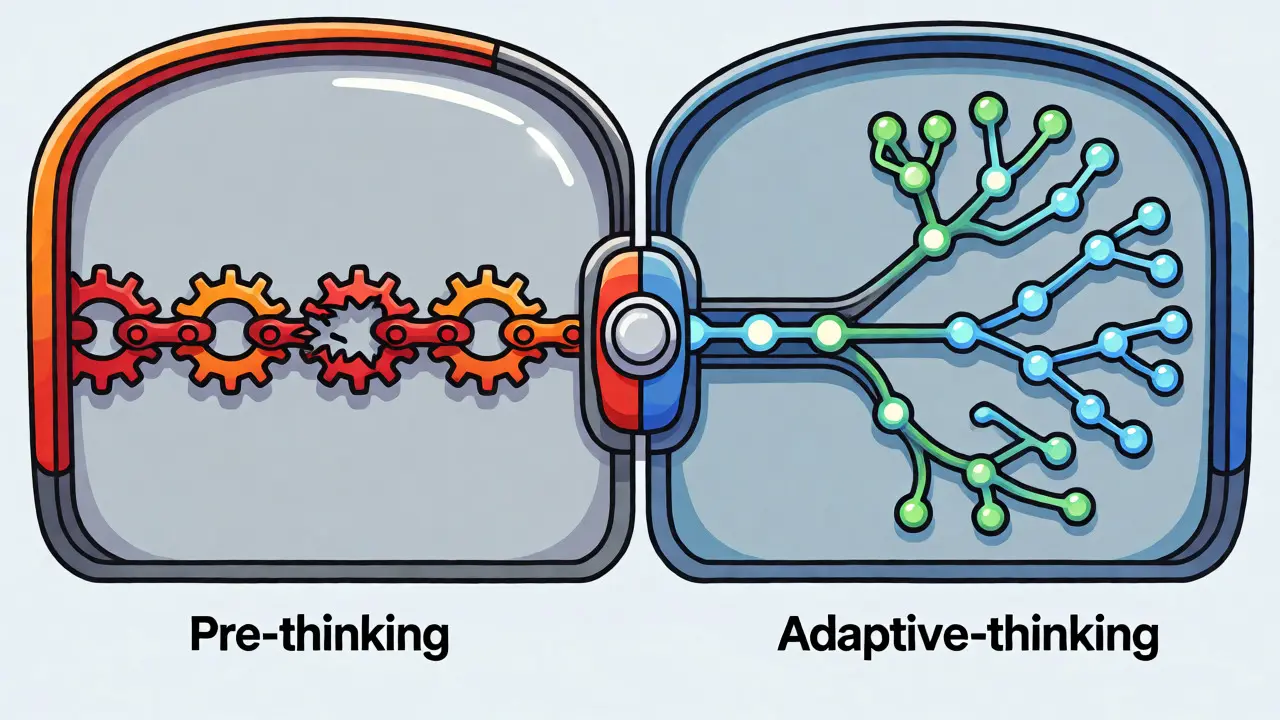
Pre-Thinking vs. Post-Thinking Mechanisms
How exactly does a small model apply this learned reasoning? There are two main approaches, and they perform differently.
| Mechanism | Description | Avg Accuracy | Error Propagation | Inference Efficiency |
|---|---|---|---|---|
| Pre-thinking | Model generates rationale first, then answers. | 68.4% | High (23.7%) | Standard |
| Post-thinking | Model generates answer first, then rationale. | Lower | Low (-18.2 pts) | +14.3% Faster |
| Adaptive-thinking | Soft prompts decide complexity; switches modes. | 74.8% | Moderate | Optimized |
The traditional method is pre-thinking. The model thinks, then speaks. It’s intuitive, but it has a flaw: error propagation. If the model makes a mistake in step 2, it carries that error through to the end. Studies show a 23.7% error propagation rate here. If the rationale is flawed, the answer is likely flawed too.
Post-thinking flips this. The model guesses the answer first, then explains why. This reduces sensitivity to early errors because the answer is already locked in. While it might seem less logical, it’s more efficient for inference and safer against minor reasoning slips. However, it can sometimes lead to hallucinated explanations that justify a wrong answer.
The sweet spot seems to be adaptive-thinking. Here, the model uses soft prompt tuning to assess the difficulty of a question. Simple questions get a quick post-thinking response; complex ones trigger a full pre-thinking chain. This hybrid approach achieved 74.8% accuracy across various datasets, balancing speed and depth.
Implementation: What Does It Take?
You don’t need a supercomputer to try this. Thanks to parameter-efficient fine-tuning methods like LoRA (Low-Rank Adaptation, which updates only a small fraction of model parameters), you can distill reasoning capabilities using consumer-grade hardware.
Research indicates that 7k to 17k high-quality problem-solution pairs are often enough to see significant gains. For a 7B parameter model, LoRA fine-tuning can achieve 97.3% of the performance of full fine-tuning while using only 0.1% of the parameters. This cuts computational requirements from over 100 GPU-days to under 5 GPU-days.
However, the bottleneck isn’t compute-it’s data preparation. Users report spending 15-20 hours cleaning and formatting Chain-of-Thought datasets. Quality control is vital. One developer noted that after distilling DeepSeek-R1 reasoning into Mistral-7B, their model scored well on math benchmarks but suffered catastrophic forgetting on other tasks, like sentiment analysis, dropping 28.4% in accuracy. To avoid this, mix reasoning data with general instruction data during training.
Where Small Models Still Fall Short
Don’t expect a distilled 7B model to replace a 70B model entirely. There’s a hard ceiling. Distillation typically recovers about 84.6% of the teacher’s capability when moving from 70B to 7B parameters. For 13B students, recovery jumps to 91.2%. This gap exists because small models lack the internal capacity to store all the nuances the teacher learned.
Furthermore, weak students often learn surface-level pattern matching rather than genuine reasoning. An arXiv study found that distilled models saw a 34.2% accuracy drop on out-of-distribution tasks-problems that looked different from the training data. They memorized the shape of the solution, not the underlying logic. Professor Emily Bender also warned that distillation can amplify biases. If the teacher model had stereotypical reasoning patterns, the student will inherit and potentially exaggerate them, especially in commonsense tasks where ground truth is fuzzy.
Temporal reasoning remains a tough nut to crack. While mathematical reasoning distills well (78.3% recovery rate), tasks involving time sequences or causal relationships struggle (only 63.7% recovery). If your application relies heavily on understanding cause-and-effect over time, a distilled model might not be ready yet.
The Future: Hybrid Architectures
The industry is moving toward hybrid systems. Instead of choosing between a huge, smart model and a small, dumb one, companies are deploying both. The distilled model handles 80% of common queries instantly and cheaply. When it encounters a novel or high-stakes problem, it flags the query and passes it to the larger teacher model. This strategy offers an 89.3% cost reduction compared to always using the large model, while maintaining 92.7% of original accuracy in fields like fraud detection.
Emerging techniques like "Zero-CoT Distillation" promise to reduce data needs further by strategically omitting reasoning steps, preserving only the structural skeleton. As datasets like CoT-Collection 2.0 expand to millions of examples, the gap between teacher and student will narrow. But for now, remember: you’re buying efficiency, not perfection. Choose your mechanism wisely, watch for bias, and keep a human-in-the-loop for the tricky stuff.
Do I need a lot of data to distill Chain-of-Thought reasoning?
No, surprisingly little. Research shows that 7,000 to 17,000 high-quality problem-solution pairs are often sufficient to teach a small model effective reasoning patterns, especially when using parameter-efficient methods like LoRA.
Why do distilled models sometimes fail on new types of problems?
Smaller models often learn surface-level pattern matching rather than deep logical structures. This leads to poor generalization on out-of-distribution tasks, where the problem looks different from anything in the training set, causing significant accuracy drops.
Is pre-thinking or post-thinking better for distilled models?
It depends on your priority. Pre-thinking offers higher accuracy for complex logic but suffers from error propagation. Post-thinking is faster and more robust to minor errors but may provide weaker explanations. Adaptive-thinking, which switches between the two based on question difficulty, currently offers the best balance.
Can distillation introduce biases into small models?
Yes. If the teacher model contains stereotypical or biased reasoning patterns, the student model will inherit them. Studies have shown a 22.4% increase in stereotypical reasoning in distilled models compared to base models, particularly in ambiguous commonsense tasks.
What is the biggest challenge in implementing CoT distillation?
Data preparation is the main hurdle. Creating high-quality, structurally sound Chain-of-Thought datasets takes significant manual effort (often 15-20 hours per dataset). Additionally, preventing catastrophic forgetting of non-reasoning skills requires careful mixing of training data.